Papers and presentations by Vance Stevens
VanceStevens.com home | Learning2gether: cfp, index & podcast | EVO Minecraft MOOC | AdVANCEducation | Webheads.info
ESL_Home (web 1.0, archival): CALL resources main page | Site Index | Current 2021 CV
Papers and Presentations
|

Here, giving a presentation at the TESOL Conference in Long Beach, April 3, 2004. |
|
This section gives details about talks I have given lately.
I generally upload my slides for my presentations to http://slideshare.net/vances so there you get recent topics and an outline of the substance as well.
Some of my recent themes and topics are:
At a distance / Online
I have presented, or hosted, presentations online almost every week, over 360, since 2010). For more information:
Presentations: 2020 - Navigate to other areas of this page
Sorry, I have not been maintaining my presentations currect for 2020 and 2021 - I will try to rectify this; meanwhile, see my index of recent podcasts for these years
http://learning2gether.pbworks.com/w/page/34456755/archiveindex
Presentations: 2019 - Navigate to other areas of this page
On April 19, 2019, Vance Stevens presented a paper entitled Thinking SMALL: A case for social media assisted language learning revised and focused for the EFL teacher audience at the Penang English Language Learning and Teaching Association (PELLTA, http://www.pellta.org/) international conference in Penang, Malaysia. I webcast the presentation in Zoom, as Learning2gether episode 409 and blogged an archive with YouTube videos, including a rehearsal video made the evening before the presentation, here: https://learning2gether.net/2019/04/19/vance-stevens-on-thinking-small-at-the-2019-pellta-conference-in-penang-malaysia/.
I presented at three events, one ongoing over two consecutive days, at the annual TESOL conference in Atlanta, March 12 through 15, 2019. Each event was webcast and archived as an episode at https://learning2gether.net/.
On March 7, 2019 I presented from a distance to teachers physically attending a webinar event at Sultan Qaboos University in Muscat, Oman. The topic, Supporting Student Writing with the Help of Voice-to-Text, allowed me to consolidate my recent published research on the topic and focus it into one practical presentation, which at the end of the event, I had the opportunity to discuss with the teachers. I webcast the event in Zoom and archived it as Learning2gether episode 403 here: https://learning2gether.net/2019/03/07/vance-stevens-presents-on-supporting-student-writing-with-the-help-of-voice-to-text/
In January and February, 2019, my colleagues and I conducted our 5th annual rendition of EVO Minecraft MOOC as an EVO (Electronic Village Online Session). The EVO portal for the session was here, http://evosessions.pbworks.com/w/page/121153245/Call_for_Participation_2018#EVOMinecraftMOOC, and the online events held were archived on our wiki portal: http://missions4evomc.pbworks.com/w/page/130258521/2019_Live_Events
Presentations: 2018 - Navigate to other areas of this page
On November 16, 2018 I was in Concepción Chile to present Gamifying Teacher Professional Development through Minecraft MOOC at WorldCALL 2018. My slides and show notes were archived as Learning2gether episode 396 here: https://learning2gether.net/2018/11/16/vance-stevens-presents-gamifying-teacher-professional-development-through-minecraft-mooc-at-worldcall-2018/
On April 29, 2018, my colleagues Jane Chien, Mircea Patrascu, Dakotah Redstone, Mattie Tsai, Maha Abdelmoneim, Don Carroll, and Heike Philp demonstrated EVO Minecraft MOOC at the 10th Virtual Round Table Web Conference. We archived the event with a recording and show notes as Learning2gether episode 393 here: https://learning2gether.net/2018/04/29/176467730/
At the annual TESOL conference in Chicago, 2018 March 27-30
On Friday March 9, 2018 - I gave a presentation at the ALLT conference in Dubai on "Teaching writing to students with tablets using voice to overcome keyboard shortcomings" (ALLT is the replacement conference to the now-defunct TESOL Arabia) - http://toolkit4learning.blogspot.ae/2018/03/teaching-writing-to-students-with.html
Presentations: 2017 - Navigate to other areas of this page
June 22, 2017 - Vance and Bobbi Stevens, Domagoj and Marijana Smolčec, Dakota Redstone, Maha Abdelmoneim, and Mircea Patrascu present EVO Minecraft MOOC at the Second Life MOOC 2017 online conference https://learning2gether.net/2017/06/22/vance-stevens-domagoj-and-marijana-smolcec-dakota-redstone-and-mircea-petrascu-mine-your-language-on-sl-mooc/
May 5, 2017 - Dave Dodgson, Jeff Kuhn, Vance Stevens, and other moderators of EVO Minecraft MOOC present at the 9th Virtual Round Table Web Conference, hosted by Heike Philp
https://learning2gether.net/2017/05/05/learning2gether-weekend-with-the-9th-virtual-round-table-web-conference/
March 23 - Vance Stevens presented a paper entitled "Finding Your Voice: Teaching Writing Using Tablets with Voice Capability" on site at the TESOL Seattle conference, March 22-24, 2017, http://tinyurl.com/vance2017tesol
March 22, 2017 - Presented on "Configure Encoders, Stream YouTube Live, and Record Lesson Materials On-the-Fly" on site at the TESOL Seattle conference, March 22-24, 2017
https://docs.google.com/presentation/d/12KL1390JLzBsopdsMLMi6ZHNC23CEzT2biNp0mCOV3M/edit?usp=sharing
March 22 through March 24 - Vance Stevens and Learning2gether assisted CALL-IS with streaming from 2017 Seattle TESOL
https://learning2gether.net/2017/03/24/learning2gether-assists-call-is-with-streaming-from-2017-seattle-tesol/
March 10, 2017 - Presented on "Using OBS software for multiple purposes in TESOL" on site at the TESOL Arabia conference in Dubai
https://docs.google.com/presentation/d/12KL1390JLzBsopdsMLMi6ZHNC23CEzT2biNp0mCOV3M/edit?usp=sharing
The following online presentations were made in the course of conducting the Electronic Village Online EVO Minecraft MOOC January 8 through Feb 12, 2017
http://evosessions.pbworks.com/w/page/113561512/2017_EVO_Minecraft_MOOC
Presentations: 2016 - Navigate to other areas of this page
Nov 28, 2016 - Vance Stevens joined Nellie Deutsch, Nives Torresi, and Tom Hodgers at the Moodle MOOC 9th online conferene for a panel on Badges: Choices and Options
https://learning2gether.net/2016/11/28/nellie-deutsch-nives-torresi-tom-hodgers-and-vance-stevens-at-mm9-panel-on-badges-choices-and-options/
August 7, 2016 - Vance Stevens gave a presentation at the online Moodle Moot Virtual Conference for 2016 entitled "Abundance in TPD: More than meets the eye"
https://learning2gether.net/2016/08/07/mmvc16-abundance-in-tpd-more-than-meets-the-eye/
May 8, 2016 - I participated in the EVO Symposium at the 8th Virtual Round Table Web Conference, as part of a panel on Electronic Village Online, called "EVO Symposium": https://learning2gether.net/2016/05/08/176465791/
Apr 24, 2016 Vance presented "Minecraft and the gamification of teacher and student learning" at the SLMOOC16 annual online conference, which served as Learning2gether Episode 330, https://learning2gether.net/2016/04/24/minecraft-and-the-gamification-of-teacher-and-student-learning-at-the-slmooc16-annual-online-conference/
Apr 17, 2016 Mircea Patrascu, Rose Bard, and Vance Stevens addressed online one of the IATEFL YLT SIG Bi-Monthly Webinars to discuss EVO Minecraft MOOC, Learning2gether Episode 329, https://learning2gether.net/2016/04/17/mircea-patrascu-rose-bard-and-vance-stevens-address-iatefl-ylt-sig-bi-monthly-webinars/
April 10, 2016 Learning2gether Episode 328 met online with Jack Watson, Jennifer Meyer, and Robert Wachman to follow up on lessons learned from webcasting at TESOL 2016
https://learning2gether.net/2016/04/10/learning2gether-with-jack-watson-jennifer-meyer-and-robert-wachman-about-webcasting-at-tesol-2016/
April 2016 - I presented the following events on-site at the annual International TESOL Conference in Baltimore
March 10, 2016 - Gamifying Teacher Professional Development through Minecraft MOOC presented by Vance Stevens at TESOL Arabia 2016 in Dubai,
http://www.slideshare.net/vances/gamifying-teacher-professional-development-through-minecraft-mooc-at-tesol-arabia-2016Feb 21, 2016, "How effective is gamification for learners?" Question answered online by Vance Stevens For EFLtalks Answers 10x10 Sunday; Learning2gether Episode #319 https://learning2gether.net/2016/02/21/vance-stevens-talks-gamification-on-efltalks-answers-10x10/;
Slides, http://www.slideshare.net/vances/how-effective-is-gamification-for-learners
Feb 7, 2016 - Vance Stevens presented at the Connecting Online Conference on "EVO MineCraft MOOC and Gamification of Teacher Professional Development"
http://learning2gether.net/2016/02/07/vance-stevens-at-co16-evo-minecraft-mooc-and-gamification-of-teacher-professional-development/
Feb 3, 2016 - Vance Stevens presented on "Learning2gether with EVO Minecraft MOOC and Gamification of Teacher Professional Development" online to theTechno-CLIL EVO (Electronic Village Online) session. The presentation used an early rendition of this slide show:
http://www.slideshare.net/vances/a-convergence-of-minecraft-and-clil-57860221
Presentations: 2015 - Navigate to other areas of this page
Nov 17, 2015 - Vance Stevens presented on Why online teacher trainers should know about cMOOCs at the online 2015 Global Education Conference
Nov 15, 2015 - Bron Stuckey and Vance Stevens with Filip and Marijana Smolčec presented on Learning2gether meets Moodle MOOC 7, EVO, and gamification in TPD at the 8th annual SLanguages Conference online
Oct 4 - Vance Stevens presents "All you need to know about Learning2gether in 10 slides 10 minutes" in EFLTalks World Teachers’ Day event, online at http://efltalks.com hosted by Rob Howard
September 21, 2015 - Vance Stevens presented "Connecting Learning2gether with events like the Fall Blog Festival" at the free online Fall Blog Festival
Aug 9, 2015 - Vance Stevens presented “Teaching writing using voice tools on mobile devices and iPads” at the MMVC15 Online Virtual Conference August 9, 2015
July 6, 2015 - I presented a short paper on-site at the XVII CALL Research Conference entitled Minecraft as a model for gamification in teacher training, about what we have learned so far from EVO Minecraft MOOC about the gamification of professional development, how learning the game of Minecraft (ultimately while trying to stay alive in Minecraft) can inform educators on how professional development can be structured in a more meaningful sense than that which many of us often encounter. Here are the links documenting this:
June 28, 2015 - ISTE in Philadelphia, I conduced a 6-hour workshop along with Dani Coelho, Nery Alvarado, and Ellen Dougherty (with Anthony Cashin and Mary Kay Polly appearing at a distance) on iPadagogy: A Bloomin' Better Way to Teach. My contribution was entitled Teaching writing on iPads and other voice-enabled mobile devices
March 2015 - I presented at the following events at the annual International TESOL Conference in Toronto
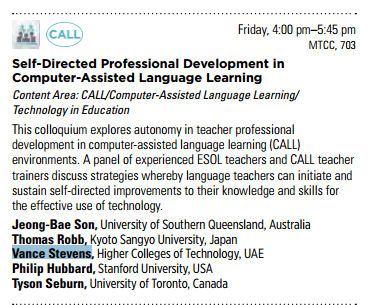
March 13, 2015 - I presented at TESOL Arabia: on Developing online listening exercises for natural English about how to listen to natural English samples, speak them back into Dictanote Chrome plugin to quickly produce accurate transcriptions, use those and media embed script to make Hot Potatoes multimedia exercises, then make those available to students via web or Blackboard with gradebook tracking, PC or iPad
Presentations: 2014 - Navigate to other areas of this page
Global Education Conference
October 11 - I presented live on-site: a plenary at GLoCALL Ahmedabad on Chaos and Learning: What we learn from MOOCs about Professional Development, Flipping Classrooms, and Sharing Digital Stories
Blog: http://learning2gether.net/2014/10/09/learning2gether-with-glocall-2014-ahmedabad-india/;
Slides: http://www.slideshare.net/vances/plenary-ahmedabad2014
WizIQ recording: http://www.wiziq.com/online-class/2186507-plenary-session-4
October 9 - I presented live on-site: a live-streamed of workshop on Hangout on Air at GLoCALL, Ahmedabad;
Blog: http://learning2gether.net/2014/10/09/learning2gether-with-glocall-2014-ahmedabad-india/
Slides: http://www.slideshare.net/vances/vance-stevens-livestreams-workshop-on-hangout-on-air-at-glocall-ahmedabad
Plenary and workshop listed in program: http://www.vancestevens.com/papers/archive/2014bhavan_plenary.pdf
September 21 - I presented online: Flipping the flip: Organizing students around a wiki and training colleagues to do likewise
Blog: http://learning2gether.net/2014/09/21/learning2gether-with-the-fall-blog-festival/
Slides: http://www.slideshare.net/vances/fall-blogfest2014
July 12 - I presented online: on aggregated artifacts from the Antwerp CALL 2014 conference July 7-9 in an online presentation at the RSCON5 conference
http://learning2gether.net/2014/07/13/learning2gether-3-days-with-rscon5-and-last-week-of-tto-mooc/
Slides: http://www.slideshare.net/vances/rscon5-vancestevensv2
Apr 27,2014 - I presented online: MultiMOOC EVO session, presentation at 7th Virtual Round Table Online Conference EVO Symposium,
Blog: http://learning2gether.net/2014/04/27/learning2gether-with-the-7th-virtual-round-table-evo-symposium/.
Slides: http://www.slideshare.net/vances/multimooc
April 22, 2014 I participated online in Earthcast 2014
http://learning2gether.net/2014/04/27/learning2gether-with-the-7th-virtual-round-table-evo-symposium/
March 29, 2014 - I presented live on-site: Learning2gether with MultiMOOC and SMALL, presentation given at TESOL Convention in Portland Oregon, EV Classics Fair, http://www.slideshare.net/vances/learning2gether-with-multi-mooc-and-evo - http://learning2gether.net/2014/03/29/learning2gether-from-tesol-2014-portland-march-25-29/
March 25, 2014 - I presented live on-site: MOOCs and the Flipped Classroom, at a PCI (Preconvention Institute) entitled Integrating CALL with Web 2 0 and Social Media,
http://www.tesol.org/convention2014/pre-and-postconvention-education/pre--and-postconvention-institutes/pcis-tuesday-25-march
Slides, http://learning2gether.net/2014/03/25/mooc-and-the-flipped-classroom/
Mar 14, 2014 - I presented live on-site: Extending Google+ Hangouts to way beyond 10 participants, presentation given at TESOL Arabia conference, Dubai
Slides: http://www.slideshare.net/vances/hangouts14mar2014tacon - http://learning2gether.net/2014/03/14/extending-google-hangouts-to-way-beyond-10-participants-vance-stevenss-presentation-at-the-tesol-arabia-conference-in-dubai-uae/
Feb 23, 2014 - I presented online: The Elephant in the Fire Hose, MultiMOOC, What was that all about? Moodle MOOC 3 online conference
Slides: http://www.slideshare.net/vances/the-elephant-in-the-fire-hose
Feb 11, 2014 - I presented online: Once a Webhead always a Webhead, Social Media Assisted Lifelong Learning, presentation for ICT4ELT EVO session
Slides: http://www.slideshare.net/vances/once-upon-awebhead
Jan 30, 2014 - I presented live on-site: How Can the MOOC Model Be Applied in the UAE? Presentation given at Education 2020 conference, Abu Dhabi , http://educationabudhabi.com/conference.php#day2
Slides: http://www.slideshare.net/vances/education-2020-presentation-how-can-the-mooc-model-be-applied-in-the-uae
Jan 26, 2014 - I presented online: Chaos in learning: Engaging learners in resolving chaos through networking, talk given for YLTSIG EVO Session
Slides: http://www.slideshare.net/vances/chaos-in-learning
Presentations: 2013 - Navigate to other areas of this page
November 19, 2013 - I presented online "Meet online using Google HoA with unlimited participants" at the 4th Annual Global Education Online Conference
Blog: http://learning2gether.net/2013/11/19/learning2gether-with-gec2013-4th-annual-global-education-conference/
Slides: http://www.slideshare.net/vances/meet-online-with-unlimited-users-in-google-hangout
October 15, 2013 - I presented online at RSCON4: From teacher networked learning to transformation in your classroom
Blog: http://learning2gether.net/2013/10/15/vance-stevens-representing-learning2gether-at-rscon4-from-teacher-networked-learning-to-transformation-in-your-classroom/
Slides: http://www.slideshare.net/vances/rscon4-27141110
June 2 Slides: http://www.slideshare.net/vances/learning2gether-classroots-weekly-online-professional-development
April 2, 2013 - I presented "Training Teachers in Web2.0 Tools for Teaching and Learning EFL" at the eLearning in Action conference in Sharjah, presentation
April 1, 2013 - I made a presentation at Al Ain Men's College entitled "Learning2gether classroots weekly online professional development." This session was one of several being held this week at Al Ain Men's College (AAMC) as part of an in-house professional development week. I simulcast the presentation in Google Hangout while streaming it on http://webheadsinaction.org/live.
March 23, 2013 - Claire Siskin and I did a presentation on MultiMOOC http://goodbyegutenberg.pbworks.com at TESOL in Dallas for the Electronic Village Classics Fair, http://callis2013.pbworks.com/w/page/65033145/EV%20Fair%20Classics.
March 22, 2013 - Presentation at the TESOL Conference in Dallas, March 20-23, 2013 entitled "Thinking Small: Training Teachers in Web2.0 Tools for Teaching and Learning EFL" which appeared here in the program: http://www.tesol.org/convention2013/education-schedule/academic-sessions
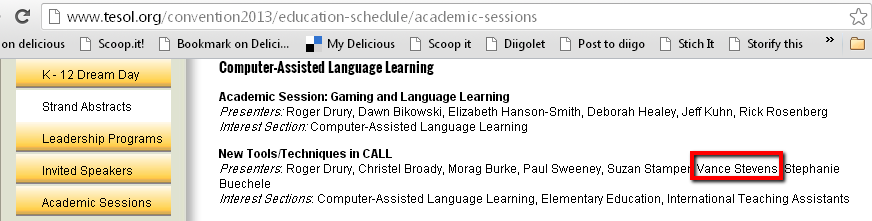
I gave a TESOL Arabia presentation on Friday, March 15, entitled "How MOOC learning reaches students through TPD" (teacher professional development). The slides are here: http://www.slideshare.net/vances/how-mooc-learning-reaches-students-through-tpd
Feb 3 Connecting Online Conference Slides: http://www.slideshare.net/vances/ance-stevens-and-colleagues-present-multimooc-at-connecting-online-2013
On Saturday Jan 12, 2013 Vance Stevens presented on "Teacher-centered PD via TESOL Electronic Village Online: Free, Annual, Online" at the live face-to-face TAEDTECH Sig w/ TA Abu Dhabi Chapter “Addressing language Learning Objectives with the Help of IT” conference. The schedule and other information is at http://buckinsand.titanpad.com/213. I live-streamed the event in Google Hangout with the help of Jeff Lebow and blogged the relevant links here: http://learning2gether.net/2013/01/12/jeff-lebow-hanging-out-at-vance-stevenss-live/
Slides: http://www.slideshare.net/vances/vstevens-tesol-arabiaabudhab-chapte-event2013
Presentations: 2012 - Navigate to other areas of this page
On Wednesday Nov 14, 2012 at noon GMT, John Hibbs and Vance Stevens had an online session entitled "The New Frontier of Massive Open On-line Learning" accepted as part of the free online Global Education Conference taking place November 12 - 16, 2012: http://www.globaleducationconference.com.
The conference brings together educators and students from around the world to discuss globally-connected education, projects, and activities and organizers anticipate some 20 - 30,000 attendees. The schedule in GMT is here http://www.globaleducationconference.com/page/globaledcon-schedule-gmt-0 and.
 |
On October 14, 2012 I gave an hour long mini-workshop entitled "Web 2.0 toolkit for teaching and learning academic presentation skills" as a part of the online series of professional development webinars organized by the EdTech Lounge, an initiative of the EdTech Innovation Centre, Higher Colleges of Technology UAE: http://elearning.hct.ac.ae/edutech/edtech-lounge |
Associated URLs:
Blogged archives:
On September 22, 2012 I presented in person, on site, at the aPLaNet conference at Yeditepe University in Istanbul, Turkey.
Proposal: https://docs.google.com/document/d/1KPGEheBVeREr14794oVzmBTio89ho9juPReVTjxRXKo/edit?usp=sharing
or the mnemonic http://tinyurl.com/aplanet2012
Slides:
http://www.slideshare.net/vances/learning2gether-to-develop-personal-learning-networks-to-model-collaborative-learning-for-teachers-to-use-with-students
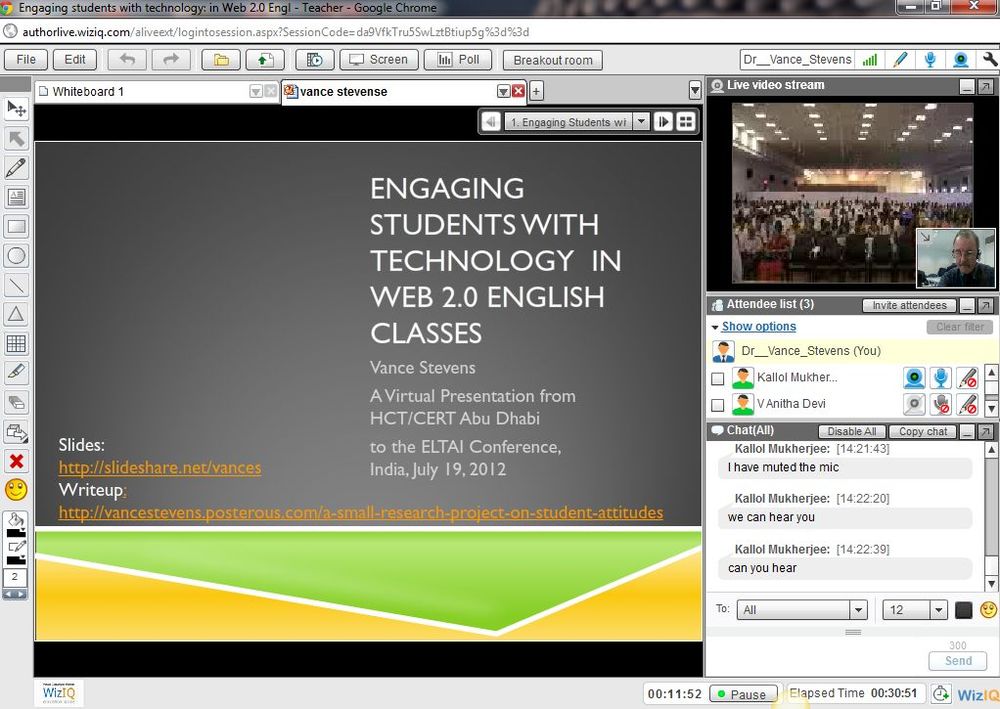
On July 19, 2012 I presented a talk entitled Engaging students with technology in Web 2.0 English classes at a distance from Abu Dhabi to the ELTAI Conference in Vellore, India. There is a write-up of the presentation here: http://vanceposterous.wordpress.com/2012/07/14/a-small-research-project-on-student-attitudes/ and a TESL-EJ updated variation on the theme here: http://www.tesl-ej.org/wordpress/issues/volume16/ej62/ej62int/.
Presentation links include:
On April 3, 2012 I presented a talk on DIYLMS: Student-centered do-it-yourself Learning Management Systems at the 6th eLearning in Action conference at the Sharjah Higher Colleges of Technology, "an event where teachers, eLearning developers and educational technology specialists from HCT and other educational institutions convene to share, connect, discuss and learn about the best ideas and technologies for eLearning;" see:
Slides: http://www.slideshare.net/vances/learnercentered-doityourself-learning-management-systems-practical-aspects
http://194.170.54.16/events/edtechpd2012/index.asp and also the program with the schedule of streamed events: http://fcwr101.pbworks.com/w/file/51166274/sharjah3apr2012programme.pdf
I presented session number 223375, entitled, "Learning2gether to teach one another about learning online," at the TESOL 2012 convention program, held on 28-31 March 2012 in Philadelphia, Pennsylvania, USA. My presentation was on March 31, 2012 at 11:00 AM in room 411 at the Marriott. The slides are here: http://www.slideshare.net/vances/learning2gether31march2012
On March 13 and 14 I gave two seminars in Erzincan, Turkey. The one on March 13 was given to around 50 Erzincan University Civil Aviation students and was prepared and delivered via a wiki forming a part of a DIYLMS (do-it-yourself learning management system) based at http://erzincancalling.pbworks.com/. The talk produced an article entitled "Turning a 3-hour face-to-face seminar into an opportunity for extended online blended learning" which I published first as a blog post and then in two different versions in two publications:
At the TESOL Arabia Conference in Dubai March 8-10, 2012, I was invited to give two presentations.
On Wednesday, 08 February, 2012, I gave a keynote speech entitled Learner-centred do-it-yourself Learning Management Systems at the IATEFL Learning Technologies SIG http://ltsig.org.uk/ conference on Opportunities, challenges and practical solutions for the integration of ICT in education in Marrakech, Morocco from 8-11 February 2012, http://ltsig.org.uk/events/13-future-events/221-marrakesh-february-2012.html; program at: http://ltsig.org.uk/media/Marrakech2012_Programme.pdf. Write-up, slides, and recordings are linked from the URLs below:
I conducted a 5-week seminar on Multiliteracies for social networking and collaborative learning environments, http://goodbyegutenberg.pbworks.com for the 2012 EVO sessions from January 9 - February 12, 2012, http://evosessions.pbworks.com
Presentations: 2011 - Navigate to other areas of this page
My proposal for the GLoCALL conference http://glocall.org/ Oct 27-29, 2011 in Manila was accepted (but I was not able to get there: http://vancestevens.tumblr.com/post/14716957918/ive-been-meaning-to-write-a-new-years)
Abstract: Learning2Gether is a wiki which serves to organize teachers in meeting online at regular times weekly to conduct free ‘class-roots’ professional development seminars and discuss topics of mutual interest. Presenters and participants range from expert to those merely interested in the topics. Sessions are recorded, and a growing archive of recorded resources is accumulating at the site. This talk explains how Learning2Gether came about, and how it draws on and expands its participants’ personal learning networks so that knowledge is transferred informally and peer to peer. A crucial aspect of the learning that takes place there is where teachers model to one another how to use Web 2.0 tools to leverage learning through networking, and to apply these to classroom and other professional development opportunities. This talk is couched it in the perspective of how teachers achieve the aha! Moment, where they 'get' how technology can become a critical enabler of what they ordinarily try to do pedagogically in their classrooms. In this presentation I will try to provoke an aha! moment by illustrating how a PLN works to enhance such learning by getting people from other virtual spaces to join us in real time, live and online.
Author: Vance’s career includes CALL coordinator, software developer, lecturer in ESL and computing, founder of Webheads as well as CALL-IS in TESOL, and facilitator in TESOL's online professional development programs. On the boards of APACALL, TESL-EJ, CALL Journal, and Writing & Pedagogy, he encourages people to have F.U.N. and think SMALL.
|
September 5-October 2, 2011 - I taught this course for the last time as PP 107: Multiliteracies for Collaborative Learning Environments: as part of TESOL's Principles and Practices of Teaching Online Certificate Program: http://www.tesol.org/s_tesol/sec_document.asp?CID=664&DID=2642. Course details are continually undergoing revision at http://goodbyegutenberg.pbworks.com |
My presentation (online via WiZiQ) "Me-Portfolios: Putting the 'me' in Me-Learning" for the MoodleMoot Virtual Conference 2011 from August 17-21 http://moodlemoot.integrating-technology.org/, is in the program at http://www.wiziq.com/events/moodlemoot-conference-2011.aspx for Aug 21, 2011 at 1300 GMT. Abstract: Vance Stevens has been teaching a course on multiliteracies and revising it for a number of iterations over the past several years now (http://goodbyegutenberg.pbworks.com). One recent innovation was to set evaluation of the course by means of e-portfolios. I have started referring to them as "Me-Porfolios" to draw attention to their constructivist/connectivist nature. The presentation describes the multiliteracies course and how it has recently evolved a MOOC approach with berry-bush supermarket presentation rather than prescribed guidance through course components. MOOC stands for "massivie open online course" but I have suggested scaling the concept where "massive" becomes "miniscule". User choice in material to be covered makes it logical to encourage participants to adopt Me-Porfolios in (1) specifying their own course objectives and outcomes as they orient in the course; (2) presenting their individually tailored plan of achieving those objectives, and ; (3) documenting their accomplishments through an online portfolio linking to deliverables prepared in showcasing those outcomes. The presenter has found it wise to model e-portfolios to the participants as well as identify successful examples of e-portfolios. This presentation covers the literature on e-portfolios as presented in the course and shows the portal linking the Me-Portfolios prepared by the participants in the most recent rendition of the course.
2011-06-17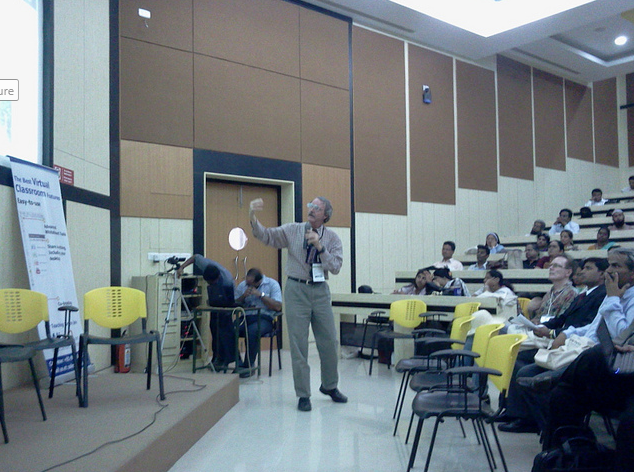
http://www.flickr.com/photos/vancestevens/5856073940/
I was invited to give a talk entitled "Learning2gether to achieve the aha! moment" as a plenary address at the 6th International and 42nd Annual English Language Teachers' Association of India (ELTAI) Conference held at VIT (Vellore Institute of Technology), Vellore, India, 16-18 June, 2011 (http://viteltai.com/invited_speakers.asp). I was also on two panel discussions, http://viteltai.com/ConferenceProgram.asp. These sessions were streamed live via WiZiQ: http://www.wiziq.com/course/698-6th-International-and-42nd-ELT-i-conference-16-18-June-2011
Here are details of my events:
Program listings: http://www.vancestevens.com/papers/archive/2011eltai_plenary.pdf
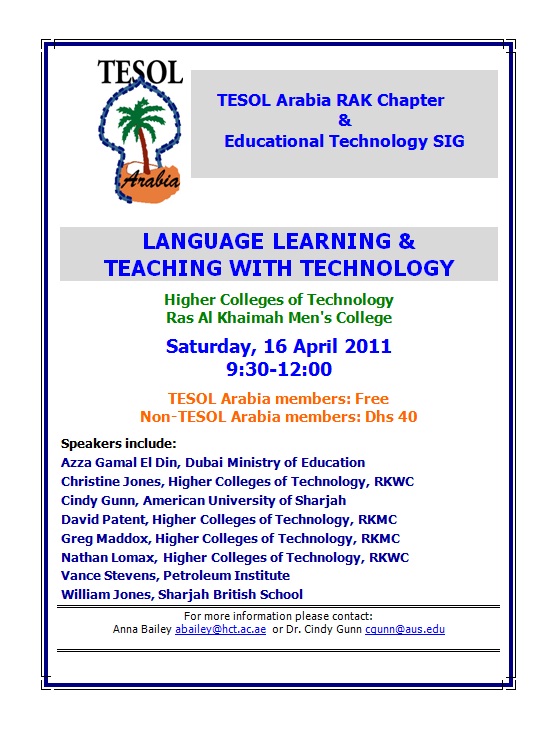
I gave this presentation at the TESOL Arabia SIG event in Ras Al Khaimah April 16, 2011: Connecting the Dots: Transforming learning with creative technogogy to achieve the aha! moment. The presentation was given live and face-to-face in Ras Al Khaima and at a distance with IATEFL in Brighton, where we were joined by Nik Peachey, Graham Stanley, and Jo Mynard
 |
|
March 26 at 7pm GMT - I was invited to be a part of a panel to discuss the recent EVO Electronic Village Online as a part of the 4th Virtual Round Table Online Conference on Language Learning Technologies March 25-27, 2011. Links:
Thursday, March 17, 2011 at the International TESOL Convention in New Orleans, from 3:00 pm to 4:30 pm in the Electronic Village located in the Convention Center, my proposal was accepted to present a 90 min. mini workshop entitled Collaborative writing using Google Docs and Tagging in Delicious
My talk at the TESOL Arabia 2011 Conference to be held at J W Marriott Hotel in Dubai, United Arab Emirates on March 10-12, 2011 was designated as the Featured Speaker presentation for the TESOL Arabia Educational Technology SIG:
|
January 10 - February 13, 2011, my proposal to conduct the constantly evolving course on Multiliteracies for Social Networks and Collaborative Learning Environments was accepted again this year as one of the Electronic Village Online (EVO) http://evosessions.pbworks.com/ sessions for 2011. Co-moderators this time around are Nelba Quintana and Jennifer Verschoor. The course was conducted through its evolving wiki http://goodbyegutenberg.pbworks.com/ and through the Ning http://multiliteracies.ning.com/ and YahooGroup mailing list http://tech.groups.yahoo.com/group/multilit/ or http://multilit.grouply.com/ |
February 9, 2011 - I was invited to appear in Second Life at EduNation I http://edunation-islands.wikispaces.com/ (rendered before the demise of Wikispaces July 31, 2018 in this pdf: http://www.vancestevens.com/papers/archive/EduNation Islands home.pdf; SLURL: http://maps.secondlife.com/secondlife/EduNation/49/179/23 for a conversation with Dennis Newson and Kalyan Chattopadhyay, via a bridge between Adobe Connect screensharing Second Life skillfully orchestrated by Heike Philp.I was invited as one of "a number of colleagues with considerable experience in various aspects of TEFL in Second Life [who]have agreed to take part ... Our first guest will be: Vance Stevens: Wed 9 Feb at 5 pm GMT Founder of The Webheads ..." Due to technical difficulties the session was late to start, but I hope it was recorded and that I can provide the URL here shortly.
Presentations: 2010 - Navigate to other areas of this page
I was first to "present" on November 7, 2010: http://groups.yahoo.com/group/evonline2002_webheads/message/26838 when Elizabeth Hanson-Smith coordinated a presentation on EVO, or Electronic Village Online, the free professional development available over a 5-week period this coming January and February 2011 http://evosessions.pbworks.com/. This live event showcased some of the moderators who are now preparing to put on these sessions; e.g. * PLEs and PLNs: Susan Berg, Letizia Cinganoto, Daniella Cuccurullo * Second Life: Dennis Newson, Kalyan Chattopadhyay, Heike Philp, Maria Pinto, Nahir Aparicio * Podcasts: Evelyn Izquierdo, Jose Rodriguez, Miguel Mendoza * Digital Storytelling: Carla Arena * Multiliteracies: Vance Stevens, Dennis Oliver, Jennifer Verschoor, Nelba Quintana * Internet4YoungLearners (a 2010 EVO session)
October-November, 2010, I taught a short course entitled Enhancing Student Performance and Professional Development Online as part of the Petroleum Institute community outreach and staff development program. The course culminated with this event: Date: November 3, 2010 http://groups.yahoo.com/group/evonline2002_webheads/message/26832 The final session was broadcast from the PI in Abu Dhabi in Elluminate and turned out to be a discussion of tagging. Considering it was announced at the last minute it was well attended by Amer, a student at the PI, John, one of my colleagues at the PI, and Ingrid and Dennis (both from Germany). Recording: http://tinyurl.com/tags2010nov3. We made ESPPDO into a tag and incorporated it into a number of URLs meant to be ‘hooks’ into the course; for example:
October 31, 2010 - Perspectives on eLearning and the TESOL Principles and Practices of Online Teaching program Date: Announcement: http://groups.yahoo.com/group/evonline2002_webheads/message/26821 Overview: Dafne Gozalez, Teresa Almeida d'Eca, and Vance Stevens discuss approaches to teaching in the TESOL PPOT online program
October 17, 2010 - Deborah Pincon interviews Vance Stevens Date: Announcement: http://groups.yahoo.com/group/evonline2002_webheads/message/26742 Overview: Deborah Pincon is in the Ph.D. program at the University of Wisconsin Milwaukee, and is conducting a qualitative analysis of the types of support Webhead members provide to one another in the context of mediated (virtual) communication and small groups. To begin the study, she interviews Vance Stevens to get a feel for the overall goals and history of the Webheads. This will be followed by content analyses of some postings to the Webheads YahooGroup and interactions at virtual conferences, and interviews of other Webheads members, after which she will submit her research for publication. Debby has graciously consented to allow the initial interview to take place as one of our regularly scheduled Sunday teacher professional events, and to welcome everyone to attend.
Susan Marandi was working on arranging my visit to Tehran, Iran this fall, to be a plenary speaker, as well as deliver a workshop, at the TELLSI conference there Oct 13-15, 2010, see http://tellsi8.alzahra.ac.ir/PlenarySpeakers.aspx . The talk was to be on the crucial role of personal learning networks in teacher professional development, and the workshop on writing materials for students to teach them 21st century critical skills in such a way that the materials will help train the teachers in a non-threatening way in use of what might be unfamiliar Web 2.0 tools. The Iran Foreign Ministry denied me permission to travel there but some of the websites are still active in November 2010. A rendition was copy/pasted to Google Docs: http://tinyurl.com/tellsi2010 or https://docs.google.com/document/pub?id=1y10EQGMUkoVCZFExbZROEanucXcauww8VWrJ8ZKP_3U
Webheads gave a presentation at VRT3 - Blended, face-to-face or online? What works where in teacher training? Date: October 8, 2010 Announcement: http://groups.yahoo.com/group/evonline2002_webheads/message/26716 Panelists included: Teresa Almeida d'Eca, Portugal; Dafne Gonzalez, Venezuela; Carla Arena, Brazil; Michael Coghlan, e-Learning Consultant and Trainer, Australia; Erika Cruvinel, Brazil; Vance Stevens, Petroleum Institute, UAE; Jennifer Verschoor, Argentina; Patrick Murphy, Qatar. All panelists are innovative educators with long experience in both face-to-face and online teacher training, and long-time active participants in the web-based community of practice and social network, Webheads in Action http://webheads.info. They meet at this event to discuss their involvement with teacher training face-to-face, online, and in virtual worlds. They will focus all of these modalities towards a greater understanding of what teachers need to know and practice in this digital age of greater connectivity with its many affordances and potentials for all kinds of learning. Recording: http://lancelot.emea.acrobat.com/p66604305/ (1:28min) All VRT3 recordings: http://tinyurl.com/VRT10Notes-Recordings
|
September 6-October 3, 2010 - I taught this course: PP 107: Multiliteracies for Collaborative Learning Environments: "A multiliterate online language teacher creates learning environments interweaving sound and image with text over networked media. This course is part of TESOL's Principles and Practices of Teaching Online Certificate Program" http://www.tesol.org/s_tesol/sec_document.asp?CID=664&DID=2635 Clicking on the course title takes you to http://www.tesol.org/s_tesol/sec_document.asp?CID=664&DID=2642 and this description: "A multiliterate teacher understands the many ways that technology interacts and intertwines with academic life, and actively learns how to gain control over those aspects impacting teaching and professional development. Multiliterate individuals are aware of the pitfalls inherent in technology while striving for empowerment through effective strategies for first discerning and then taking advantage of those aspects of changing technologies most appropriate to their situations. These strategies include managing, processing, and interpreting a constant influx of information, filtering what is useful, and then enhancing the learning environment with the most appropriate applications. This course * models effective approaches and strategies for responding to technology issues in the academic environment * provides opportunities for expansion of technical skills required for coping with information overload * utilizes video, web cam, image, and voice technologies in communicating through communities of practice which in turn model collaborative, constructivist learning settings. Topics covered and skills developed * What is multiliteracy? * Mechanics of an online community: social networking and collaborative learning portals * Theoretical framework for cultiliteracies and how they apply to collaborative learning environments * Managing information: utilizing RSS and bloglines * Theoretical framework for multiliteracies * Types of multiliteracies." The course will be adapted from the work done on the EVO version of the course given in January 2009 and 2010 at http://goodbyegutenberg.pbworks.com. |
For the above course I conducted interviews with (among others):
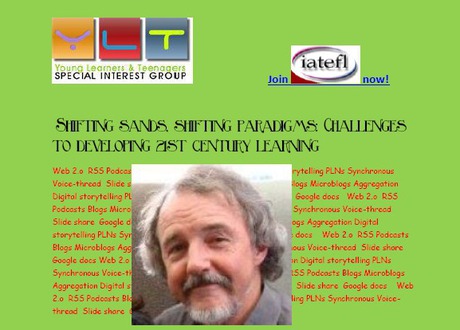 |
September 19, 2010 at 13:00 GMT I was invited to give a presentation in Adobe Connect to the IATEFL YLTSIG group, hosted by Dennis Newson. The talk is entitled "Shifting sands, shifting paradigms: Challenges to developing 21st century learning skills," and we have agreed that a variation on the talk I gave at CALICO in June will be suitable: On this topic, I've written out a text here. https://docs.google.com/View?id=ddkc6v4f_162cw45m8c9 and I'll adapt the slides from here: http://www.slideshare.net/vances/shifting-sands-shifting-paradigms. This event is part of a participant-driven professional development series planned for the TESOL Arabia EdTech SIG at 13:00 GMT each Sunday (5 pm in UAE). Between Sept 6 and Oct 3, 2010 the event coincides with the TESOL PPOT 107 Multiliteracies course.Here are some more relevant URLs: |
|
In September 2010 I started a series of regular weekly "Sunday Speedgeek" professional development sessions based here http://learning2gether.pbworks.com, and archived the session recordings at http://learning2gether.net. See an index of all the recordings at http://learning2gether.pbworks.com/archiveindex |
August 27, 2010 - I was invited to be a speaker at an event hosted by Gavin Dudeney and Graham Stanley: the IATEFL Learning Technologies special interest group round table online discussion on Educational Technology, held as part of the 'Rebooting the Conference: Technologies in Education' being held August 26 – 28 at the British Council in Moscow (see http://www.teachingenglish.org.uk/event/rebooting-conference-technologies-education or http://tinyurl.com/32ya4a8 for details) The discussion took place on: Friday 27th August from14:00 -15:00GMT, in Adobe Connect. Sound quality for online participants was poor, with half-minute lags and patchy voice quality. Sometimes these are smoothed out in the recordings, which often assemble the voice packets as they should have been delivered. Find out here:
|
I outlined my professional goals for the summer in Argentina and Brazil here: http://advanceducation.blogspot.com/2010/02/paradigm-shift-as-agent-of-changing.html. Some of my incentive to devote a portion of my summer leave to giving presentations in Argentina and Brazil was to take part in the Future of Learning in a Networked World event declared to be held in Brazil around the time of Braz-TESOL in July and August: http://flnw.wikispaces.com/schedule. |
August 11, 2010 from 12:30 to around 2:00 Argentina time, I was invited to give a presentation in La Plata about "PLN (Personal Learning Networks): The paradigm shift in learner and teacher autonomy" at the School of Languages: http://englishvirtualcommunity.blogspot.com/2010/08/vance-stevens-and-pln.html?spref=fb. It was essentially the same talk I gave in Sao Paulo in July, except that I was able to record the session and podcast it at https://www.podomatic.com/podcasts/vance_stevens/episodes/2010-08-13T07_51_45-07_00. All the relevant links including to the recorded podcast are here: http://braz2010vance.pbworks.com/PLN.
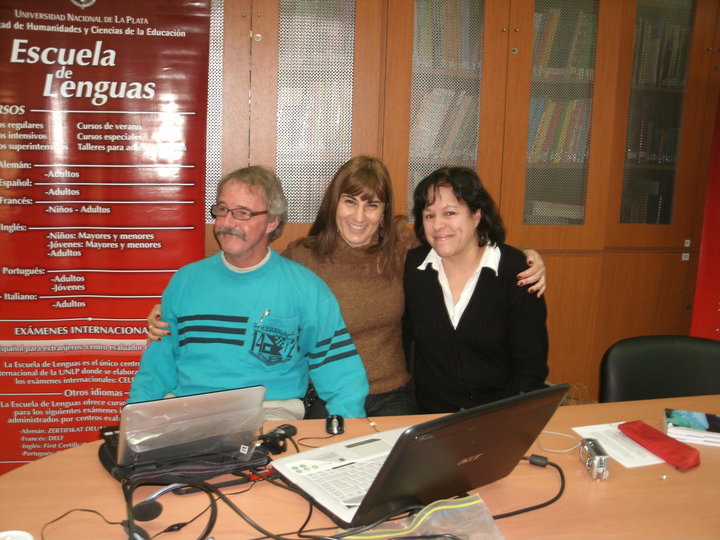
Left to right: Vance Stevens, Nelba Quintana, Susana Canelo, Escuela de Idiomas, La Plata, August 11, 2010
The presentation resulted in a publication, here:
http://www.puertasabiertas.fahce.unlp.edu.ar/numeros/numero-6/pln-the-paradigm-shift-in-teacher-and-learner-autonomy
August 9 and 10, 2010, 5:30 pm until 7:00 pm in Buenos Aires and Martinez- I was invited to do some speed-geeking with Jennifer Verschoor and Rita Zeinstejer : https://sites.google.com/site/baffledincyberworld/. Our working document with abstract and program can be found here: http://tinyurl.com/vanceritajen2010 or https://docs.google.com/document/pub?id=1h66HBtc93b-detTUchfspn-DTLYZlHDM0y9CQ7NGBGk
On July 23, 2010 the Future of Learning in a Networked World team (Barbara Dieu, Michael Coghlan, and I) flew to Brasilia to give a session at the Casa Thomas Jefferson 8th TEFL Seminar entitled 'Thinking SMALL: Helping teachers model 21st century skills to students". I created a page for the event here http://braz2010vance.pbworks.com/brasilia with our proposal and program and notes on what we said, and also Twitter feedback.
My two proposals to the 12th National BRAZ-TESOL Convention to be held in Sao Paulo, SP, July 19-22, 2010 were both accepted. I created a wiki page to document my activities here: http://braz2010vance.pbworks.com/.
In addition to the two sessions I gave I also participated as an International Guest in an all-day EduTech SIG PCI or pre-conference institute on July 19th 2010: The Braz-TESOL site at https://braztesol10.wikispaces.com/ will disappear at the end of July 2018, so I made a static pdf of what was there relevant to me here:
http://www.vancestevens.com/papers/archive/2010brazTesol_wikispaces.pdf
and http://www.vancestevens.com/papers/archive/braztesol10-international guests.pdf
300 word session description: This session introduces the concept of tags and enables participants to explore their power in language learning. The session explains tags in familiar terms (e.g. photos on Facebook). It then describes a project where teachers around the world had their students create content online in blogs, and then find one another anywhere in the world using the tag, 'writingmatrix'. This project left many artifacts online for participants to examine.
To show how it works we play a number of tag “games”. I (and others) take pictures at the conference in advance of the workshop and tag them on Flickr. Participants find them and create attractive visuals from them using Taggalaxy. I show other web sites where objects can be tagged and we explore online tools to find these tagged objects. Some of these other tools are:
- Google image search
- Spezify and Addictomatic
- Twitter and Twibes
- Diigo and Delicious
- Technorati and Google Blogsearch
I show how these sites can be used to manage collaborative projects and to research topics apart from familiar Google searches through methods utilizing tags. The presentation itself will create a set of tagged objects that participants can retrieve later through techniques learned at the workshop. For example, the presentation will be available on Slideshare.net and tagged so it can be found using the tools above.
Participants learn how these concepts can be used with students. Delicious can be used to channel knowledge for a group of students or online collaborators. To illustrate the point, all of the links introduced are tagged so that participants can to retrieve them via their common tag from the perspective of students. Through exploration and using the tools to recapture what they have themselves learned, teachers leave the workshop with a greater understanding of tagging and its possibilities in language learning.
I created a page here http://braz2010vance.pbworks.com/TagGames with links to my slides, a uStream recording of the session, notes on all the links I used, and Twitter feedback.
I was invited to present at the CALICO 2010 conference 2010, Enhancing Language Learning: Research, Innovation, and Evaluation in CALL http://calico.org/conference on the Amherst College campus in Amherst, Massachusetts, as part of a panel to discuss the book I helped co-edit called CALL in Challenging Technology Contexts, published by CALICO (Computer-assisted Language Instruction Consortium) as part of their monograph series. The presentation, was entitled "Teaching and Learning in Limited Technology Contexts," and took place on Thursday, June 10th from 2:00 – 3:30 p.m.. Panelists were Vance Stevens, Levi McNeil, Cara Preuss, Tanya Chen, Jeff Nelson, Senem Yilidiz, Jarek Krajka, and Joy Egbert. Abstract: "Authors and editors from CALICO's 2010 book will describe issues of limited technology contexts and interact with participants to explore solutions and workaround."
The publication of the book was timed to feature at the 2010 CALICO Conference in Amherst, June 8-12 . The following is the announcement as it appeared at thehttp://calico.org portal in May and June, 2010. A click on the link takes you to https://calico.org/page.php?id=452:
April 22-23, 2010 - I was invited to be on two panels, one with EVO and one with EUROCALL et al.
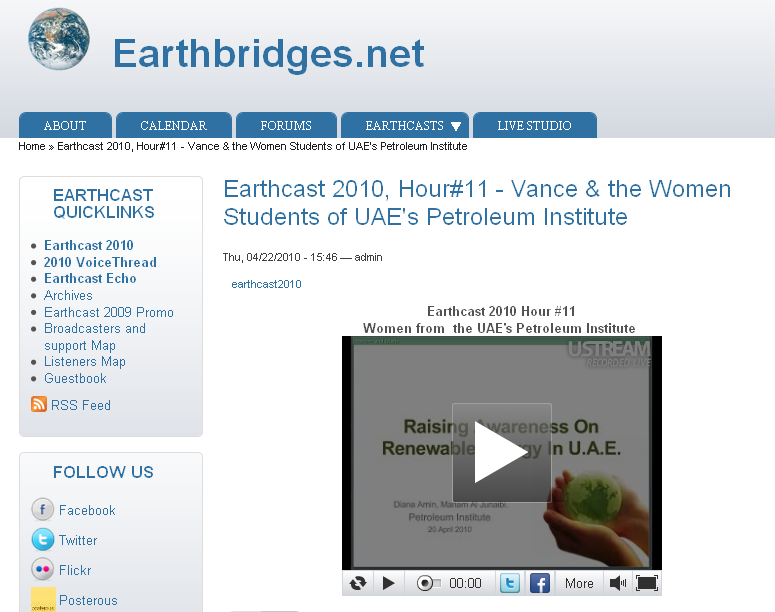
April 22, 2010 - On the occasion of Earth Day 2010, I set up a presentation for some of my students at the Petroleum Institute at 11:00 GMT in the annual Earthbridges Earth Day Earthcast. The Earthcast is a 24 hour webcastathon conducted each year by http://earthbridges.net. Numerous URLs were generated in conjunction with this event:
My presentation with Jim Buckingham entitled "Thinking SMALL: Realizing Ongoing Professional Development through Grassroots Social Networking in the UAE" was accepted at the Abu Dhabi Chapter, Abu Dhabi ELT Conference, on April 10 at Zayed University in Abu Dhabi. The writeup with link to Adobe Connect recording and slideshare.net slides is here: http://curiousvance.wordpress.com/2010/04/09/modeling-and-demonstrating-professional-devel/
Abstract The presenters will discuss how to realize an online community for EFL instructors in the UAE and its integration with professional or personal learning networks (PLN). They propose a social network structure that will address the need for ongoing PD in the UAE that is driven bottom up, not top down, according to the perceived interests of practitioners involved in language education and other a of learning in the UAE. The session will suggest means by which practitioners can share knowledge and skills and contribute to each others’ PDs by practicing within a PD network dedicated to the needs of knowledge workers in the UAE as well as connecting with similarly motivated networks and communities worldwide. NB: SMALL stands for Social Media assisted Language Learning
The presentation is also featured on the program of the Ras Al Khaima Chapter conference on the same day. The session "Thinking SMALL: Realizing ongoing professional development through grassroots social networking" will be streamed in from Abu Dhabi thanks to the third presenter listed in the program on site in RAK, Phil Cozens. Abstract (50 words): Two presenters webcasting live from the TESOL Arabia Chapter event at Zayed University in Abu Dhabi interact online with participants and their on-site presenter in RAK to discuss how to further professional development across the Emirates by nurturing online community-based interaction within distributed professional or personal learning networks (PLNs).
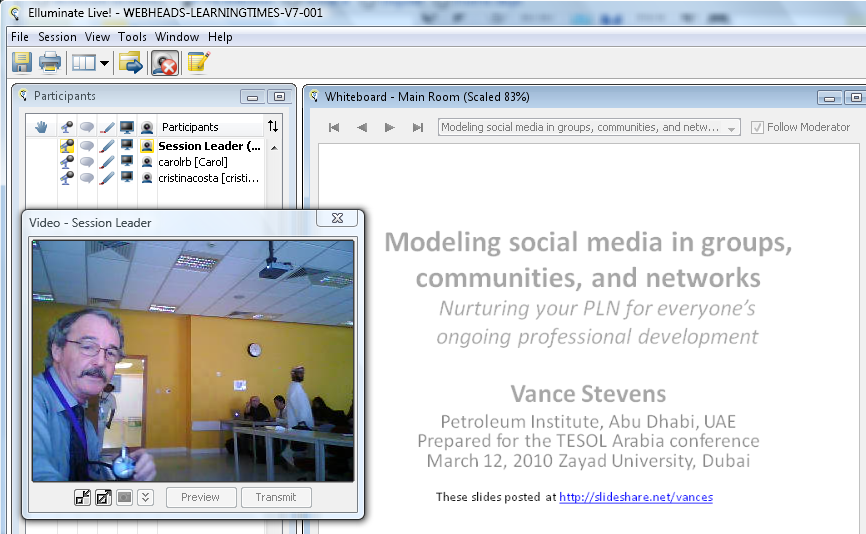 |
I was invited to present at the TESOL Arabia Conference 12 March, 2010 at Zayed University in Dubai, UAE on "Modeling social media in groups, communities, networks: Nurturing your PLN for everyone’s ongoing professional development " - Abstract: This presentation examines social networking in groups, communities, and networks. Teachers must be trained not only IN use of social media, but THROUGH use. This presentation suggests how teachers interact with communities of practice and distributed learning networks where participants are modeling optimal ways of using social media in teaching. |
I recorded the presentation in Elluminate on ZU's robust and ubiquitous wireless.
Wednesday Feb 3, 2010 at 1400 GMT (ending at 16:00) I gave at a distance a lecture and workshop at the NileTESOL AUC Skills Conference taking place face-to-face in Cairo between 2 and 4 February 2010. My workshop is entitled generallyTalking about tags, trying them out and has two parts, lecture/discussion and hands-on workshop/experiments and games. I blogged the event, including links to online artifacts, here: http://curiousvance.wordpress.com/2010/02/05/powerful-ideas-and-tools-for-getting-the-most/. More details:
January 11 - February 21, 2010, my proposal to conduct my constantly evolving course on Multiliteracies for Social Networks and Collaborative Learning Environments http://goodbyegutenberg.pbworks.com/ was accepted again this year as one of the Electronic Village Online (EVO) http://evosessions.pbworks.com/ sessions for 2010 http://evosessions.pbworks.com/Call_for_Participation2010 . My co-moderators this time around were Nina Liakos and Jennifer Verschoor.
At the TESOL conference in Denver I agreed to give my online course for TESOL PP 107 Multiliteracies for Collaborative Learning Environments starting September 7, 2009, which was a change of dates from that originally established. The course was listed at the TESOL website here: http://www.tesol.org/s_tesol/sec_document.asp?CID=664&DID=2642 but the dates given are for the old dates. Consequently I proposed to give the course as an EVO session again this year, as noted above. I have since been invited to give the course again (for TESOL) Sept 6-Oct 5, 2010, though the exact dates are under negotiation.
|
January 10 - 19, 2010, I taught a course entitled 21st Century Skills for Professional Development Online as part of the program of The Petroleum Institute AUP Computing Professional Development and Community Courses. The course began with a 1-hour presentation explaining the annual TESOL-sponsored Electronic Village Online (http://www.slideshare.net/vances/you-can-participate-in-electronic-village-online-2882887) and proceeded in four 1.5-hour face-to-face class sessions. Skill-building began with synchronous tools and RSS feed readers and proceeded in the second week to synchronous tools. Marian Heddesheimer from Germany and Jennifer Verschoor in Argentina were invited to the last session, which was recorded and can be played back here:
Other online spaces include:
|
Presentations: 2009 - Navigate to other areas of this page
November 13, 2009 at 18:00 GMT I was invited to join Graham Davies, Ton Koenraad, and Duane Sider (from Rosetta Stone) in a panel discussion at Lancelot Schools's Virtual Round Table Conference, hosted by Heike Philp: http://virtual-round-table.ning.com/events/virtual-round-table-conference
November 6, 2009 - I was invited to present at the Social Networking 2009 Conference November 5-8, 2009, an open-knowledge event completely online and free and jointly organized by AVEALMEC (http://avealmec.org.ve/) and ARCALL (Argentine Computer Assisted Language Learning at: http://arcallmashup.ning.com). Speakers include: George Siemens, Etienne Wenger, Vance Stevens, Nik Peachey, Charalambos Vrasidas and Maria Solomou, Nicky Hockly, Erika Cruvinel and Ronaldo Lima, Rita Zeinstejer and Paula Ledesma, Nellie Muller Deustch, Carla Arena, Graham Stanley, and Jennifer Verschoor, Evelyn Izquierdo and Erika Cruvinel - all presenting on some aspect of how social networks can be used in language teaching and learning, concepts and theories around social networks, communities of practice and the Web 2.0, as well as about the use, advantages and drawbacks of social networking tools.
My presentation on Friday, November 6, 2009 at 18:30:00 GMT was entitled Modeling social media in groups, communities, and networks the presentation intertwines two threads: (1) an examination of social networking as practiced distinctly in groups, communities, and networks. Drawing from experience coordinating a teachers' community of practice for the past decade, I illustrate the evolution of what was initially a group into a community of practice, and how social media enables one CoP to interact with others to become part of a distributed learning network. and (2) the notion that teachers must be trained not only IN the use of social media, but THROUGH its use. Recidivism is a problem in technology training for education; teachers can be shown how to use social media, but unless they use it themselves they are unlikely to change their practices. There is evidence that teachers trained in programs where their instructors used social media (modeled it) are more comfortable with technology than when their instructors did not themselves use these tools. This presentation suggests how teachers can interact with numerous communities of practice and distributed learning networks where other participants are modeling to and learning from one another optimal ways of using social media in teaching. My blog post points to all the relevant links: http://advanceducation.blogspot.com/2009/11/modeling-social-media-in-groups.html
- The complete schedules and PDF promotional documents for this conference are here: http://avealmec.org.ve/moodle/
- This link gives a good overview of presenters with links to their presentation recordings http://avealmec.org.ve/moodle/course/view.php?id=4
- The writeup is here:
Stevens, Vance. (2009). Modeling Social Media in Groups, Communities, and Networks. TESL-EJ, Volume 13, Number 3: http://www.tesl-ej.org/wordpress/past-issues/volume13/ej51/ej51int/
An earlier draft version in Google Docs: http://tinyurl.com/vance-socialnet09- The presentation recording is here: http://tinyurl.com/vance091106wiziq
- The slides are posted here: http://www.slideshare.net/vances/modeling-social-media-in-groups-communities-and-networks-socialnetworking-2009-online-conference
I was invited to take part in the Worldbridges Equinox 2009 Webcastathon Sept 25-27, 2009 http://worldbridges.net/node/3618. Webheads participation was scheduled for 13:00 GMT Sunday Sept 27 As shown on the schedule: http://www.webcastacademy.net/2009-equinox-webcastathon. So far, I haven't been able to locate any audio.
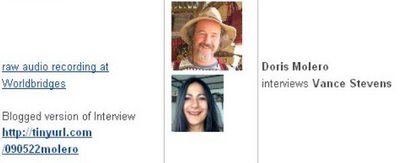
Mireille Massue interviewed me at her first interncast for the Webcast Academy (the one where the intern is supposed to record the two sides of a Skype conversation) on August 3, 2009 and posted her work at http://www.webcastacademy.net/audio/mireilles-interview-vance-stevens. I podcast the mp3 at my own GeekSpeek site http://vance_stevens.podomatic.com/entry/eg/2009-08-03T19_12_16-07_00, or http://tinyurl.com/geekspeek090803. This was either Mireille's first or second 'interncast'. Her task at this point was not to webcast it yet, so it was just a recorded interview, which is why there was not a general invitation to join us or listen in live.
|
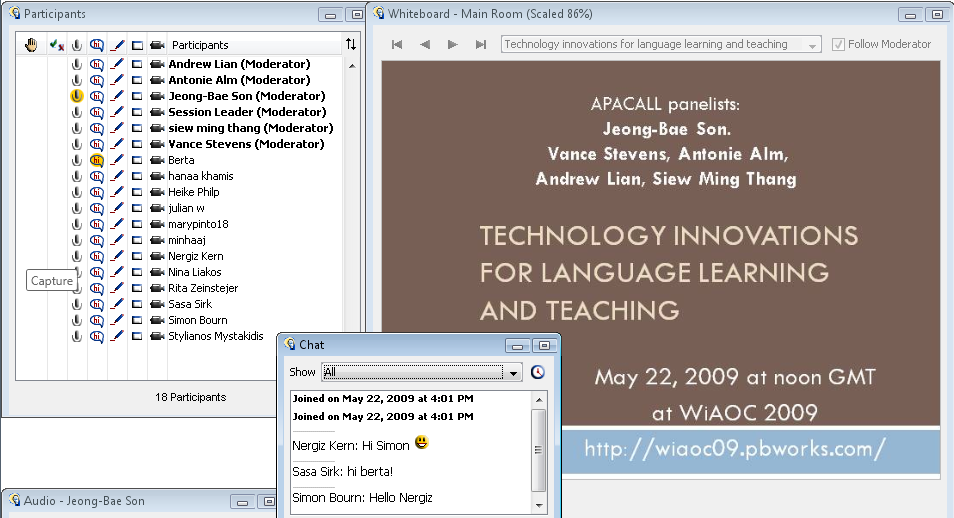
For the third time in 5 years I coordinated the 3rd bi-annual Webheads in Action Online Convergence held May 22-24, 2009, http://wiaoc.org.
On April 26, 2009 we held a planning session at Worldbridges, recording published at http://webheadsinaction.org/wiaoc09-prep1 I gave two presentations on May 22, 2009
|
May 17, 2009 - I spoke to group of ARCALL teachers on: Multiliteracies in Elluminate. Their announcement at the time read: "We have the honor to have Vance Stevens as our special guest for ARCALL. Don't miss this unique event to learn from the best!!!!" Unfortunately, links to this event are locked in the Ning, http://arcallmashup.ning.com/events/event/listByDate?date=2009-05-17, which is still hosted as of summer 2011 but locked in oblivion by the Ning gatekeepers who will only release the content if someone pays them..
May 7, 2009 - I was interviewed by Leslie Shield for one of her projects concerning the impact of ICT and new media on language learning.
I moderated three hours of conversation being sustained online for 24 hours April 21-22 by Jay Cross and friends. Jay was known for his Internet Time blog, which used to be at http://www.internettime.com/ and books/writings on Informal Learning. This event was based at the Corporate Learning Trends and Innovation Ning: http://learntrends.ning.com/ which is now up for sale. Jay wanted to feature Webheads in this program and he gave us three hours, 1000 to 1300 GMT on April 22nd. The sessions were held in Elluminate and there was an Adobe recording of the session on the LearnTrends Ning. The idea for our session was to stimulate conversations by pulling together voices at these times, with others besides Webheads joining in from around the world. It was informal, no slides, or maybe just a few. One of Jay's ideas was to have a web tour up showing a Twitter feed aggregated on #learntrends, at a link which still works but needs to be migrated to API v1.1, http://search.twitter.com/search?q=@learntrends
I was an Invited Speaker at two sessions on pages 10 and 15 of the TESOL Advanced Program book http://www.tesol.org/s_tesol/convention2009/docs/advanceprogram.pdf for the 43rd Annual TESOL Convention in Denver Thursday March 26 through Saturday March 28, 2009:
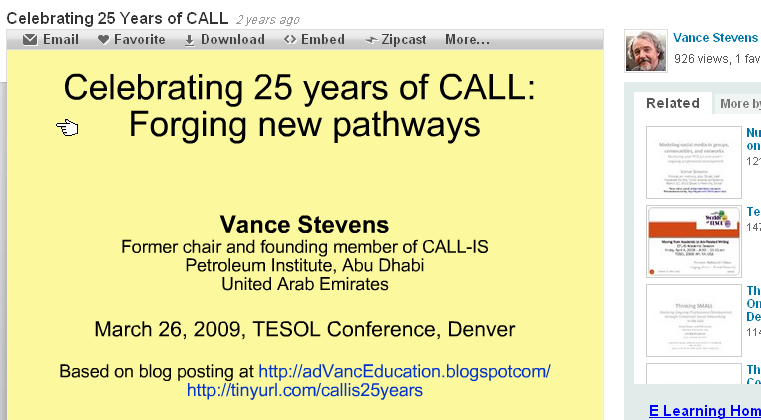
February 23, 2009 at 02:00 GMT- I was invited as a guest on It's Elementary Show #31 streamed live on the EdTechTalk Channel of the Worldbridges network with Lisa Durff, Jose Rodriguez, Maria Knee, and Alice Mercer. The program is about Self Directed Learning and Online Professional Development and I join guests Dennis Newson and Nick Noakes from EVO2009 Virtual Worlds and Language Learning. Links:
Feb 20, 2009 I gave a talk entitled "After a decade of inroads, SUCCESS in modeling blended learning in theory AND practice at F2F and online conferences" at AACE's Spaces of Interaction: An online conversation on improving traditional conferences http://aace.org/globalu/ - George Siemens's 4 min. introduction to the event: http://www.aace.org/conf/spaces/intro/player.html - Ning http://aacecommunity.ning.com/ for conversation and brainstorming before, during, and after the presentations.
My abstract: The presenter has been a long-time advocate and agitator for broadcasting online both into and out of on-site professional development events and conferences. The presenter describes inroads made during the past decade from 1999 to the present in making conferences accessible to many more than just their physically present delegates. Having debunked the myth that if conferences were open to online access on-site attendance would drop off, a case is made for the opposite scenario: that broadening channels for conversation at conference venues is a win-win situation in which everyone benefits, and conferences where these channels are blocked are the dinosaurs doomed to extinction.
- The portal for my session is archived here: http://www.editlib.org/p/30446
- The draft of my talk is here: http://tinyurl.com/aace-vance
- The slides are posted at http://www.slideshare.net/vances/success-in-modeling-blended-learning-in-theory-and-practice-at-f2f-and-online-conferences
- The presentation recording is available here: http://aace.na4.acrobat.com/p92907860/
Feb 17, 2009 at 13:00 GMT http://tinyurl.com/090217-1300 I assisted from a distance Rick Rosenberg presenting live and online from Beirut conducting a workshop on integrating technology in the classroom, designing engaged learning projects with the tools, training teachers how to develop online and multimedia teaching material, and on how to use technology in assessment. Rick invited webheads to drop by to discuss these resources at http://statedept.connectsolutions.com/amman
|
From January 2 to February 22, 2009 I moderated a session entitled Multiliteracies for Social Networking and Collaborative Learning Environments, http://evosessions.pbwiki.com/multiliteracies, co-moderated with Nelba Quinta, Doris Molero, and Jennifer Verschoor and assisted by Dennis Oliver. Our wiki is here: http://goodbyegutenberg.pbwiki.com. About this seminar: Multiliterate individuals are aware of the pitfalls inherent in technology while striving for empowerment through effective strategies for first discerning and then taking advantage of those aspects of changing technologies most appropriate to their situations. These strategies include managing, processing, and interpreting a constant influx of information, filtering what is useful, and then enhancing the learning environment with the most appropriate applications. This course seeks to heighten awareness of these considerations, and to enable participants to explore ways of dealing with them in professional and interpersonal development as well as work with students, see links below:
Some other links:
|
Presentations: 2008 - Navigate to other areas of this page
In October-November 2008 I was again involved with EVO, Electronic Village Online as a member of the http://evosessions.pbwiki.com/Coordinating_Team. I have been a coordinator since 2003, after moderating the seminal Webheads in Action session in 2002.
| Web page | 2008-2009 page |
| EVO Portal | http://evosessions.pbwiki.com/ |
| Coordinating team | http://evosessions.pbwiki.com/Coordinating_Team |
| Call for Proposals | http://evosessions.pbwiki.com/CfP |
| Moderator training | http://evo-training.pbwiki.com/ (choochoo) |
| Call for Participation, moderator profiles, and session descriptions | http://evosessions.pbwiki.com/Call_for_Participation09 |
| Tweme | http://twemes.com/evo2009 |
081109 - Leigh Blackall's Facilitating Online Communities course mounted a conference Nov 2-9, 2008. Presentations in the mini conference are listed here: http://www.wikieducator.org/Facilitating_online_communities/course_mini_conference#8Nov-7AM_GMT__Connecting_Online_in_Developing_Countries. On November 9, 2008 at 11:00 GMT - Minhaaj ur Rehman invited me "being the founder of Webheads will be highlighting the spirit of webheads and their efforts in the proliferation of ICT and CALL in ESL teaching" to be interviewed for his FOC08 course session of 30-45 mins on the topic of Webheads, its inception, development and goals.
081106 - I was invited to speak at the Network to Support Trainers in Europe’s first annual on-line conference on “the Training of Trainers” on 6 November, 2008 http://www.trainersineurope.org/files/2009/05/itb_final_conference-proceedings.pdf (pp.36-37). The organizers had four speakers in each session and the title of my contribution was Teacher professional development in groups, communities, and networks.
Abstract: At the second WiAOC conference, Etienne Wenger (2007) gave one of our keynotes and I asked him if his ideas on CoPs had changed at all as a result of his interactions with Webheads. Surprisingly, he said that they had, especially regarding the nature of space occupied by the community. He said that we knew who we were in terms of domain and practice but that we had freed ourselves from constraints on space in spanning so many available spaces in distributing ourselves, and that this was a revelation to him in that we were clearly a CoP, but with very loosely defined boundaries. At that same online conference, Stephen Downes (2007) spoke to us about the distinction between groups, communities, and networks. A YahooGroup characterizes that first level of interaction, where a group forms to disseminate information, but might not necessarily be a community. A community implies greater interaction where members are impacting one another, and a community of practice suggests that this interaction is directed toward the professional development of all concerned. For some time Webheads have considered themselves a CoP but with so many more opportunities for connectivist knowledge to be disseminated across many groups and communities (Siemens, 2004), Downes's notion of individuals interacting as nodes in a complex and interlaced distributed learning network is the one that I think best fits Webheads in its current configuration. I think this is what Etienne was getting at when he said that Webheads had freed themselves from constraints on spaces in which to meet, and thus his notion of what characterizes a CoP might be merging with the connectivist network model (Stevens, 2007).
081101 - November 1, 2008 - I joined Dafne Gonzalez and Chis Hill in Second Life. Chis was presenting live at the Ohio TESOL conference at a Technology Session: Access to Virtual Worlds: How Languages are Being Taught in Second Life, abstract: "Second Life, an internet-based, multi-user virtual world, can provide access to education via the Internet. This panel of language teachers who have taught in Second Life will discuss research, methodologies and challenges for teaching within a virtual world." My slide show for my part of the presentation is here: http://www.slideshare.net/vances/language-learning-resources-in-second-life-presentation
081009 - I adapted my workshop which was never given in Sudan to my possible appearance at the 6th International TELLSI Conference to be held at Guilan University on October 8 & 9, 2008 - http://prosites-vstevens.homestead.com/files/efi/papers/iran2008/web20workshop.htm. However, my appearance in person in Rasht was thwarted by special permission not being granted by Iran Ministry of Foreign Affairs) but we managed something live online. I was at one point listed in the program here, http://www.guilan.ac.ir/files/other/Conference_Tentative_Schedule.pdf for 09:00 - 10:30 their time on Oct 9, 5:30 to 7:00 a.m. GMT. In the end the presentation was made and blogged here: http:/tinyurl.com/iranpost and, even better, recorded and made available here: http://tinyurl.com/uae2iran
 |
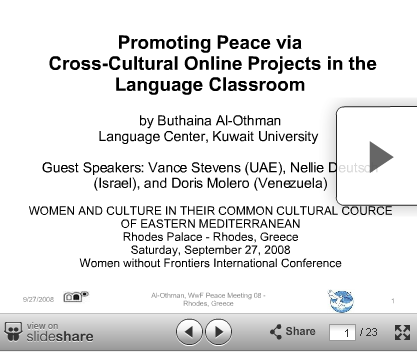 |
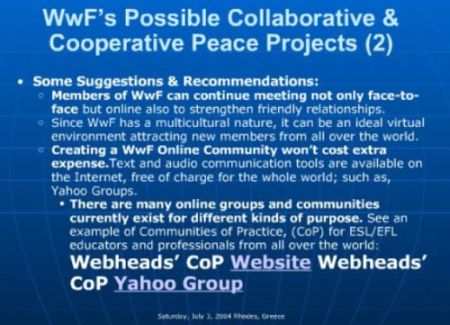
080927 - Saturday, September 27, 2008, I was invited to assist at a distance along with Nellie Deutsch and Doris Molero in a presentation given by Buthaina Alothman at the Women without Frontiers International Conference 2008, held physically in Rhodes, Greece, on September 26-28. The presentation focused on ways we can promote peace and reduce discrimination against gender, origin, religion, and color in our societies through Cross-Cultural online projects in the Language Classrooms .
080806 - At the August 6-9, 2008 WorldCALL congress in Fukuoka, Japan, http://www.j-let.org/~wcf/modules/tinyd0/. My 45 min. session on Engaging collaborative writing through social networking listed in the program as http://www.j-let.org/~wcf/docs/Web_20080728.htm was given on Aug 6 from 17:25 to 18:10 Tokyo time, http://tinyurl.com/6bjk7r; or Wednesday, August 6, 2008 at 08:15 GMT.

Nelba Quintana and I after we gave our presentation - photo by Joseph Dias
I submitted the same abstract as I did for the GloCALL 2007 conference in Hanoi the previous November, but my presentation developed as per changes noted here: Becoming Multiliterate requires changing attitudes AND practices in education. Content management through aggregation and understanding of tags and RSS is key to collaboration and control of information resources online. This presentation will explain these concepts in terms accessible to educators and then describe how the concepts were applied in a worldwide collaboration project involving bloggers in two countries in South America and one in Balkan Europe, who utilized tagging and social networking tools to enable students to locate each other's blogs and then interact with selected individuals thus identified as being of similar age and interests. This presentation went beyond previous ones by suggesting numerous sites for aggregation and mashup that can be used with students to exploit the concepts associated with the techniques demonstrated here. Nelba Quintana, one of the original Writingmatrix teachers, joined me at my session, and Rita Zeinstejer and Sasa Sirk joined in online.
Several webheads attended this conference. Some are shown in this photo, which Tom Robb (also a Webhead) annotated for mouseover. They might have been about to listen to Vera Menezes give an interesting plenary address on CALL development in the context of chaos theory and how strange attractors create butterfly effects impacting subsequent development of a field like CALL felt all around the world. For example ... imagine huge auditorium, huge screen dwarfing tiny podium with speaker on stage, who clicked on a slide on ... Webheads in Action, and another slide on Writingmatrix. Erika Cruvinel also rated her own slide and several minutes of Vera's presentation as she talked about Erika's model project sharing with Claudia's class in La Plata.
- Webheads created a Posterous blog which has been moved here: http://webheadsinfukuoka.wordpress.com/ and is associated with http://worldcall2008.blogspot.com/.
- There is also a Webheads at WorldCALL 2008 wiki: http://webheadsatwc3.wetpaint.com.
- Twitter posts have been aggregated here: http://twemes.com/worldcall08 and the preferred tag is obviously worldcall08.
- Photos are being aggregated here: http://technorati.com/photos/tag/worldcall08. For some fun use the worldcall08 as your target at http://taggalaxy.de
On May 29 I was invited by Sheryl Nussbaum-Beach to participate in an Elluminate session as a panel guest for 75 Superintendents from around Western NY who were discussin Current Internet Issues for Schools http://21stcenturylearning.wikispaces.com/Current+Internet+Issues%2C+Obstacles+and+Challenges+for+schools-+Panel+Discussion
I had been asked to help "set the stage for this discussion and brainstorm challenges and obstacles to using the Web and Web 2.0 tools (the Internet) for teaching and learning" as one of a panel of "key leaders from around the globe." This session lasted for 50 minutes and ws part of an all day workshop. URLs:
In preparation for the demise of Wikispaces July 31, 2018, I created imperfect HTML and PDF forms of backup of the Wikispaces pages here
http://www.vancestevens.com/papers/archive/Sheyrl NB Superintendent workshop.html
http://www.vancestevens.com/papers/archive/Sheryl NB 21st century learning.html
http://www.vancestevens.com/papers/archive/21stcenturylearning-SuperintendentWorkshopJMT.pdf
http://www.vancestevens.com/papers/archive/21stcenturylearning-PanelDiscussion.pdf
|
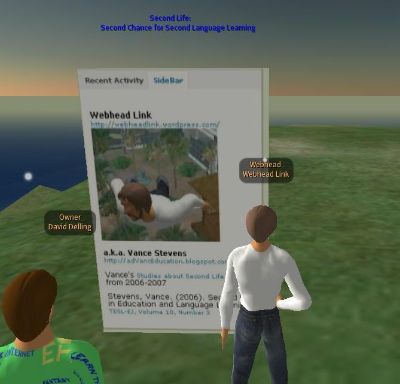
May 10, I joined David Winet and Dafne Gonzalez in Second Life in Christopher Hill's live presentation at a conference put on by the Linguistics Department at Ohio University. He introduced Second Life and talked about how SL can be / is being used in teaching. http://esl.osu.edu/staff/hill/resources/secondlife.htmlThe presentation was in the form of a panel discussion. He asked in-world panelists to give perspectives on what works well and what challenges are faced there. Chris Hill planned "to spend the first 20-30 minutes introducing SL to the audience in RL on a large projection screen, lecture-style. I'm going to show a couple of YouTube videos and then have the audience watch me navigate my avatar through SL, including the SL version of the OhioU campus, which is hosting the conference . After they're up to speed, I'll meet you at the OhioStateU island, TELRport. Some SLURLs are locked down, so use this one: http://slurl.com/secondlife/TELRport/89/211/24 This is the main entrance area of the island. We'll use SL voice chat for you to communicate with my avatar, which the RL audience will also watch on the big projection screen. You'll each have about 15 minutes, so introduce yourself and what you've done in SL. Dafne has a PowerPoint presentation http://dafnegonzalez.pbwiki.com/SL-COULD08; Dave is thinking of including a tour of interesting sites. A variety of perspectives is great. Vance will be basing his presentation on http://sl2ndchance.pbwiki.com/ |
 |
May 7, 2008 at 17:00 GMT Barbara Dieu and I participated in a CPsquare Field Trip to Webheads. Bee and I set up a wiki for it here: http://beevance.wikispaces.com/cp2. There are numerous other links posted to Webheads in Action list.
In preparation for the demise of Wikispaces July 31, 2018, I created imperfect HTML and PDF forms of backup of the Wikispaces page here
http://www.vancestevens.com/papers/archive/BeeVance_CP2.html
http://www.vancestevens.com/papers/archive/beevance-cp2.pdf
April 23, 2008, I participated in an interview with Carla Arena which she shared with her class resulting in some marvelous repercussions; e.g. http://explorations.bloxi.jp/a/vance-stevens-talks-about-abu-dhabi/. I blogged the event here: http://advanceducation.blogspot.com/2008/04/carla-arena-interviews-advanceducation.html. There is also a Voicethread, link in my gmail.
April 22 I participated in the EarthDay presentation listed as Elderbob Brannon and Jose Rodriguez "two night owls trying to connect with the world" at 5:00 a.m. GMT at http://enviroscims.wikispaces.com/Earth%20Day. There is no link to the recording from here or from http://www.edtechtalk.com/earthcast08.
In preparation for the demise of Wikispaces July 31, 2018, I created imperfect HTML and PDF backups of the Wikispaces front page here
http://www.vancestevens.com/papers/archive/2008EarthDay.html
http://www.vancestevens.com/papers/archive/2008EarthDay.pdf
The Writingmatrix team were invited to give an online presentation April 20, 2008, at http://www.instantpresenter.com/lancelotschool5 (now links to an inactive meeting). This presentation was meant to explain aggregation, tagging, and RSS with respect to filtering content online and describes how these were applied in a worldwide collaboration project involving student bloggers tagging their posts writingmatrix and then using Technorati and Del.icio.us to identify each other's posts and explore mutual interests through social bookmarking. This session was billed as a discussion with the coordinator of the project, as well as with any other Writingmatrix project participants who might join us. It then developed that the session might include other EVO session moderators apart from Writingmatrix so was asked to keep our part down to ten minutes. The announcement was but is no longer here: http://www.lancelotschool.com/Terminkalender/details/EVO-Sessions-2008---The-Writing-Matrix-or-How-bloggers-connect-their-brain-neurons or and a recording apparently never materialized.
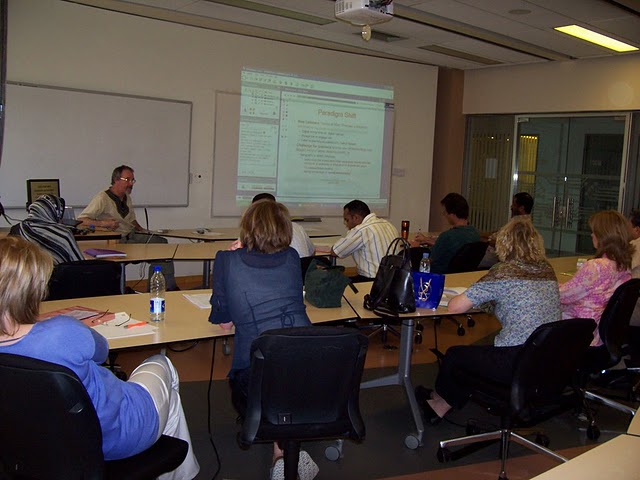
I repeated my Exeter presentation at an event April 12, 2008, 11:15 to noon in Abu Dhabi, or 7:15 to 8:00 a.m. GMT at the Abu Dhabi Men's College in Abu Dhabi. I started with a short report from the LA SIG Preconference Event in Exeter (IATEFL) which I attended briefly, I then did the larger presentation on The Multiliterate Autonomous Learner: Teacher attitudes and the inculcation of strategies for lifelong learning, "with focus in particular on the influence of teacher attitudes towards technology as it might impact autonomy in the newer generations of learners."
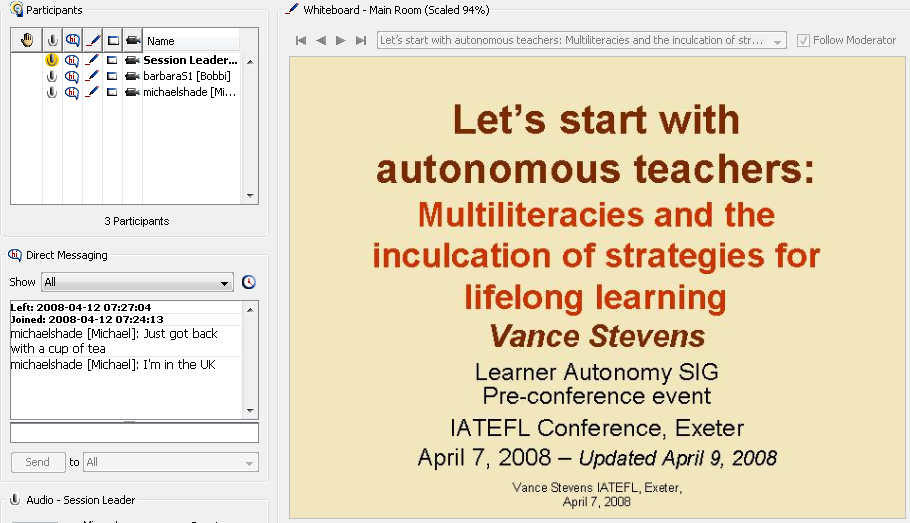
07-04-2011 On April 7, 2008 I was invited to present at the Learner Autonomy SIG Pre-conference event which was scheduled as part of the 42nd Annual IATEFL Conference in Exeter, 7th-11th April 2008. My presentation was requested as a part of the "Autonomy and the language classroom: opening a can of worms!" project, http://learnerautonomy.org/wormsindex.html. I was indicated as being 'keeper' of the Technology worm here: http://learnerautonomy.org/wormsmay2007.html, but learningautonomy.org is no longer online.
 |
I produced a paper prior to this: Stevens, Vance. (2007). The Multiliterate Autonomous Learner: Teacher Attitudes and the Inculcation of Strategies for Lifelong Learning, in Independence,Winter 2007 (Issue 42) pp 27-29. Retrieved February 17, 2008 from http://www.learnerautonomy.org/VanceStevens.pdf, but no longer available from that now-defunct site.
|
On April 4, 2008, joint proposal, number 119652, titled, "CALL and SLA: Research, Applications, and Beyond " has been accepted for the TESOL 2008 convention program. I have been asked to "be prepared to present your session on 4/4/2008 from 9:30 AM to 10:15 AM and in Gibson Suite in the Hilton." This is part of a panel discussion and it could conceivably be done online as well. Abstract: 'Technology and Second Language Acquisition evoke consternation, innovation, and excitement. From any perspective, technology has had an impact on SLA. This session investigates current research on SLA, how research translates into best practices in CALL, land how future trends in SLA and emerging technologies may effect classroom applications.' I have been asked to address Emerging Technologies. The session is listed on p.7 here: http://www.tesol.org/s_tesol/docs/convention08/AdvancedProgram.pdf. My slides have been posted to http://tinyurl.com/5tjtdy .
At this conference I also did a stand-in presentation of a workshop on Second Life for two presenters who had their workshop accepted in the EVO but did not turn up in NYC. In pulling this off I also engaged Christopher Hill and Graham Stanley to assist me live in New York, with Gavin Dudeney graciously meeting us at Edunation. We had about 30 participants and doubled them two to a computer. After explaining SL minimally, we got them to create avatars and befriend Dudeney Ge, who teleported them to his location, and got them morphing and off and running, flying, etc.
At the TESOL Arabia 2008 Conference to be held at Dubai Men's College, in Dubai, United Arab Emirates on March 13-15, 2008 I present on: Writingmatrix: Engaging collaborative writing through social networking - Abstract: This presentation explains aggregation, tagging, and RSS with respect to filtering content online and describes how these were applied in a worldwide collaboration project involving student bloggers tagging their posts writingmatrix and then using Technorati and Del.icio.us to identify each other's posts and explore mutual interests through social bookmarking.
250 word summary: Multiliteracy is increasingly recognized as being critical for student development, and requires changing attitudes AND practices. Content management through aggregation and understanding tags and RSS is key to collaboration and filtering and regulating the flux of information resources online. This presentation explains these concepts in terms accessible to educators and then describes how the concepts were applied in a worldwide collaboration project involving bloggers in two countries in South America and one in Balkan Europe, who utilized tagging and social networking tools to enable their students to locate each other's blogs and then interact with individuals whom participants identified as being of similar age and interests. To achieve this, students were encouraged to blog their interests and concerns, then tag posts with an identifier unique to the project. Technorati was used to ferret out the posts of participants in other countries. RSS feeds are generated not only by blogging individuals but by Technorati searches, and all these can be subscribed to in aggregators such as Bloglines or Google Reader. Many participants became motivated to form writing partnerships spontaneously or in projects set by teachers collaborating in the project, and engagement in the project occurred simply through tagging posts; no other coordination required. A final aspect of the project was to have students explore areas of mutual interest through tagging each other's posts in Del.icio.us, and then discern who else was reading and tagging their own posts. Positive outcomes are expressed in the voices of the instructors and students in the project.
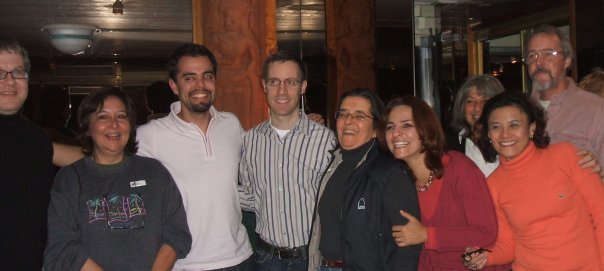
Graham Stanley, Dafne Gonzalez, Ronaldo Lima, Jonathan Finklestein, Teresa Almeida d'Eca, Carla Arena, Rita Zeinstejer, Aiden Yeh, et moi vraiment after dinner in New York City
Another pic with Carla, Jeff Lebow and his wife, Michael Coghlan, moi-meme and Jennifer Madrell: http://screencast.com/t/KWEou3Ye
I participated on February 24, 2008 in the EVO2008 Closing Ceremony with Worldbridges http://webheadsinaction.org/taxonomy/term/82
February 22, 2008 - I participated in WAOE conference in SecondLife; documented here: http://prosites-vstevens.homestead.com/files/efi/chat2008/chat2008.htm#080222
February 13, 2008, from noon to 13:15 UTC (GMT), have been invited to present online at the 4th Inter-college Conference on Technology and Multiculturalism being organized by Elaine Hoter at Talpiot College of Education, to take place in Intwise (exact URL to be announced). Title: RSS, Tagging, and Collaboration Online
Abstract: Mutual understanding, key to harmony between peoples of different cultures, is often facilitated through the leveling impact of Internet connectivity. The widest area network, the Internet, is in aggregate peer to peer, with millions of nodes which tend toward commonality in outlook and agreement on content, Wikipedia being perhaps the classic example. Interactants often initiate encounters with some degree of anonymity and are generally met with openness by other interactants. Although there can be a downside to this (predation, spam) many aspects of the Internet, subsumed under terms such as connectionism and Web 2.0, lend themselves to effective peer-to-peer learning environments with reduced affective filters. In this presentation we can look at some of these environments and see how certain characteristics of connectivity on the Internet serve to diminish cultural barriers.
RSS and tagging are key to p2p collaboration over the Internet. Tags allow people to organize the information available through their distributed networks in ways that are meaningful to them, and social networking enables nodes in these networks to interact with each other according to how these tags and other folksonomic data overlap. When productive tags are identified, then RSS is used to monitor where web artifacts using those tags are accumulating, or being aggregated. This presentation will explore some of the ways that tagging can be used productively by people wishing to locate one another in order to discover more about each other's cultural and linguistic backgrounds. The WritingMatrix project will be used as an example of how basing interaction on tagging has enabled students in various parts of the world to interact with one another in the ways suggested here. Slides: http://www.slideshare.net/vances/rss-tagging-collaboration-online-264077/ or http://tinyurl.com/2bwfuy
On February 3, 2008 I was interviewed by Anne Fox for her Absolutely Intercultural podcast, http://www.absolutely-intercultural.com/?p=76. The audio is available here: http://www.absolutely-intercultural.com/podcast/absolutely_intercultural_show_050.mp3, and Anne blogged about the event here: http://eduspaces.net/annef/weblog/267747.html
|
January 14 - February 24, 2008 - I am participating in the 2008 TESOL Electronic Village Online (EVO) http://evo08sessionscfp.pbwiki.com/ Blogging for Educators. My 'extension' activity entitled "Exploring Tagging with Vance Stevens" http://blogging4educators.pbwiki.com/Week3 is set for Week 3, January 28-Feb 3, 2008. Material for it will be drawn from this working paper: http://docs.google.com/View?docid=dr22kn2_24dpqdgg. URLs associated with B4E:
As EVO Coordination Team member, I was again involved in the organization of training of moderators for the 2008 EVO (Electronic Village Online) sessions for 5 weeks in Oct-Nov and leading up to Jan-Mar 2008 EVO sessions themselves. My responsibility was supposed to be in helping to coordinate management of the EVO Moodle: http://evo.tesol.org/moodle/ however there were no requests for use of this facility. The EVO call for proposals is here: http://dafnegonzalez.com/evo08/Cfproposals.htm and for those who responded and were accepted, the EVO moderator training wiki and syllabus is at http://evo-training .pbwiki.com/. I mentored two sessions:
|
080122080122 - Tuesday, January 22, noon UTC (GMT) - I was invited to be a guest speaker for the EVO 2008 session, Getting the Most Out of Web 2.0 for ESP, on the advantages of using tags and technorati for a community of bloggers in the ESL/EFL/ESP classroom. http://evo08esp.pbwiki.com/Week%202. The session was recorded
|
080116 January 16-19 I was a presenter in the TCC TALO Connections unConference, or Future of Learning in a Networked World 2: http://flnw.wikispaces.com/flnw2_participants FLNW2 connected TALO (Teaching and Learning Online) with FLNW2 participants on the ground in Thailand and online throughout the world between the 16th and 28th January 2008. I participated in Bangkok and Nakhon Ratchasima and recorded my impressions here http://advanceducation.blogspot.com/2008_01_01_archive.html. FLNW blogged the event here:
Michael Coghlan's pictures and podcast
Kim Cofino's pictures and blog
Other blogs:
|
Presentations: 2007 - Navigate to other areas of this page
Sunday December 23, 2007 - 16:00 GMT I was an invited guest on the Worldbridge Network Solstice 2007 Webcastathon, http://www.webcastacademy.net/solstice2007. I blogged the event here: http://advanceducation.blogspot.com/2007/12/ustream-i-stream-we-all-stream-for.html and ...
|
|
I was an invited guest on a Webcast hosted by Paul Allison, with Susan Ettenheim and Lee Baber, on Wed Dec 5, broadcast over the Worldbridges Network http://www.edtechtalk.com at 9 p.m. EST or 2 a.m. GMT Thu Dec 6. Paul maintains the blog http://www.teachersteachingteachers.org/ as an archive of the weekly show. His edit of our interview is here: http://teachersteachingteachers.org/?p=145. I put the original recording at my podcast site: http://vance_stevens.podomatic.com/entry/2007-12-11T19_13_45-08_00 |
November 23- November 25, 2007, I hosted a Knowplace event on Google Notebook, running under this byline: - "Google Notebook Location: http://knowplace.ca Google Notebook is a free service offered by Google that provides a simple way to save and organize clips of information when conducting research online. Join the webhead cat-herder, Vance Stevens as he provides his own description of the many uses of Google Notebook. You don't want to miss this one. Facilitator: Vance Stevens" - The actual course location was http://knowplace.ca/moodle/course/view.php?id=213. After the course was officially shut down at Knowplace it was archived here: http://213.42.148.233/course/view.php?id=180
I appeared at FCET, Omoku, on Nov. 21, 2007
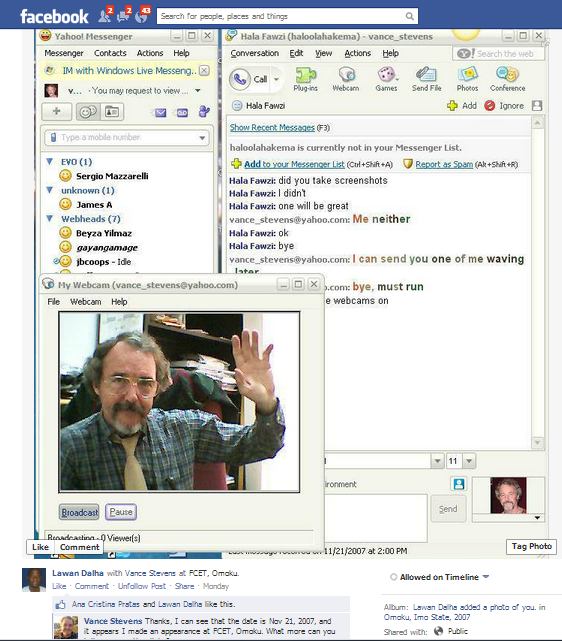
071103 - I was invited to be a Featured Speaker at GloCALL 2007, Globalization and Localization in CALL, at Hanoi University, November 2-4, 2007, http://www.glocall.org/. I gave two talks, listed in the program at http://glocall.org/program/printprog.php:
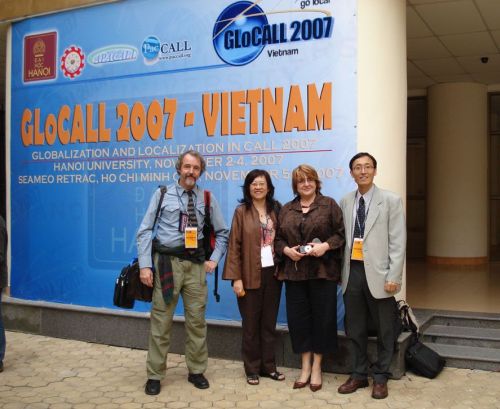 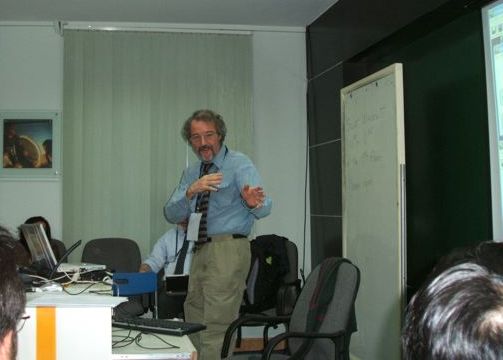 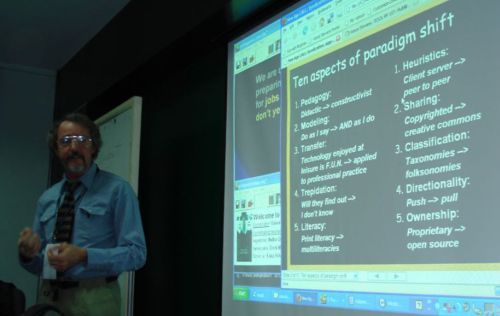 Note: When visiting the Google Docs listed at right, look for the link that allows you to view the materials without logging in, if you don't wish to sign in at Google. |
|
071020 13:00 PM GMT Saturday, October 20 was the time of our "fireside chat", on the K-12 Online Conference Live Events (Fireside chats schedule: http://k12onlineconference.org/?p=128) October 15-19 and October 22-26, 2007 - The Writingmatrix group Vance Stevens, Nelba Quintana, Doris Molero, Saša Sirk, and Rita Zeinstejer answered this CfP http://k12onlineconference.org/?p=83 and were accepted to present “Motivating Student Writers by Fostering Collaboration through Tagging and Aggregating” at the K-12 Online Conference “Playing with Boundaries,” (presenters listed here: http://k12onlineconference.org/?p=100). I also hosted an hour of the 24-hour conference wrapup, "When Night Falls" http://k12onlineconference.org/docs/k12online2007schedule.html.
Abstract: "The presenters play with boundaries through the simple expedient of having student bloggers in different countries tag their blog posts with the unique tag term writingmatrix. Searching on that tag in Technorati, the student bloggers in four locations in three different countries have managed to locate one another's posts, leave comments for one another, and have subsequently interacted in other ways as well. The presenters explain how they started the project and how it has branched into other online and even face to face activities involving the students in the participant countries. The presentation is made not only through the voices of the presenters, but with the students themselves lending their voices through their blogs and videos." Presentations at this conference are all asynchronous except for the live chat events. The presentation itself can be found at these web artifacts:
Wesley Fryer left this comment at our conference presentation node http://k12onlineconference.org/?p=162: "Wow, what a GREAT presentation on so many levels. This was the best example of a “blended” presentation I’ve ever seen," and he followed up with a podcast at http://wesleypd.blogspot.com/2007/10/pd-reflection-on-motivating-student.html. Along the lines of our presentation, more content related to the conference can be aggregated at http://www.technorati.com/posts/tag/k12online07.
|
September 10-October 7, 2007 - I facilitated the 4th rendition of my annual Multiliteracies for Collaborative Learning Environments course as part of TESOL's Principles and Practices of Online Teaching Certificate Program, which was posted on the TESOL website. The course itself is described here:
|
070928 - I participated on Friday September 28, at 9 pm GMT in Rita Zeinstejer's presentation on "Emerging Technologies for EFL Teachers and Students: the Web 2.0 and its possibilities" http://ritaz.pbwiki.com/CollaborativeTechnologies using Learning Times Elluminate http://tinyurl.com/y3eh - Rita's presentation to teachers in Argentina intended to encourage us to "say something about your own experiences using any social software with your students--blogs, wikis, Google maps, Flicker...--, live for the audience for about 5 minutes ... My idea is showing a VERY simple ppt and providing precise concepts and examples not to overwhelm the web-phobics, but to give them a view of how life for educators has definitely changed as from the advent of Web 2.0, which I'm also going to define very briefly and in a simplified way. Your live presence would be GREATLY appreciated, since that is definitely the best way to produce a consciousness-raising impact on our teachers" My slide presentation was here: http://www.slideshare.net/vances/vance-stevens-28-sept-2007/.
070905 I was invited to present online at the EuroCALL conference on 8 September from 11:15-12;00 in Coleraine, Northern Ireland (10:15-11:00-- GMT) as a featured online presenter in the Virtual Strand which includes streamed presentations from the conference, and conference blog and chat space, in addition to a limited number of invited, interactive, online presentations lasting approximately 40 minutes My paper entitled Mastering competencies for collaboration and aggregation in distributed learning networks can be accessed as indicated below. Registered delegates are expected to read the text in advance, so that during the presentation itself, I will join delegates in a chat room on a Blobber-enabled web-page for discussion and questions.
Here is the abstract:
This talk begins by discussing terms in the title, especially 'aggregation' and 'distributed learning networks'. Regarding the latter, Downes and Siemens are strong proponents of the notion that functionality of networks is of prime importance to the knowledge embedded there, and therefore accessing this knowledge is key being able to utilize and develop the knowledge within the network. We look briefly at Web 2.0 and some impacts on education, and especially at how knowledge is organized there in folksonomies as opposed to taxonomies, and finally at heuristics aimed at aggregating this knowledge. We then apply these concepts to techniques specific to second language learning.
My colleagues and I have implemented interesting experiments in applying aggregation techniques in the teaching of writing, and its counterpart reading. These colleagues are not my institutional ones, but those in my distributed (online) communities of practice, who comprise a significant part of my distributed learning network. These colleagues and I conceived the Writingmatrix project, which became our means of learning how to aggregate content (what the students were writing) via tags (a prime element in folksonomies).
The remainder of the talk explains how students posting in blogs throughout the world used the tag 'writingmatrix' to make their postings visible to others in the project, and how similar techniques can be used to promote collaboration among students around the world and motivate them to read each other's postings, comment, formulate responses, and form partnerships conducive to learning outcomes. It is stressed that understanding the concepts is key to making the paradigm shift leading to opening minds to the transformational potentials inherent in connectivity facilitating interchange across the Web 2.0. Such notions impact reading, writing, and thinking, in CALL contexts worldwide, and enable applying these concepts to one's own language learning projects.
- My presentation links
- Start with the Pageflakes portal: http://www.pageflakes.com/vancestevens/13493912
- From there find the 'paper' , prose version: http://www.homestead.com/prosites-vstevens/files/efi/papers/eurocall/coleraine2007.htm or ...
- Tiny URL: http://tinyurl.com/3ym7mv
- SnipURL: http://snipurl.com/eurocall2007vs
- Read and explore and post comments in the wiki sandbox:
In preparation for the demise of Wikispaces July 31, 2018, I created HTML and PDF forms of backup of http://eurocall2007vs.wikispaces.com:
http://www.vancestevens.com/papers/archive/2007eurocall_vs.html and
http://www.vancestevens.com/papers/archive/eurocall2007vs-home.pdf
- The Worldbridges Skype stream was here:
- http://www.webcastacademy.net/listen
- The presentation is described at http://www.webcastacademy.net/node/1325
- And links to the podcast recording here: http://vance_stevens.podOmatic.com/entry/2008-06-24T06_38_06-07_00
- Text chat is available via or alternatively
- the Blobber tabs at http://eurocall2007.blogspot.com/
- http://www.webcastacademy.net/chat
- Virtual Strand presentation links
- http://vsportal2007.googlepages.com/home
- Then click on Vance Stevens to arrive at http://vsportal2007.googlepages.com/masteringcompetenciesforcollaborationand
- This will take you to my PageFlakes portal: http://www.pageflakes.com/vancestevens/13493912
- If you sign up for the discussion list, messages are here: http://groups.google.com/group/VSChatEuroCALL2007/
- Other Virtual Strand links
- The EuroCALL conference site: http://www.eurocall2007.com/
- The Virtual Strand page: http://www.arts.ulster.ac.uk/eurocall/conference_format/virtual-strand/index.html
- EuroCALL Virtual Strand 2007 Google Group portal: http://vsportal2007.googlepages.com/
- Presentation schedule: http://vsportal2007.googlepages.com/presentationschedules
- My presentation link from the above page: http://vsportal2007.googlepages.com/masteringcompetenciesforcollaborationand
- The Virtual Strand blog is here http://eurocall2007.blogspot.com/
- You reach the Blobber live text chat by visiting http://eurocall2007.blogspot.com/ (only works with IE) and then clicking the tabs at the upper left of the page
|
070831 - - Through a recommendation on Jay Cross' Internetime Ning, I was invited to speak in the second 20 min talk in a session taking place from 9:00 a.m. to 10:45 (so, about 9:30 Egypt time) on 31 August, in session 3 of the "New Learning for Sustainability in the Arab Region" meeting 30 August - 1 September 2007 at the Alexandria Library, in Alexandria, Egypt. The event is subtitled "Motivating Change: New Learning in Formal Education for Sustainable Development", and the conference seeks regionally-based experts working in informal learning, web 2.0, active bloggers, etc. (The organizers' blog is here: http://www.welearnsomething.com). My presentation is written out here: http://www.homestead.com/prosites-vstevens/files/efi/papers/2007alexandria/web20arabia.htm; TinyURL: http://tinyurl.com/398bnw 070901 -I had originally been offered an opportunity to mount a poster session at the parallel New Marketplace at New Learning for Sustainability exhibition (with wireless, available). My idea was to use the wireless to demonstrate some of the tools we use in Webheads and Worldbridges Webcast Academy. This resulted in my eventually being offered an additional slot for a workshop on Saturday Sept 1, 9 a.m to 11:30 a.m. in Egypt (06:00 to 08:30 GMT) on: F.U.N. Fare - UnWorkshop on Computer Mediated Communications Tools for Distributed Social Learning Networks: The two convergent communities of practice Webheads in Action and Worldbridges are constantly exploring new computer-mediated communications (CMC) tools for percolating knowledge through their overlapping distributed learning networks, many of which take on many properties of social networking. Members of those communities will be invited to join us online, and the (un)workshop will take place informally, without fixed agenda, in response to the direction suggested by the online participants and those present in Alexandria. Among the spaces we can explore (more to be added as they occur to me) are:
|
070811 I was invited to teach a short course on writing on the Internet 11th-13th July during the XXVI Summer Courses of the University of the Basque Country in San Sebastian, Spain. The course is entitled "Learning to write in a global and plurilingual world" and my part is to give 3 talks (60' exposition + 15' debate) on Internet (Electronic writing, On-line learning to write, Electronic approach to language learning -focus on writing). There is more information about the university and these courses here: http://www.sc.ehu.es/cursosverano. In order to have something to talk about I instigated a writing project here: http://writingmatrix.wikispaces.com/ (now being migrated to http://writingmatrix.pbworks.com/). I created a course portal here: http://www.vancestevens.com/writing.htm. The Moodle portal for this event hosted in Taiwan at http://www.opensource.idv.tw/moodle/course/view.php?id=46 is no longer available. I also wrote out the text of each lecture, uploaded the slides, and left recordings of the lectures themselves as follows:
070518 The Webheads in Action Online Convergence was held May 18-20, 2007. http://wiaoc.org, with archived presentation details at http://schedule.wiaoc.org and http://www.webheadsinaction.org/wiaoc2007. I planned and coordinated the conference, and participated in two presentations:
May 13, 2007 - I may have put in an Ed Tech Weekly appearance on this date; link to the recording: http://www.edtechtalk.com/node/1628
070421 I was invited to present a workshop (2 hours) at the TTTT (TESOL Arabia Abu Dhabi chapter Tactile Tasks and Technical Tips 5) at the Petroleum Institute, Abu Dhabi on April 21, 2007 on Writing in a flat world: better blogging through social networking. It was presented in conjunction with the writing course I am giving in Spain this summer for which I started a project with a number of teachers worldwide - http://writingmatrix.wikispaces.com (being migrated to http://writingmatrix.pbworks.com/, among them Rita Zeinstejer, who assisted from Argentina via Elluminate. The Moodle portal for this event, hosted by Venny Su in Taiwan at http://www.opensource.idv.tw/moodle/course/view.php?id=46, is no longer available.
The workshop covered:
|
|
070414 I was invited by Ankara University Development Foundation Schools, to be a Plenary Speaker at the annual ELT Conference held at the ATAUM Conference Hall, in Ankara, Turkey on April 14, 2007. The theme of this conference is "CALL (Computer Assisted Language Learning) – Technology CALLs You". The title of my talk is "What is CALL? It's YOU!" (derived roughly from my blog posting from Sunday, April 1, 2007 What is CALL: Computer Assisted Language and Literacy as well as from Webheads chat logs from October 29-Nov 3, 2001).
URLs provided by the organizers:

I was invited to participate in a 1 hour - 45 min. Colloquium entitled: "CALL IS Electronic Village Online Communities" held on March 21, 2007 at the international TESOL Convention in Seattle, Washington State Conv Center/Room304 Hall C 8:30am ~ 10:15am PST. The event was Skypecast and the recording is posted at http://www.webheadsinaction.org/node/154.
On-site and distance presenters created a wiki for it. In preparation for the demise of Wikispaces July 31, 2018, I created HTML and PDF forms of backup of the colloquium portal here http://colloquium07.wikispaces.com, with:
http://www.vancestevens.com/papers/archive/2007 Seattle EVO Communities.html
http://www.vancestevens.com/papers/archive/colloquium07-home.pdf
and of the presenters' page, here http://colloquium07.wikispaces.com/presenters, with:
http://www.vancestevens.com/papers/archive/2007SeattleColloquiumPresenters.html
http://www.vancestevens.com/papers/archive/2007SeattleColloquiumPresenters.pdf
and of my presentation, Making it through Bootcamp, here http://colloquium07.wikispaces.com/Vance+Stevens, with
http://www.vancestevens.com/papers/archive/2007 Seattle EVO Communities VS.html
http://www.vancestevens.com/papers/archive/colloquium07-VanceStevens.pdf
and have placed my slide show version here: http://www.homestead.com/prosites-vstevens/files/efi/papers/tesol/2007seattleEVO/00.htm
I gave my talk on the potential for education of the MUVE Second Life at the METSMaC conference in Abu Dhabi, http://metsmac.org March 18, 2007 in an oral presentation entitled "Second life and online collaboration through peer to peer distributed learning networks" March 18. The draft of the paper I submitted for the proceedings can be viewed here: http://www.homestead.com/prosites-vstevens/files/efi/papers/metsmac/metsmac_secondlife.htm, and the published version is here: http://www.homestead.com/prosites-vstevens/files/efi/papers/metsmac/Stevens-METSMaC-2007.pdf. An annotated rendition of the slides presented at this talk appears here: http://www.homestead.com/prosites-vstevens/files/efi/papers/tesol/arabia2007/00.htm
I presented at the TESOL Arabia 2007 Conference in Dubai, United Arab Emirates http://tesolarabia.org/conference/ on March 17, 2007. My talk was entitled "Second Life and collaboration in distributed learning networks". As my 'handout' I gave out the link to my Studies in Second Life. An annotated rendition of the slides presented at this talk appears here: http://www.homestead.com/prosites-vstevens/files/efi/papers/tesol/arabia2007/00.htm
January 21, 2007 - I was invited to give a short talk on the topic of "Benefits of using computers and technology in teaching: Focus on language teaching" by a company called Senaco, who asked me to speak at a meeting of its sales and technical staff in Abu Dhabi. I put the text from the PowerPoint slides up at my blog: http://advanceducation.blogspot.com/, and I recorded the talk and placed it at my pod-blog GeekSpeek: http://vance_stevens.podomatic.com/entry/2007-01-21T12_33_59-08_00.
January 15-February 25, 2007 I am co-moderating the EVO rendition of the Webcast Academy Class of 2.1 http://webcastacademy.net/EVO2007 . The EVO sessions homepage is here: http://evo07sessions.pbwiki.com/. The Webcast Academy syllabus and other information are here: http://evo07sessions.pbwiki.com/webcast-academy. I am tracking my work in this endeavor at my page Tackling the Webcast Academy <-- here.
Presentations: 2006 - Navigate to other areas of this page
As EVO Coordination Team member, I was involved as usual in the organization and training of moderators for the 2007 EVO (Electronic Village Online) sessions taking place prior and leading up to Jan-Mar 2007 http://dafnegonzalez.com/evo-07/Cfproposals.htm. My evolving responsibility is helping to coordinate management of the EVO Moodle: http://evo.tesol.org/moodle/. The planning wiki was at http://evo-07- coord.pbwiki. com/ and the EVO moderator training wiki and syllabus was at http://evo-training .pbwiki.com/
I presented at GLD X - Global Learn Day 10 - Sunday October 8 - for the program of the Gulf Region http://tinyurl.com/gszbs The GLD timetable is here http://www.bfranklin.edu/gldten/. My page is here http://ben300.com/GLDTEN/?p=39. My presentation is here:http://www.homestead.com/prosites-vstevens/files/efi/papers/tesol/ppot/2006antwerp/gld10_vance.htm and I made a recording and posted it on my podblog at: http://vance_stevens.podomatic.com/player/web/2006-10-07T13_43_28-07_00
September 11-October 8, 2006 - I taught my third annual rendition of PP 107: Multiliteracies for Collaborative Learning Environments, description at http://snipurl.com/ppt107_2006.. The course is described on the TESOL website at http://www.tesol.org/s_tesol/sec_document.asp?CID=664&DID=2642. Major changes in the newly revised course include greater reliance on blogged and podcast materials for examination of evolving literacies, with participants sharing artifacts they create such as summaries of recordings, their personally aggregated rss feeds, and their own blogs and podcasts. I am articulating the focus of the revised course in my presentation given virtually via recorded video at the 12th International CALL Research Conference: How are we doing? CALL & monitoring the learner, DIDASCALIA, University of Antwerp Language Institute 20-22 August 2006: http://tinyurl.com/vance2006antwerp. I prepared a print-literacy wrap-up in my On the Internet column in TESL-EJ (Electric Online Journal) here: http://www.tesl-ej.org/ej38/int.html. The Moodle portal for this event hosted in Taiwan at http://www.opensource.idv.tw/moodle/course/view.php?id=23 is no longer available.
Note, the shortened snipURL given iin the presentation no longer works, so I changed it to TinyURL. If you click on the TinyURL links here you will reach the page in its original location http://www.homestead.com/prosites-vstevens/files/efi/papers/tesol/ppot/2006antwerp/2006update.htm
August 22, 2006 - I presented virtually via recorded video at the 12th International CALL Research Conference How are we doing? CALL & monitoring the learner, DIDASCALIA, University of Antwerp Language Institute 20-22 August 2006, more information at DIDASCALIA Research Centre: http://www.didascalia.be. The annotated text of my presentation can be found here: http://tinyurl.com/vance2006antwerp. The video of the presentation can be seen here (55 kbps) and at better quality here: http://blip.tv/file/62861 (521 kbps). I received this feedback from Jozef Colpaert: "Your presentation was shown to some 15 people and was well received. We had a discussion afterwards on learner freedom versus teacher guidance in Web 2.0-based learning environments and associated constructivist approaches."
On July 6, I presented in French (from my mom's home in Houston) as part of a presentation hosted by Jean Michel Chaupart from France in conjunction with a congres in Paraguay. The event was la conference internationale pour professeurs de francais latinoamericains – XIVe.SEDIFRALE que a eu lieu le JEUDI 6 JUILLET, entre 20 heures et 21heures 30 GMT, sur la plate-forme de conference : http://www.portafolio.org/conference.htm qui supporte la voix + image webcam + presentation de pages web. Les diapositives sont disponibles pour consultation a l'adresse suivante: http://www.cimted.org/carrusel/sedifrale/. For the text of my presentation in French, click here
June 23, 2006 - I was interviewed via podcasting on my views on various aspects of consulting. The interview was conducted by ElderBob Brannan and posted on one of his blogs, Rebuilding Indianola, at: http://rebuildingindianola.blogspot.com/2006_06_23_rebuildingindianola_archive.html. The recordings are at the links below:
April 20 I presented on Effective Strategies toward Multiliteracies for Collaborative Learning at The Language Centre 6th Annual ELT Conference, Language Learning in the Cyber Age: Innovations and Challenges 19 – 20 April 2006 Sultan Qaboos University, Muscat, Oman http://www.squ.edu.om/lan/index.html. I used Learning Times / Elluminate at http://tinyurl.com/y3eh to webcast it, and I placed the handout with links to the PowerPoint slide show, URL playlist of the presentation from here: http://prosites-vstevens.homestead.com/files/efi/papers/tesol/ppot/multilit2006.htm or http://tinyurl.com/m4ow6.
On March 30, 2006 at 3:30 PM in Dubai (11:30 a.m. GMT) I gave a talk entitled Effective Strategies toward Multiliteracies for Collaborative Learning at the12th International TESOL Arabia Conference March 29-31, 2006 in Dubai, UAE http://tesolarabia.org/conf2006/. 50 word abstract: This presentation deals with the topic of multiliteracy, the importance of including multiliteracy skills in designing almost any modern curriculum, and how teachers can develop strategies to become more multiliterate themselves and thus be better equipped to pass on these skills to their students through multiliteracy components in curricula. My handout is here: http://prosites-vstevens.homestead.com/files/efi/papers/tesol/ppot/multilit2006.htm or http://tinyurl.com/m4ow6. The conference schedule is here: http://tesolarabia.org/conf2006/speakers/ta2006schedule.pdf. My talk was listed as being at 3:30 a.m in Dubai on this document: http://tesolarabia.org/conf2006/speakers/2006ConcurrentSpeakers.pdf
I webcast at Learning Times http://tinyurl.com/y3eh from the METSMaC 2006 “Making Connections” at 9:30 a.m. in Abu Dhabi, 16 March 2006 at the Beach Rotana & Towers Hotel Abu Dhabi United Arab Emirates on Effective strategies for applying multiliteracies in collaborative learning environments by Vance Stevens Foundation Computing, Petroleum Institute, Abu Dhabi, United Arab Emirates. http://prosites-vstevens.homestead.com/files/efi/papers/tesol/ppot/multilit2006.htm or http://tinyurl.com/m4ow6
Abstract: Multiliteracy is an important aspect of almost any curriculum nowadays. Teachers and students with good multiliteracy skills have a workable grasp of the many ways that technology intertwines with academic life, and are in position to actively gain control over those aspects directly impacting the learning environment and their professional development. Multiliterate individuals are aware of the pitfalls inherent in technology while striving for empowerment through effective strategies for first discerning and then taking advantage of fast-changing technologies by adapting those most appropriate to their situations. These strategies begin with managing, processing, and interpreting a constant influx of information, filtering what is useful, and then enhancing the learning environment with the most appropriate applications.
This presentation discusses effective approaches and strategies for responding to technology issues in the academic environment. It overviews tools and skills that help cope with information overload and discusses means of communication and interaction in Internet 2.0 environments, including using social networking, RSS, video, web cam, image, and voice technologies to gain familiarity with these tools and their applications in teaching through communities of practice which in turn model collaborative, constructivist learning settings.
It is hoped that teachers will leave this presentation with a greater awareness of the potentials of Internet 2.0 in the enhancement of optimal learning environments, and with some idea of a strategy that they might pursue to learn more about the topic, thus enhancing their own awareness of multiliteracy skills and how they might include these in curricula they develop for students
Robert "Elderbob" Brannan, Buthaina Al Othman, and I conducted a session for the TESOL / Electronic Village Online (EVO2006) sessions Monday, January 16 - Sunday, February 26, 2006 entitled Establishing and maintaining 'Web presence' Part 2: The Moodle. The proposal is here: http://sites.hsprofessional.com/vstevens/files/efi/papers/tesol/evo2006/gvs2006proposal.htm. The link for the sessions is http://webpages.csus.edu/~hansonsm/announce.html and the link from there to this session is http://webpages.csus.edu/%7Ehansonsm/WebPresence.html
Tuesday February 14th I present from a distance at the invitation of Gavin Dudeney a talk entitled "Webheads: Communiities of practice in action" at a conference entitled ICT in ELT: putting the 'Learning' back into 'E-Learning' held face to face at the Manchester Conference Centre, 12-17 February 2006: http://www.britishcouncil.org/seminars-english-0563.htm. I gave a presentations at 10:00 GMT to the following specs: "Participants are all interested in ICT in ELT, on a teacher, traner and a ministry level and come from a wide variety of countries around the world. They will have seen a bit of group CoP theory, and looked extensively at Yahoo Groups beforehand. They will also have discussed, a little, what makes a good group. What I'd like you to do is present Webheads, a bit of history, what it does, how it has evolved and why they should probably think about joining it. Some nice anecdotes, practical experiences or whatever, and a look at the kind of courses you do, the Convergence, etc." Prior to the presentation there was lively interaction at the remote conference Moodle: http://www.britishcouncilinteractive.tv/moodle/course/view.php?id=5 . My presentation was recorded at Learning Times http://home.learningtimes.net/learningtimes?go=1122376 but the recording is no longer available online when you click Enter Here to play it. The Powerpoint slides are here
Presentations: 2005 - Navigate to other areas of this page
I organized and coordinated the WiAOC 2005: Webheads in Action Online Conference: Bridges across Cyberspace Friday and Saturday, November 18 - 19, 2005 and Convergence wrap-up Sunday November 20 http://www.wiaoc.org/. I was on a panel and gave a stand-alone presentation at this conference; replay here: http://schedule.wiaoc.org. The Moodle portal for this event hosted in Taiwan at http://www.opensource.idv.tw/moodle/course/view.php?id=20 is no longer available.
TESOL Arabia Abu Dhabi Chapter, IL SIG & Al Hosn University Present 4 Computer Workshops & Presentations At Al Hosn University, Abu Dhabi Thursday 17th November, 2005 10.00am - 12:30pm . My presentation discusses the WiAOC 2005: Webheads in Action Online Convergence that features guest speakers Curt Bonk, David Nunan, Dave Sperling, Randall Davis, and Joy Egbert. The conference is free and entirely online from November 18-20. Vance is coordinating on behalf of Webheads. He will explain what goes into putting on a conference like this, and suggest how students might organize their own conferences along similar lines. If you are interested in this event, come to Vance’s presentation and find out more here: http://www.vancestevens.com/papers/evonline2002/convergence2005.htm . The Moodle portal for this event hosted in Taiwan at http://www.opensource.idv.tw/moodle/course/view.php?id=20 is no longer available.
Oct. 31 - Nov. 7, 2005 - I am involved as Coordinator and TESOL Professional Development Liaison in the (TESOL) Electronic Village Online 2006 Sessions http://webpages.csus.edu/~hansonsm/How_EVO_differs.html; http://webpages.csus.edu/~hansonsm/What_is_EVO.html. Buthaina Alothman, Nicolas Gromik, and I are conducting the training during Week 4 of the moderator training sessions taking place Monday, October 10 - Sunday, November 14, 2005. The scope of our segment is to help moderators Refine their YG & syllabus based on readings - Explore advanced features of YG (or their own CMS) as described in Buthaina.s message here: http://groups.yahoo.com/group/EVO_Moderators/message/1830. My own contrbution is in helping moderators learn about voice presentation tools. Buth has created a portal for this effort here: http://alothman-b.tripod.com/evonline_voicechat_tools.htm
September 12 to October 9, 2005 (and again September 11-October 8, 2006): My online course, PP 107 Multiliteracies for Collaborative Learning Environments http://sites.hsprofessional.com/vstevens/files/efi/papers/tesol/ppot/portal2005.htm, was scheduled for the TESOL Principles and Practices of Online Teaching Certificate Program, http://www.tesol.org/edprg/olw/ppcp/index.html. The abstract is somewhat changed from the course I taught in 2004; e.g. addition of required textbook: Course-specific requirements: Internet Explorer 6.0, sound card, some means of reading/accessing and composing/sending e-mail, course text: Selber, Stuart. (2004). Multiliteracies for a digital age. Carbondale: Southern Illinois University Press. The Moodle portal for this event hosted in Taiwan at http://www.opensource.idv.tw/moodle/course/view.php?id=23 is no longer available.
A multiliterate teacher understands the many ways that technology interacts and intertwines with academic life, and actively learns how to gain control over those aspects impacting teaching and professional development. Multiliterate individuals are aware of the pitfalls inherent in technology while striving for empowerment through effective strategies for first discerning and then taking advantage of those aspects of changing technologies most appropriate to their situations. These strategies include managing, processing, and interpreting a constant influx of information, filtering what is useful, and then enhancing the learning environment with the most appropriate applications. This course
- models effective approaches and strategies for responding to technology issues in the academic environment
- provides opportunities for expansion of technical skills required for coping with information overload
- utilizes video, web cam, image, and voice technologies in communicating through communities of practice which in turn model collaborative, constructivist learning settings.
Topics covered include:
- Mechanics of an online community
- What is multiliteracy?
- How multiliteracies apply to collaborative learning environments
- Managing information
- Theoretical framework for multiliteracies
- What kinds of multiple literacies are there?
- More detailed examinations of
- functional literacy
- critical literacy
- rhetorical literacy
|
Sat April 30 at 07:00 a.m. GMT I was invited to address an audience virtually at the Qatar Teachers English Network Conference (QTEN) conference in Doha, Qatar and was listed in the conference program as appearing Saturday, in room C107 in the Liberal Arts Building in the Qatar Foundation though physically present in Abu Dhabi: Blogging in online communities of practice: Impact on language learning and teacher professional development abstract: "Blogging is an Internet phenomenon with significant impact on both language learning and teacher professional development, It is now possible for students AND teachers to create their own web pages in minutes and, with minimal guidance, extend these to more elaborate web sites. This workshop will guide participants in creating and developing their own blog sites, and illustrate and discuss ways that blogs can be configured to create authentic, interactive, communicative, reflective, creative, and motivating learning environments that engage students and provide a means for teachers to further their ongoing professional development." http://prosites-vstevens.homestead.com/files/efi/papers/qten2005/vancestevens2005qten.htm The session was recorded and is here: http://home.learningtimes.net/learningtimes?go=805285. Incidentally, the slide presentation explaining how to create a blog in Blogger was updated in April 2007 and is available here: http://www.homestead.com/prosites-vstevens/files/efi/blogger_tutorial.htm At right, in my capcity as Amideast consultant in one of the classroms at the MLI, with furniture which we ourselves designed, January 2000 |
 |
On Wednesday April 27 at 07:20 GMT (11:20 in Abu Dhabi) I presented on "Online Webcast: Computer mediated communications tools used with teachers and students in virtual communities of practice" at METSMaC–I The First Annual Middle East Teachers of Science, Mathematics and Computing Conference “Strategies for Effective Learning in the Middle East” 26 to 28 April 2005 at the Armed Forces Officers' Club and The Petroleum Institute in Abu Dhabi, UAE http://metsmac.org. Further information on the presentation can be found here: http://www.homestead.com/prosites-vstevens/files/efi/papers/tesol/arabia/metsmac2005gvs.htm
I gave an online 2-part workshop at The Petroleum Institute in Abu Dhabi UAE Tactile Tasks and Technical Tips Event for the Learner Independence and IT SIGs of TESOL Arabia April 14, 9:00 - 13:00 in Abu Dhabi. The presentation is at: http://www.homestead.com/prosites-vstevens/files/efi/papers/tesol/arabia/tttt2005/blogging_now.htm or http://tinyurl.com/3jc5o. The workshop was in two 1 hour blocks starting around 05:00 GMT . The two parts were on starting blogs, and the second hour got into what to do with them (e.g. how to use them as portals to learning communities such as that at http://webpres2005.buzznet.com . (More info about the past TTTT events can be found at http://ilearn.20m.com/pasteventsb.html#tttt)
|
At the TESOL 2005: The 39th Annual TESOL Convention and Exhibition March 30-April 2, 2005 San Antonio, Texas, USA - http://www.tesol.org. Online participants were encouraged to participate in these events at http://www.tappedin.org, http://www.alado.com/webheads, http://www.tinyurl.com/y3eh, and at Yahoo Messenger for web cams of multiple participants.
|
|
Tuesday, March 15, 2005 at 17:00:00 GMT: I was invited to give a voice-enabled virtual presentation for the Horizon Wimba Desktop Lecture Series, an entirely free, online presentation series in which experts in the field of higher education give hour-long interactive presentations, live over the internet via the Horizon Wimba OpenCampus virtual classroom. The bi-line on the session from the HWDLS website was: "Building Community Among Educators: Webheads is an ongoing 'experiment in world friendship through online language learning' whose participants have been meeting weekly online since 1998. During that time, Webheads have experimented with numerous synchronous and web-based multimedia communications formats, and presented at several live and online conference venues." The text and graphics of the talk are here: http://www.homestead.com/prosites-vstevens/files/efi/papers/horizonlive/2005mar15vance.htm. As of March 16 the talk is still listed as an upcoming one: http://www.horizonwimba.com/community/upcoming.php, but a recording should soon appear in the archives here: http://www.horizonwimba.com/community/archived.php; or here: http://lecture.horizonwimba.com/launcher.cgi?channel=stevens_2005_0315_1202_45
I conducted an online training session on Web presence for the Electronic Village Online 2005 Sessions, Monday, January 17 - Sunday, February 27, 2005 [6 weeks]
Friday Feb 25, 2005 15:00 to 16:00 GMT: At the Knowtips Conference http://knowtips.ca I was part of an online panel presentation entitled: Webheads – Intuitive chaos management in online collaborative interaction http://wiaknowtips.buzznet.com/. Presentation description: "Webheads in Action With Susanne Nyrop, Vance Stevens, Dafne Gonzalez, Sergei Gridushko. Webheads in Action (WiA) is a robust community of educators worldwide. Active WIA participants bring evidence of strong bonds of online collegiality and loyalty, while questioning and reflecting critically upon our experiments, tinkering with free communication tools and environments. During the Knowtips conference, we'll engage in storytelling and discussion about such shared experiences. Join our narrative inquiry on how to help each other, moving from novice to practitioner to domain experts by inclusive participation, peer scaffolding and inspiration." My part of the presentation is entitled: The intuitive chaos manager as cat herder: Helping others to have F.U.N. navigating simplexity while developing cohesion in communities of practice online and the presentation itself can be found here: http://www.homestead.com/prosites-vstevens/files/efi/papers/horizonlive/2005feb25whjam.htm or via its link in the presentation blog http://wiaknowtips.buzznet.com/user/?id=983482
This was scheduled for Feb 14, 2005, at 8:00 GMT but has been postponed due to technical problems. I was invited to participate in a presentation Buthaina Alothman was delivering before executive managers and employees of the Kuwait Petroleum Corporation, (KPC) http://www.kpc.com.kw/index2.htm, in conjunction with her work as technology consultant with HRD, Int. specialising in training programs for workers at both the private and public sectors. Presentation title: E-Learning in the Age of Information Technology: http://alothman-b.tripod.com/hrd_kpc_wia_mvpresentation.htm.The presentations were to be held here: https://www.virtexc3.com/clients/kuwaituni/. I was to elaborate on the concept of e-learning & successful/effective learning environments for e-learning from his perspective and experience as the founder/leader of several online communities, (for ESL/EFL educators, teachers, and learners), like Webheads in Action, with focus on Managing at a distance and The role of collaborative e-learning to enhance performance and to increase productivity of groups and sub-groups; (e.g. the Webheads in Action and Writing for Weheads CoPs for teachers and students from his perspective as the founder and owner/moderator). The text of my presentation can be seen here.
Tuesday, February 8, 14:00-15:00 GMT, at Learning Times http://www.tinyurl.com/3yeh: Teresa Almeda d'Eca and Vance Stevens gave a joint session as guest speakers in the TESOL sponsored EVOnline 2005 course entitled, The Use of Blogs in ESL/EFL http://groups.yahoo.com/group/weblogging/. The topic was: Blogging Beyond Text and is now listed as "Jam session: Adding Sounds and Photos" http://www.beewebhead.net/Evo05/week.htm. My presentation is here: http://webpres2005.buzznet.com/user/?id=871727. It explains how the links are achieved in your blogs, through postings and comments to each other's postings.
Presentations: 2004 - Navigate to other areas of this page
Thursday, Dec 16, 2004 - At an event sponsored by the TESOL Arabia - Teacher Education SIG, held at the British Council, Abu Dhabi, 9:30 to 12:30 (05:30 to 08:30 GMT), Vance Stevens gave a workshop Communities of Practice for Ongoing Online Teacher Professional Development for Teacher Educators and K-16 teachers interested in collaborative networking in Teacher Education. Handout: http://sites.hsprofessional.com/vstevens/files/efi/papers/tesol/evo2005/webpresence.htm and abstract:
Students and teachers are increasingly meeting online to explore ways of using the latest free communications technologies that promote language learning and teacher training. These technologies include synchronous text, voice, and web cam -enabled chat services that are educational in nature as well as asynchronous tools such as blogs, groupware, and open source applications like Moodle. Accordingly it is becoming important for teachers to establish a Web presence in order to participate in robust online communities which often influence how these teachers interact with their students. The presenter will show numerous ways that an online presence can be maintained using free online tools, and give examples of how these tools are used to achieve pedagogical goals.
|
Thursday, November 3, 2004 at 11:00 - 12:20 GMT, Dafne Gonzales, Susanne Nyrop, and I were asked to give the lead presentation online, entitled "Intro To Asynchronous Communication Tools", during the Belarusian Association of Teachers of English (BelNATE) and Minsk State Linguistics University 6th International BelNATE-IATEFL Conference 'Teaching English as a World Language in the Information Age' (November 3 - 5, 2004). The aim of the on-line workshop was to bring together EFL teachers and specialists in an online session to demonstrate a number of synch/asynch tools available on the web. URLs for the conference are:
Our Abstract: Why educators would want to get themselves online (and once that is established, then how?). This will be an overview of the tools available on the web, with references to further information to get participants started with any or all of them. We intend to demonstrate to participants how they can establish their online presence and be empowered to upload photos they can link to, create simple web pages, etc. Our presentation put these in a perspective of WHY educators would want to put files and web pages online (and once that was established, then HOW?). In other words, this was an overview of the tools available and enough of an explanation with reference to further information to get participants started on any or all of them. A PDF of the PowerPoint slides is here (2.15 Mbytes): http://sites.hsprofessional.com/vstevens/files/efi/papers/belnate2004/belnate041103.pdf Some of the tools are:
|
Friday, October 29, 2004 20:30 to 21:30 GMT, I agreed to conduct session 7 on Learning From Others - Learning in a Social Context at http://www.groups.yahoo.com/group/theenglishworkshop;
September 13-October 10, 2004 - I gave an online course as part of the TESOL Principles and Practices of Online Teaching Certificate Program, http://www.tesol.org/edprg/olw/ppcp/index.html. My course is listed as PP 107: Multiliteracies for Collaborative Learning Environments - Instructor: Vance Stevens. Its description: A multiliterate online language teacher creates learning environments interweaving sound and image with text over networked media. This course provides experiential training in the technological skills required to develop effective strategies for utilizing video, web cam, image, and voice technologies in communities of practice as enhancements to collaborative learning settings. Course-specific requirements: Internet Explorer 6.0, sound card, and some means of reading/accessing and composing/sending e-mail. http://www.tesol.org/edprg/olw/ppcp/courses-1.html#pp107. The course was run through the CMS Desire to Learn at http://uwec.courses.wisconsin.edu but I created an alternative portal whose purpose was to bring knowledgeable others into contact with participants in this course and thereby enrich the learning experience for all: http://sites.hsprofessional.com/vstevens/files/efi/papers/tesol/ppot/portal2004.htm
Wednesday Aug 25, 12:00 to 14:00 GMT, at a Cyberlangues http://cyberlangues.online.fr/ atelier (workshop) on blogging - Barbara Dieu made an online presentation on blogs at http://www.alado.net/webheads. I was invited to join this presentation and present (in French) my work on building communities through photoblogs at http://mahdia2004.buzznet.com and show as an example of blog journalism my travel photoblog at http://vancestevens.buzznet.com. The text of my presentation appears here: http://sites.hsprofessional.com/vstevens/files/efi/chat2004/chat2004.htm#040825
July 19 - 31, 2004, I gave a series of workshops in an English Language Specialist Program http://exchanges.state.gov/education/engteaching/ Tunisian Summer English Institute for secondary school teachers - "New Information Technologies in ELT - IT Networks in ELT" in Mahdia, Tunisia. The request was to combine lectures and demonstrations with hands-on workshops and activities with a view to giving participants ideas, methods and materials they would be able to put to immediate use in their own classrooms. The course objectives were to introduce concepts of Information and Communication Technology (ICT) projects in preparatory and secondary schools, digital content, production and exploitation, online tutoring, management and optimization of ICT spaces and networks and ICT quality control.
The courses started with a look at a number of sites which explain the principles of good online tutoring. During the course of these workshops I created a blended learning environment working face to face with the participants to help them explore a set of community building tools for interacting with each other online. The progress of the workshops and the syllabus evolved was recorded at http://www.homestead.com/prosites-vstevens/files/efi/papers/tunisia2004/mahdia.htm. At the top of these pages, there are links to our YahooGroup, the pictures we took and placed at Ofoto, the blogs created at Blogger and Buzznet, and web sites created using Tripod. The most developed of the two syllabi is here: http://tinyurl.com/47snq. The workshops were meant to establish:
- that in order to use online tools effectively with students, teachers need to familiarize themselves with the tools in benign collaborative settings (that is, with each other first; not use them without practice with students straight away).
- the importance of encouraging what I call F.U.N. or Frivolous Unanticipated Nonsense ...
- the benefits of taking advantage of the spontaneous and sometimes unexpected or serendipitous aspects of the medium, which sometimes involves a teacher making a paradigm shift in attitudes toward the nature of learning, rather than hold to less flexible teaching styles that might not apply to multiliterate learning.
Participants formulated a set of principles that applied to the group, learned to use various tools for interacting in constructivist learning environments such as the one created in the workshops, and learned just enough HTML to let participants fine tune (really use) some of these tools. It was challenging to make it all fit together and make sense and be effective by the end of the workshop, and also to put in place a mechanism by which activities started at the workshop would continue after the workshop ended on July 31.
Sunday, May 23, 2004 at 12:15 GMT- An M.A. TEFL Conference entitled Developing Teacher Practices for Turkey was held at Bilkent University. The audience and speakers were alumni of the M.A. Bilkent program. reunion at Bilkent University MA TEFL program. The program URL is at http://www.bilkent.edu.tr/~matefl/. This reunion was celebrated with a conference, where William Grabe, Bill Snyder, Fredricka L. Stoller and Kimberly Trimble were invited speakers. They expected approx. 150 EFL instructors all around Turkey. A joint proposal was accepted: "Sustaining an online community: Webheads experience" for an online presentation with Arif Altun (Abant Izzet Baysal University, Bolu Turkey) physically present at the Bilkent MA TEFL Reunion Conference (with Vance Stevens connecting online from The Petroleum Institute, Abu Dhabi, UAE). The online venue for the presentation will be http://home.learningtimes.net/learningtimes?go=27366. Our abstract:
Language learning is an ongoing engagement, which requires learners to experience authentic use of language. Webheads, which is the name of an online community promoting just that, comprises a number of communities of practice of language students and teachers who meet regularly online to explore ways of using the latest free communications technologies that work over the Internet for language learning and teacher training (for more information see, http://www.webheads.info). Webheads use emerging and existing technologies both in their weekly synchronous meetings and in asynchronous messaging within the group. One part of the Webheads mission is to introduce teachers and students to CMC environments despite many of those involved being novice computer users.
This presentation will be a demonstration of the tools used to sustain such online communities of learners and teacher-collaborators. The on-site participants will have the chance to meet the initiator of this group, Vance Stevens, and interact with a remote audience of Webheads, who will tune in live and online for the occasion using the tools being demonstrated to allow us to hear their voices and view their web cams. The participants will also have the opportunity to discuss with the online guests the advantages and disadvantages of using these tools with students and other teachers. Consequently, the opportunities, limitations and strengths of joining an online community will be examined together with Turkish participants.
On Tuesday, May 18, 14:30 - 16:00 GMT (9:30 am - 11:00 am, CST) Vance Stevens (Webhead's Leader, Abu Dhabi, UAE) and Teresa Almeida d'E�a (Lisbon, Portugal) were scheduled to present "Building Online Communities for Professional Development" at the First Tutor/Mentor Leadership e-Conference Overlay to the face-to-face Tutor/Mentor Leadership Conference being held at Richard J. Daley College in Chicago on May 17 and 18, 2004.
Thursday, April 22, 2004 - 6:00 a.m. to 8:00 a.m. GMT - Tools used to create online communities of learner- and teacher-collaborators A Demonstration and Workshop by Vance Stevens as a TESOL Arabia Abu Dhabi Chapter special event held at the Petroleum Institute in Abu Dhabi, from 10:00 to noon local time. Helping with the second lab: Phil Cozens
We met starting at 5:00 a.m. GMT in TappedIn, Yahoo Messenger, and the Learning Times Webheads room: http://home.learningtimes.net/learningtimes?go=273662 . This event kicked off in the theatre where Michael Coghlan, Buthaina Alothman, and I did the Global Learn Day presentation on November 16, 2003. See a copy of the flyer here. Below is a description of the event, and there is more information on the online_events page:
Webheads comprises a number of communities of practice of language students and teachers who meet regularly online to explore ways of using the latest free communications technologies that work over the Internet for language learning and teacher training http://www.webheads.info. These technologies include synchronous text, voice, and web cam -enabled chat services that are educational in nature http://www.homestead.com/prosites-vstevens/files/efi/software.htm. The use of these tools is simpler than many people think and Webheads have consistently introduced teachers and students to CMC environments despite all concerned being novice computer users. Webheads have in turn documented their experiences with these tools and used them to work collaboratively on numerous student projects http://www.homestead.com/prosites-vstevens/files/efi/papers/tesol/colloquium2004/fun00.htm. This event was planned in two parts.
First there was a demonstration of the tools used to create online communities of learners and teacher-collaborators http://www.homestead.com/prosites-vstevens/files/efi/papers/cairo2004/workshops/demo.htm. The demonstration was in the PI Auditorium and introduced the auditorium audience to a remote audience of Webheads who tuned in live and online for the occasion so that we could use these tools to hear their voices and view some of their web cams.
There was then a regrouping in the language labs at the PI where workshop participants experimented with the tools hands-on to communicate more closely with the online participants. Workshop participants were able to discuss with the online participants the advantages and disadvantages of using these tools with students and other teachers, and compile lists of pros and cons on the whiteboards.
April 8, 2004, I was invited to present at the TESOL Arabia Independent Learning SIG ( iLearn) "Tactile Tasks and Technical Tips 2 morning of practical workshops" at the Petroleum Institute in Abu Dhabi. I patterned my talk after my most recent TESOL presentation and entitled it Having F.U.N. in communities of practice for independent learning. The hypertext PowerPoint 'handout' was actually the one from the TESOL conference, though I re-purposed the PPT slide show for the SIG event.
March 30 to April 3, 2004, I was invited to make the following presentations at the 2004 TESOL Conference in Long Beach, California.
| Tuesday, March 30, 2004 from 17:00-24:00 GMT or 9 am - 4 pm in Long Beach Click here for the 'handout' |
With colleagues from Webheads I am presenting a PCI or 'pre-convention institute' on Enhancing Online Communities with Voice and Webcams (2xzax).This is a major 6-hour event where I and five colleagues arrange for participants to experience hands-on use of chat (text only, and voice and web cam enhanced) in safe, educator-friendly online environments. Any and all online participants are welcome to join us. Dafne Gonzales is organizing the online participants and has set up a sign-up page for this event here: http://www.geocities.com/bawebhead/pci-invitation.html Objectives, participants will: (1) become familiar with easily implemented technologies to enable interactions in text-based chat augmented with voice and web cam; (2) through interaction with peers, extrapolate to pedagogical advantages of using media-enhanced chat with students; (3) increase awareness, through community-building techniques, of the effects group solidarity can have on individual student output and improvement. For example, using images and voice on a communal web page helps emulate face-to-face community interaction, facilitating natural communication practice for the learner; (4) working in groups by level, devise chat projects for students that can be implemented on return to work/school. We presenters will show sample class projects demonstrating a wide range of potential uses of chat for language learning. These case studies will show how much students and teachers enjoy participating in such projects, meeting other students and educators online, and entering an environment that fosters community support and out-of-class language development. Hands-on activities include: (1) using voice and webcams to chat with online partners worldwide, (2) creating or joining online communities, (3) and preparing photos and sound files for upload to shared web spaces. Buth's photo-record of the event: http://alothman-b.tripod.com/tesol2004_pci_webheads.htm |
| Wednesday, March 31, 2004 from 10:30 to 11:30 at the Long Beach Convention Center (Room 103 A&B), in the Electronic Village EV Click here for the 'handout' |
Applications Fair http://www.pgcps.org/~esol/AppFair2004.html. Integrating keyboarding and language skills with MS Office will be a 25-30 minute presentation, with handouts for about 20-30, conducted as 2 small group presentations during the hour long period, with participants given the chance to switch between multiple presenters. - I have my students practice their keyboarding skills in a simple typing program. I have them track the results on a worksheet I gave them which is really a printout from an MS Office Excel spreadsheet. The worksheet has space to record date, exercise number, typing speed, and accuracy for the 50 lessons in the typing program. The students then create their own spreadsheet and key in their individual data. From the spreadsheet they use the Wizard to create a line graph which lists date and exercise on the bottom and two 'series' of connected points on the graph labeled 'accuracy' and 'fluency'. They then import their graph into an MS Word memo wizard and send me a report on how they have been doing. That is, they have to create a document in the register of an office memorandum and in that memo report and evaluate their progress. Their keyboarding is then graded on their report of their progress in the memo (and language skills as well as ESP for business skills could be evaluated as well). The 'handout' is available here: http://www.homestead.com/prosites-vstevens/files/pi/kbtutor_lnx.htm |
| Thursday, April 1, 2004 Internet Fair: 16:30 to 17:30 GMT, 8:30-9:30 am in Long Beach Christine's handout is here. |
The EV Online proposal titled "Professional Development through 2004 EV Online Sessions" is organized by Suzan Moody, Randall Davis, and Malika Lyon. The fair takes place from 8:30-9:30 each morning of the convention (Wednesday-Saturday). I am involved in my role as one of the coordinators for the annual EVOnline events. That aspect of the program is being organized by Christine Bauer-Ramazani, whose handout is at http://academics.smcvt.edu/cbauer-ramazani/TESOL/2004/InternetFair/EV2004.htm.
|
| Friday, April 2, 22:00 to 23:00 GMT, 2:00 - 3:00 pm in Long Beach, in rooms 103 A-C of the Long Beach Convention Center. Click here for a 'handout' |
I was invited to present in an Electronic Village Special Event, The Internet Classics Fair. My presentation will connect conference participants with members of the Webheads community of practice who will join online from locations distant from the conference. As I have done at this conference the previous two years, I will set up a web cam and use this and voice chat software to enable the local and distant participants to communicate and interact with one another. According to the invitation: "This invitation is based on the high quality of the presentation you gave for either the 2002 or 2003 TESOL Internet Fair. This "invitation only" forum will feature the best presentations from the past few years of Internet Fair presentations. It is a means to bring back some of the best, thus providing access to those who may have missed these exceptional examples of Internet use for ESL/EFL instruction."
|
| Saturday, April 3, 8:30 AM to 10:15 AM - Control (Event) Number: 3026 Session Title: Multiple Perspectives on the Virtual Learning Environment Type of Session: Colloquium Scheduled Location: Long Beach Convention Center/Grand Ballroom Maximum Room Capacity: 989 |
I am one of the panelists at the TESOL 2004 presentation "Multiple perspectives on the on-line conversation class" with David Nunan, Mark Warschauer, Andy Chao, Lillian Wong, etc. (acceptance letter here). In a talk entitled Voices heard having F.U.N. in online communities of practice I spoke on Webheads experiences with using voice chat with students, realized and potential benefits of such use, as well as some drawbacks associated with realities on the ground as concerns bandwidth and issues of voice quality. I will stress that in order for the potential of voice interaction to be realized with students, teachers much first become comfortable with the medium in their own communities of practice. I can speak from extensive experience with use of numerous voice chat clients with students and teaching peers in Writing for Webheads and Webheads in Action respectively. The goal of each endeavor has been to promote learning through creation of a community of practice of participants in each group. It is important to speak of both groups, the teachers / practitioners and the students because training teachers experientially in techniques for forming robust online communities and in their look and feel informs the way these teachers subsequently interact with students. We apply many such techniques to our online community formation projects, including creating portals with pictures and personal vignettes of all participants, and use of voice and web cams in synchronous chat events. We feel that voice is pivotal to these projects. It's the element of humanism in online interaction that projects best over the Internet. Web cams, the way we have used them so far, have had limited impact, but voice interactions consistently work for us in cementing bonds in our communities. With our student groups, in addition to enhancing the ability to get to know one another, it has the added benefit that for those in remote locations where there are few or no native speakers available, it may the only opportunity that such students have to interact aurally in real time with native speaking informants. Buth's pictures: http://alothman-b.tripod.com/tesol2004_vance_colloquium.htm |
cairo2004 I had the following engagements in Cairo January 23-24, 2004
Saturday, January 24 - 2 to 6 p.m Cairo time; noon to 4 p.m. GMT, with Buthaina Alothman and Randa Effat: Enhancing Online Educational Communities with Computer-Mediated Communications Tools, an IELP2 mini workshop at the Central Department for In service Training lab in Cairo. Participants receive information on free software, explore techniques and resources for community-building, and experiment with a variety of synchronous and asynchronous communication resources for language learning and teacher professional development. Participants in Cairo were meant to work with online participants from Webheads groups online, but were prevented from doing so by the local firewall. See: html version with links that work online and a PDF version used as a handout at the session. Buthaina documented the event: http://alothman-b.tripod.com/vance_workshop_jan2404.htm and went on to create a portal for the EgyptWebheads group that emerged from this session: http://alothman-b.tripod.com/egyptwebheads_portal_jan2404.htm.
Presentations at the 9th EFL Conference: "INTEGRATING EFL SKILLS: STRATEGIES FOR THE TEACHER, CREATIVITY AND ASSESSMENT" Wednesday through Friday January 21-23, 2004 - at the Center for Adult & Continuing Education, The American University of Cairo http://www.aucegypt.edu/Conferences/EFLconf/
Tuesday Jan 20 at 13:30 to 3:00 at the EFL Fellows Conference at the Nile Hilton Jan. 19-20th, with attendance of RELOs and PAOs/CAOs, and guest appearance by Buthaina Alothman. IT in Context in the Middle East: This presentation will suggest ways that Instructional Technology can be used to enhance the IT component in EL and EFL programming and program follow-up. The session is intended to help EFL fellows from Bahrain, Morocco, Lebanon, Syria, and Tunisia see what's going on now and what might be the shape of things to come regarding use of IT in the region as regards practices, opportunities, and challenges. Participants at this session will sample some uses of easily accessible technology, explore a virtual learning resource center, and see how the VLRC format can lend itself to production of student eZines. The presentation will overview tools for online communication, and consider a case study prepared by Buthaina al Othman, who applied these tools with students at Kuwait University. Buth's photos from this event: http://alothman-b.tripod.com/buth_vance_cairo04.htm
Presentations: 2003 - Navigate to other areas of this page
December 18, 2003, 9:00 to 10:00 GMT - I was a keynote speaker, presenting from a distance, at a conference in Cairo. Title of presentation: Teacher professional development in online communities of practice: How does this impact language learning? The thesis was that only through use of CMC in professional development does its use with students become second nature. The chat was webcast from this chat room: http://home.learningtimes.net/learningtimes?go=273662. The PowerPoint slides are available to webheadsinaction members here: (forthcoming)
Euro Language Teachers Forum on Tapped In, Sunday 23 November at 19 hours GMT at http://www.tappedin.org, Vance Stevens presented "the Virtual Resource Center". You can view this resource at: http://www.homestead.com/prosites-vstevens/files/vlrc/t2t2003.htm. This is a tool that is designed to reference online libraries and other resources on many topics, including e-Learning, mulitmedia learning opportunities and professional development.
As one of the coordinators of the EVO-2004 moderator's group, I was nominally involved in training newcomers to EV ONLINE and YahooGroups, from Monday, October 27 to Friday, November 28, 2003. In reality I was overwhelmed with my Online Academy class running at the same time.
October 27 to November 23, 2003 I put on one of the TESOL Online Academies. My session is listed as: Enhancing Online Communities with Voice and Webcams (W-3) Workshop Leader: Vance Stevens, Petroleum Institute, Abu Dhabi, United Arab Emirates: http://www.tesol.org/edprg/olw/academies.html#w3 and it has its portal here: http://www.homestead.com/prosites-vstevens/files/efi/papers/tesol/academy/portal2003.htm.
Sunday November 16, 2003 10:00 to 11:30 GMT Michael Coghlan and I were key presenters for the Global Learn Day VII presentation on "Meet the Webheads: An experiment in world friendship through online language learning." The presentation was cybercast live from the Lecture Hall, Bldg 1, Room 100 at the Petroleum Institute, Abu Dhabi. Buthaina Othman flew from Kuwait to Abu Dhabi especially to be on hand to present: http://alothman-b.tripod.com/esl-ef_wia_gld_files/frame.htm. Buthaina took pictures and archived the event at her website: http://alothman-b.tripod.com/wia-buth-gld.htm.
Global Learn Day is an annual event that circumvents the world in a 24 hour broadcast, and involves presenters on various aspects of education and IT and participants meeting in voice chat online from all over the globe. It starts at midnight GMT at the International Dateline in the Pacific and moves for 24 hours or more west around the globe, picking up presenters as it progresses. For more info: http://bfranklin.edu/gld/; see also the blog at http://www.bfranklin.edu/blog
Webheads in Action is a community of practice of language teaching/learning practitioners interested in exploring how the interests of language learners can be furthered via community formation online when facilitated through text, voice, and webcam enabled synchronous and asynchronous computer mediated communication - http://www.vancestevens.com/papers/evonline2002/webheads.htm
Oct 25, 2003 I was invited to be Guest Speaker at the The 4th Wen Shan Conference on English Teaching The Department of English National Chengchi University October 25, 2003. I discuss my philosophy of teaching (constructivist, communicative) in the context of how we used to teach in the mid seventies and early 80's, and how we wished we could teach even then, and how computers changed what was possible for language teachers to do, culminating in Creating Environments for Teaching and Learning Languages Online for the Webheads Community of Language Learners and Teachers. Ying Lan Liu, Aiden Yeh, and Venny Su were on hand to help me co-present.
From the Wen Shan Conference program booklet: http://www.vancestevens.com/papers/archive/2003Stevens_inTaipei.pdf
Thursday, May 8, 2003, 11:30 to 12:20 in Abu Dhabi at the Teacher to Teacher Conference of the Military Language Institute May 7-8, 2003, - "The virtual learning resource center reaches out" http://www.homestead.com/prosites-vstevens/files/vlrc/t2t2003.htm
In Dec 2003 there was a TESL-EJ article about this Virtual Learning Resource Centerhttp://cwp60.berkeley.edu:16080/TESL-EJ/ej27/int.html.
In a world with increasing interconnectivity, the boundaries of learning resources available to those in an educational setting extend far beyond the walls of the brick-and-mortar institute. Most learning resource centers will have a virtual component, whether it is simply an online card catalog or something more ambitious. In charge of establishing a virtual presence for the new Learning Resource Center at the MLI, the presenter maps out some potentials for such a facility, assuming optimal use of available synchronous and asynchronous web-based tools to promote learner-centered, constructivist, and socioculturally oriented collaborative online learning environments. This presentation will describe a Virtual Learning Resource Center under conception at the MLI. Starting from a computer-based mock-up of an actual LRC, the presenter will show how a virtual world of educational resources can be opened by clicking on hotspots on the shelves and walls. This world will open onto numerous educational resources available for free and for subscription in the online environment. Not only can the walls of a reference library be extended indefinitely in this way, but the presenter will show how other learners and language practitioners in cyberspace can be contacted and included in a healthy and productive educational environment. Numerous practical examples will be shown of sites and resources that can be accessed by teachers and learners asynchronously as well as synchronously. The examples shown will be focused on those that promote language learning but may apply to other fields as well.
Tuesday, April 22, 2003, 16:00 to 16:50 GMT at the Eighth Annual Teaching in the Community Colleges Online Conference April 22-24, 2003 http://tcc.kcc.hawaii.edu
Tuesday, April 22, 2003, 16:00 to 16:50 GMT in the Hibiscus chatroom, Webheads present "Student Perspectives on Participating in Webheads, a Community of Online Language Learners and Teachers" at the Eighth Annual Teaching in the Community Colleges Online Conference April 22-24, 2003. Our 'poster' is here: http://sites.hsprofessional.com/vstevens/files/efi/papers/tcc2003/proposal.htm. For more information on the presentation, see http://makahiki.kcc.hawaii.edu/tcc/2003/preconf/presentations/stevens.html; chat log for the presentation: http://makahiki.kcc.hawaii.edu/tcc/2003/conference/chatlogs/stevens.04.22.2003.1600.html (tcc / kumu03)
2nd annual Saudi International TEFL Symposium (SITS), Madinah College of Technology, Canceled by organizers
I had been invited to be a Plenary Speaker at the 2nd Saudi International TEFL Symposium (SITS) from 8 to 10 April 2003, and to give a workshop there entitled Building tools for on-line learning. The Symposium is the main TEFL event in Saudi Arabia and one of the largest gatherings in the region. The meeting was to have been attended by over 1000 professionals, with David Nunan, Peter Master, and Keith Johnson also as plenary speakers. The 2nd SITS was to have addressed a wide range of issues concerning TEFL and related fields. It would have comprised, in addition to presentations (Papers, Panel Discussions, Demonstrations, and Workshops), an electronic village, and a book fair. Proceedings of the Symposium were to have been published and distributed on CD ROM.
Events leading to and during theTESOL 2003 Convention March 25-29, 2003 Baltimore, Maryland, USA
Presentations: 2002 - Navigate to other areas of this page
Saturday December 14, 2002 8-9 a.m. GMT, at the Education Technology Special Interest Group of EgypTesol Electronic Oasis, at the EgypTesol Conference (December 13- 15 2002), Sheraton Heliopolis http://www.egyptesol.org
Main Presenter: Ismail Fayed, Integrated English Language Program - II, Giza, Egypt
Joint presenter: Vance Stevens, Amideast UAE/MLI Project, Abu Dhabi, UAE
Demonstration, with Internet access: A visit with Webheads online community of practice for language learners and teachers
Abstract: Writing for Webheads is an ongoing 'experiment in world friendship through online language learning' whose participants have been meeting weekly online for over 4 years now. During that time, Webheads have experimented with numerous synchronous and web-based multimedia communications formats, and presented at several live and online conference venues. More recently, the community has formally expanded to embrace language teaching professionals in a community of practice called Webheads in Action. These communities come together online every Sunday for a regular session at noon GMT. On that session, we will try to convene members of the community online to demonstrate 'live' our use of free and easily accessible text, video, and voice enhanced synchronous communications technologies, while showing conference delegates around the Webheads community.
Files pertaining to this presentation are accessible here (links to be embedded shortly)
In addition, Webheads in Action members may access the following files from our Yahoo Groups portal:
Oct. 21 - Nov. 29, 2002 - Pretraining for EVOnline moderators - I was part of a team providing technical training for the moderators during the 2003 EVOnline sessions. This entailed providing pointers in running online courses as well as introduction and training in use of numerous synchronous online computer-mediated communications tools.
Global Learn Day 6, Sunday, October 13, 2002 - http://www.bfranklin.edu/gld6/
|
|
Vance Stevens and Webheads present A visit with Webheads online community of practice for language learners and teachers: http://users.voice-alert.com/gld6/6151.html in the European (UK) part of the program. We have cited the following links as being related to our presentation / work: |
For some insights into this event ...
e-Merging e-Learning Conference at Higher Colleges of Technology Men's College, Abu Dhabi, UAE, http://www.admc.hct.ac.ae/admcinternet/eeconference/ee2002/Program.asp
A visit with Webheads online community of practice for language learners and teachers, noon GMT, Sunday September 8, 2002. Abstract: Writing for Webheads is an ongoing 'experiment in world friendship through online language learning' whose participants have been meeting weekly online for almost 4 years now. During that time, Webheads have experimented with numerous synchronous and web-based multimedia communications formats, and presented at several live and online conference venues. More recently, the community has formally expanded to embrace language teaching professionals in a community of practice called Webheads in Action. These communities come together online every Sunday for a regular session held at about the time of this demonstration. Therefore we have an opportunity at this session to convene members of the community online to demonstrate 'live' our use of free and easily accessible text, video, and voice enhanced synchronous communications technologies, while showing conference delegates around the Webheads community.
A transcript with video images of our presentation is here: http://sites.hsprofessional.com/vstevens/files/efi/chat2002/wfw020908.htm
Net Working 2002, http://flexiblelearning.net.au/nw2002/, an online conference held 19-30 August, 2002
What's all the fuss about? An online presentation by Vance Stevens to be given as part of Michael Coghlan's session, Cross Cultural Communication 0nline - perspectives from around the globe - presented by the Webheads Community, http://users.chariot.net.au/~michaelc/ccc/pres.htm, Wednesday, August 21, GMT 12.30 pm. A follow-on session was held Thursday, August 22, GMT 12.30 am.
Logs and other relevant URLs for the Webheads presentation on Cross Cultural Communication are:
TESOL Course Materials Online: A description of the EVOnline 2002 sessions and where to find the materials and selected presentations from the 2002 CALICO and TESOL Conferences, a presentation given at the MLI Tuesday, April 23, 2002 by Vance Stevens, MLI CALL Coordinator, http://www.vancestevens.com/papers/evonline2002/tesol_online2002.htm
At: TESOL 2002: Language and the Human Spirit - http://www.tesol.org/ April 9-13, 2002, Salt Lake City, Utah
The Classic IF schedule is here: http://darkwing.uoregon.edu/~call/ev2002/ifclassic2002.html
At: TESOL 2002: Language and the Human Spirit - http://www.tesol.org/ April 9-13, 2002, Salt Lake City, Utah
CALICO 2002 Annual Symposium: Creating Virtual Language Learning Communities - http://calico.org/CALICO02 March 26 - March 30, 2002, University of California, Davis.
EV Online 2002 - http://personalweb.smcvt.edu/gsl520/TESOL/ev_online02_TESOLblast.htm and http://groups.yahoo.com/group/evonline January 25 - March 25, 2002
TESOL Arabia 8th Annual International Conference: "Critical Reflection and Practice" - March 20-22, 2002, Hilton Hotel, Abu Dhabi, United Arab Emirates. It
Presentations: 2001 - Navigate to other areas of this page
The ELT online conference (ELToc) - http://www.eltoc.com
November 10 & 11 2001, NetLearn Solutions
Further information about the Webheads ELToc session:
- The presentation 'slide show' can be accessed here: http://sites.hsprofessional.com/vstevens/files/efi/papers/eltoc2001/webheads00.htm
- Transcipts of the session are here: (forthcoming)
The Webheads Community of Language Learners Online, a demonstration by Vance Stevens and Arif Altun, Wednesday Nov 7, 12:00 GMT, at The Teacher to Teacher 2001 conference, November 7 & 8 2001, Abu Dhabi, UAE
For Global Learning Day 5 October 7, 2001
A Virtual Tour of Computer-Based Language Learning at the MLI
a presentation by Vance Stevens and the developers of the Online Student Center: Ed Chaffin, Randy Gonzales, and Paul Crane. The Student Center itself is no longer online since the closure of the MLI, nor are the GLD 5 pages from that era. Our presentation homepage remains here: http://www.vancestevens.com/papers/gld5/verp.htm
|
IATEFL CALL-SIG, Cyprus I gave a plenary and workshop at the May 5th - 6th, 2001 conference – “Implementing Call in EFL: Living up to Expectations” - at the University of Cyprus, Nicosia |
Plenary Implementing Expectations: The Firewall in the Mind The plenary was audio webcast. Unfortunately, the audio portion was not preserved but the slides and text are included with the presentations archived at http://www.nll.co.uk/cyprus |
Workshop |
What's new in free, adaptable chat tools, Wednesday, March 14, 2001, at the TESOL Arabia Conference 2001 at Dubai Women’s College, United Arab Emirates.
Vance Stevens and Bob Campbell. "Towards Acceptance of Free Online Chat Tools" and follow-on session with Zafar Syed, "Virtual Connections." Demonstration and drop-in session at the TESOL Arabia Abu Dhabi branch conference "Connecting the Classroom and the Community" at the Al Ittihad Model School, Abu Dhabi, February 15, 2001
Presentations: 2000 - Navigate to other areas of this page
At the ESADE and IATEFL Computer SIG joint event "CALL for the 21st Century" June 30th - July 2nd, 2000, Barcelona, Spain Community Building Tools for Online Language Learning A presentation by Vance Stevens Amideast Consultant and CALL Coordinator, Military Language Institute
CTELT 2000 Alternate Assessment 4th Annual Conference "Current Trends in English Language Testing" May 10-11, 2000 Zayed University - Dubai Campus (UAE) Community Building Tools for Online Language Learning A presentation by Vance Stevens.
"Community Building Tools for Online Language Learning," a presentation by Vance Stevens given at the Military Language Institute's Teacher-to-Teacher Conference 2000 "Tools of the Trade" May 3-4, 2000 Al-Nahyan Base, Abu Dhabi (UAE); website: http://t2t2000.cjb.net . This paper was updated and submitted in July 2001 to the conference proceeds (updated in Sept 2001 locate and link):
Developing a Community in Online Language Learning: A presentation by Vance Stevens, Amideast UAE/MLI Project. Prepared in Sept 29, 2001 for publication in the Proceeds of the Military Language Institute's Teacher-to-Teacher Conference 2000 "Tools of the Trade" May 3-4, 2000 Abu Dhabi (UAE) is here:
https://docs.google.com/document/d/1MWIB3d-s3YK4Yr3-0GG6wUYU0t0-X9stw39B4C2DH0I/edit?usp=sharing
Michael Coghlan and Vance Stevens presented at the Fifth Annual Teaching in the Community Colleges Online Conference, April 12-14, 2000 - Michael’s report is cited as:
Coghlan, M. and Stevens, V. 2000. An Online Learning Community -- The Students' Perspective. Paper presented at the Fifth Annual Teaching in the Community Colleges Online Conference, April 12-14, 2000 - (www) chariot.net.au/~michaelc/TCC2000.htm. More information can be found at http://sites.hsprofessional.com/vstevens/files/efi/reports.htm#000412
Handouts to papers given by Vance Stevens, Amideast UAE/MLI Project, TESOL Conference 2000, Vancouver, March 15-18 2000. These handouts are accessible through https://docs.google.com/document/d/1W-iji8HtM0vQE0vvlPcq9EDAEAHOHCS1vGJz2zeB5qQ/edit?usp=sharing
Community Building Tools for Online Language Learning A presentation by Vance Stevens, Amideast UAE/MLI Project TESOL Arabia, Abu Dhabi February 24, 2000, Zayad University, Abu Dhabi - http://prosites-vstevens.homestead.com/files/efi/papers/zu2000tesol.htm
Presentations: 1990's - Navigate to other areas of this page
AMIDEAST Education and Training Services throughout the Arab World, an online presentation by Vance Stevens and Mary Corrado; Global Learn day 99 (Oct 10, 1999). Our presentation links are no longer at http://www.bfranklin.edu/hubs/gulf/gulf9801.htm and http://www.bfranklin.edu/hubs/gulf/amideast/index.htm.
Fourth Annual Teaching in the Community Colleges Online Conference, April 7 - 9, 1999. See http://sites.hsprofessional.com/vstevens/files/efi/hawaii99.html for a revised version of the paper, Writing for Webheads: An Online writing Course Utilizing Synchronous Chat and Student Web Pages. (Good thing!) I preserved the log of the presentation WebChat at http://sites.hsprofessional.com/vstevens/files/efi/hawaii99.htm
My Web sites, ESL_Home and Writing for Webheads, featured at the New York TESOL '99 Web Faire, March 10, 1999, CALL-IS Electronic Village. Maggi and Michael both appeared at the Palace and chatted with passers-by. Student reactions:
Software Selection, Evaluation and Use , a seminar presented by Vance Stevens, Courseware Publishing International, Cupertino, CA at the 1996 Summer Technology Seminars held August 12-15 at the English Language Institute, Oregon State University, Corvallis, Oregon - The original link at http://www.orst.edu/Dept/eli/vstevens/main.htm no longer works, but the files are nicely hyperlinked here: https://web.archive.org/web/19991011084708/http://www.orst.edu:80/Dept/eli/vstevens/main.htm
I presented "Making the invisible visible" at a colloquium at the 1993 TESOL Conference in Atlanta on Text Analysis and Data Driven Learning in the Classroom, Saturday, April 17, 1993. Panelists, Vance Stevens, Geoff Jordan, Simon Murison-Bowie, Martha Pennington, Tim Johns. Handout:
http://www.vancestevens.com/papers/pdfs/stevens1993apr17tesol_textanal.pdf
https://docs.google.com/document/d/1t4AgGpIF7rLOFPQgzA_s9n_yGcqf-gRji6cYYbc9RjY/edit
My presentation at the 1992 TESOL Conference in Vancouver, Text is to templates as fuel is to engines: Creating CALL materials using just your word processor. Handout available:
http://www.vancestevens.com/papers/pdfs/stevens1992tesol_textanglers.pdf (This is page 1 of 2 - Page 2 may be included eventually)
1987 Three-part symposium on Computers in Applied Linguistics, organized and moderated by Martha Pennington and Vance Stevens, at the AILA Conference in Sydney, Australia: http://www.vancestevens.com/papers/archive/1987AILAsymposium.pdf
Publications - Navigate to other areas of this page
All in-press works published at the moment
Published works - Navigate to other areas of this page
140. Stevens, V. (2021). Up your game: Engage your learners with Minecraft. TESOL Connections (September 2021), 1-8.
http://newsmanager.commpartners.com/tesolc/downloads/features/2021/2021-09_Minecraft_Stevens.pdf
https://vancestevens.com/papers/TESL-EJ/2021-09_Minecraft_Stevens.pdf
Unpaginated HTML: http://newsmanager.commpartners.com/tesolc/issues/2021-09-01/4.html
Find the complete issue here: http://newsmanager.commpartners.com/tesolc/issues/2021-09-01/email.html
https://www.researchgate.net/publication/359790760_Up_Your_Game_Engage_Your_Learners_With_Minecraft
139. Stevens, V. (2021). Virtual worlds at virtual conferences. Teaching English as a Second Language Electronic Journal (TESL-EJ), 25(1), 1-32.
https://tesl-ej.org/pdf/ej97/int.pdf
https://vancestevens.com/papers/TESL-EJ/2021TESL-EJ_VWsVconferences.pdf
https://www.researchgate.net/publication/354372071_Virtual_Worlds_at_Virtual_Conferences_On_the_Internet_2021
Unpaginated HTML version: http://www.tesl-ej.org/wordpress/issues/volume24/ej97/ej97int/
138. Stevens, V. (2020). Best of EVO 2020 – NOT cancelled! Moved ONLINE!! A webcastathon over two days in 3 parts. TESOL Italy Newsletter, XXVIII(2), 3-8.
http://www.vancestevens.com/papers/pdfs/Stevens_BestEVO_TESOL_Italy_NL_Mar_Apr_2020.pdf
https://www.researchgate.net/publication/354686413_Best_of_EVO_2020_-_NOT_cancelled_Moved_ONLINE_A_webcastathon_over_two_days_in_3_parts
137. Stevens, V. (2020). The sky is falling: Are we nearing the end of Web 2.0? Teaching English as a Second Language Electronic Journal (TESL-EJ), 23(3), 1-14.
ttp://tesl-ej.org/pdf/ej92/int.pdf
https://vancestevens.com/papers/TESL-EJ/2020TESL-EJ_endWeb2-0.pdf
https://www.researchgate.net/publication/354371995_The_sky_is_falling_Are_we_nearing_the_end_of_Web_20_On_the_Internet_2020
Unpaginated HTML version:
http://www.tesl-ej.org/wordpress/issues/volume23/ej92/ej92int/
136. Stevens, V. (2019). Thinking SMALL about social media assisted language learning. In J. Colpaert, A. Aerts, Q. Ma, & J. L. F. King (Eds.). Proceedings of the Twentieth International CALL Research Conference: Social CALL (pp. 257-272). Hong Kong: The Education University of Hong Kong.
https://www.vancestevens.com/papers/2019/CALL2019proceedings_stevensSMALL.pdf
https://www.researchgate.net/publication/354117758_Thinking_SMALL_about_social_media_assisted_language_learning_2019
135. Stevens, V. (2019). Teaching writing to students with tablets using voice to overcome keyboard shortcomings. In Zoghbor, W., Al Alami, S., & Alexiou, T. (Eds.). (2019). Proceedings of the 1st Applied Linguistics and Language Teaching Conference: Teaching and Learning in a Globalized World. Dubai: Zayed University Press, pp.22-47. https://www.vancestevens.com/papers/2019/ALLT2018_Proceedings_vstevensVoiceFeebback_onWriting.pdf
https://www.researchgate.net/publication/354117745_Teaching_writing_to_students_with_tablets_using_voice_to_overcome_keyboard_shortcomings_2019
https://www.academia.edu/39012683/Chapter_2_Teaching_Writing_to_Students_with_Tablets_Using_Voice_to_Overcome_Keyboard_Shortcomings
The entire proceedings are available in full-text here:
https://www.zu.ac.ae/main/en/research/publications/_books_reports/2018/ALLT2018Proceedings.pdf.
134. Stevens, V. (2019). Gamifying teacher professional development through Minecraft MOOC. In D. Barr, E. Bañados, & A. Gimeno (Eds.), Proceedings of WorldCALL 2018, Concepción, 13-16 November, 2018: CALLing all the CALLers Worldwide (pp. 122-125). Universidad de Concepción. http://worldcall5.org/images/WorldCALL_2018_Proceedings_compressed.pdf
https://www.vancestevens.com/papers/2019/Gamifying_teacher_professional_development_through_Minecraft_MOOC_Worldcall2018proceedings.pdf
https://www.researchgate.net/publication/354117563_Gamifying_teacher_professional_development_through_Minecraft_MOOC_WorldCALL_proceedings_2019
133. Stevens, V. (2018). Webheads. In Liontas, J. (Ed.). The TESOL Encyclopedia of English Language Teaching. Wiley-Blackwell. 5824 pages. This work is also available as an online resource at http://www.tesolencyclopedia.com. ISBN: 978-1-118-78422-8; Online ISBN: 9781118784235; DOI: 10.1002/9781118784235
http://www.vancestevens.com/papers/archive/9781118784235eelt0458webheads.pdf
Recent draft submission here:
https://docs.google.com/document/d/14C2WZfXyvJLQPKMkT4oAr-l_u9F1Y8XcSZ9Py04cQto/edit?usp=sharing
More information in Christine Coombe's Facebook posting, in this screenshot: https://www.screencast.com/t/uKiWo8Vz8hh1
132. Kuhn, J. and Stevens, V. (2017). Participatory culture as professional development: Preparing teachers to use Minecraft in the classroom. TESOL Journal 8, 4:753–767.
https://doi.org/10.1002/tesj.359 and https://onlinelibrary.wiley.com/doi/full/10.1002/tesj.359
Pre-publication proof available: https://vancestevens.com/papers/tesol/r1_TESJ_359_review2017oct25_1_archivecopy.pdf
131. Stevens, V. & Verschoor, J. (2017). Coding and English language teaching. Teaching English as a Second Language Electronic Journal (TESL-EJ), 21(2), 1-15.
http://tesl-ej.org/pdf/ej82/int.pdf
https://vancestevens.com/papers/TESL-EJ/2017TESL-EJ_codingELT.pdf
ttps://www.researchgate.net/publication/354380583_Coding_and_English_Language_Teaching_On_the_Internet_2017
Unpaginated HTML version: http://www.tesl-ej.org/wordpress/issues/volume21/ej82/ej82int/
130. Bauer-Ramazani, C., Meyer, J., Reshad, A., Stevens, V., & Watson, J. (2017). A brief history of CALL-IS webcasting in the new millennium. Teaching English as a Second Language Electronic Journal (TESL-EJ), 21(1), 1-16.
http://tesl-ej.org/pdf/ej81/int.pdf
https://vancestevens.com/papers/TESL-EJ/2017TESL-EJ_callisWebcasting.pdf
https://www.researchgate.net/publication/354401825_A_brief_history_of_CALL-IS_webcasting_in_the_new_millennium_On_the_Internet_2017
Unpaginated HTML version:
http://www.tesl-ej.org/wordpress/issues/volume21/ej81/ej81int/
129. an excerpted version of the above article was also published as
Bauer-Ramazani, C., Meyer, J., Reshad, A., Stevens, V., & Watson, J. (2017). A brief history of CALL-IS webcasting in the new millennium. On CALL: The Newsletter of the Computer Assisted Language Learning Interest Section. n.p.
http://newsmanager.commpartners.com/tesolcallis/issues/2017-09-12/2.html
https://www.vancestevens.com/papers/archive/CALL%20Newsletter_September2017_CALL-ISwebcasting.pdf
https://www.researchgate.net/publication/354117375_A_brief_history_of_CALL-IS_webcasting_in_the_new_millennium_On_CALL_2017
128. Stevens, V. (2017). Gamifying Teacher Professional Development through Minecraft MOOC. In Zoghbor, W., Coombe, C., Al Alami, S. & Abu-Rmaileh, S. (Eds.). Language Culture Communication: Transformations in Intercultural Contexts. The Proceedings of the 22nd TESOL Arabia Conference. Dubai: TESOL Arabia. Pages 75-92.
http://vancestevens.com/papers/evomcmooc_TACON2016.pdf
https://www.researchgate.net/publication/354117182_Gamifying_Teacher_Professional_Development_through_Minecraft_MOOC
127. Stevens, V. (2016). Learning2gether: An open project available to APACALL for online collaboration. APACALL Newsletter, Series No. 20, December 2016, pp 4-5.
https://www.vancestevens.com/papers/archive/2016StevensApacall_Newsletter20.pdf
https://www.researchgate.net/publication/354117255_Learning2gether_An_open_project_available_to_APACALL_for_online_collaboration_2016
The complete newsletter is online here: http://www.apacall.org/news/Newsletter20.pdf
126. Stevens, V. (2016). Developing online listening exercises for natural English. In Elsheikh, A., Riddlebarger, J., Abu-Rmaileh, S., & Al Alami, S. (Eds.). Proceedings of the 21st TESOL Arabia Conference: Theory, Practice, Innovation, Teaching and Learning in the Digital World. Dubai: TESOL Arabia Publications, pp.27-37. Available from author:
http://www.vancestevens.com/papers/pdfs/stevens2016developing_online_listening_TACON.pdf
https://www.vancestevens.com/papers/archive/stevens2016developing_online_listening_TACON.pdf
https://www.researchgate.net/publication/354116949_Developing_online_listening_exercises_for_natural_English_2016
125. Stevens, V. (2015). Finding Your voice: Teaching writing using tablets with voice capability. Teaching English as a Second Language Electronic Journal (TESL-EJ), 19(3), 1-11.
http://tesl-ej.org/pdf/ej75/int.pdf
https://vancestevens.com/papers/TESL-EJ/2015TESL-EJ_FindingYourVoice.pdf
https://www.researchgate.net/publication/354543250_Finding_Your_Voice_Teaching_Writing_Using_Tablets_with_Voice_Capability_On_the_Internet_2015
Unpaginated HTML version: http://www.tesl-ej.org/wordpress/issues/volume19/ej75/ej75int/
124. Stevens, V. (2015). How the TESOL CALL Interest Section began (updated). On CALL (Sept 2015).
http://newsmanager.commpartners.com/tesolcallis/issues/2015-08-25/1.html
https://www.vancestevens.com/papers/archive/Newsletter-September%202015-howCALLISbegan.pdf
https://www.researchgate.net/publication/354046971_How_the_TESOL_CALL_Interest_Section_began_updated_2015
This is an updated version of:
Stevens, V. (2003). How the TESOL CALL Interest Section began. On CALL News, 21:1 (October 2003). No longer available at http://www.tesol.org/read-and-publish/newsletters-other-publications/interest-section-newsletters/on-call/2011/10/27/on-call-news-volume-21-1-(october-2003)
The originally submitted version of the 2003 original appears on my website here, http://www.vancestevens.com/papers/tesol/newsletter/callis_began.htm
It was reprinted as Stevens, V. (2003-2009). How the TESOL CALL Interest Section began. On CALL News, 25:1 (March 2009). Available: http://www.tesol.org/read-and-publish/newsletters-other-publications/interest-section-newsletters/on-call/2011/10/28/on-call-news-volume-25-1-(march-2009) (the bookmarks there don’t work but you can scroll down to find the article).
The Google Doc version of the updated article appears here: https://docs.google.com/document/d/1COnc1P8sWxsJYZsEkWiLAddGGVETi_72jI3UBrJ4yH8/edit?usp=sharing
123. Stevens, V. (2014). TESOL CALL-IS Electronic Village Online: One of the best free annual online professional development opportunities on the planet. APACALL Newsletter, Series No. 18, December 2014, pp 5-6.
https://www.vancestevens.com/papers/archive/APACALL2014Stevens_Newsletter18.pdf
https://www.researchgate.net/publication/354047017_TESOL_CALL-IS_Electronic_Village_Online_One_of_the_best_free_annual_online_professional_development_opportunities_on_the_planet_-_Event_of_Interest_APACALL_Newsletter_2014
The entire newsletter is available here: http://www.apacall.org/news/Newsletter18.pdf
122. Stevens, V. (2014). Connectivist Learning: Reaching Students through Teacher Professional Development. In Son, J.-B. (Ed.). Computer-assisted language learning: Learners, teachers and tools. APACALL Book Series Volume 3 (pp.151-172). Newcastle upon Tyne, UK: Cambridge Scholars Publishing.
http://www.vancestevens.com/papers/archive/2014connectivist_learning.pdf
https://www.researchgate.net/publication/354046610_Connectivist_Learning_Reaching_Students_through_Teacher_Professional_Development_2014
A draft, annotated in the context of SMALL (Social Media Assisted Language Learning) can be read online here: http://tinyurl.com/small2014
More information on the book can be found here: http://www.cambridgescholars.com/computer-assisted-language-learning/
121. Smolčec, M., Smolčec, F. and Stevens, V. (2014). Using Minecraft for learning English. Teaching English as a Second Language Electronic Journal (TESL-EJ), 18(2), 1-15.
http://www.tesl-ej.org/pdf/ej70/int.pdf
https://vancestevens.com/papers/TESL-EJ/2014TESL-EJ_Minecraft4learningEnglish.pdf
https://www.researchgate.net/publication/354544013_Using_Minecraft_for_Learning_English_On_the_Internet_2014
Unpaginated HTML version: http://www.tesl-ej.org/wordpress/issues/volume18/ej70/ej70int/
120. Stevens, V. (2014). The elephants in the fire hoses. Teaching English as a Second Language Electronic Journal (TESL-EJ), 17(4), 1-8.
http://tesl-ej.org/pdf/ej68/int.pdf
https://vancestevens.com/papers/TESL-EJ/2014TESL-EJ_ElephantsFireHoses.pdf
https://www.researchgate.net/publication/354543973_The_Elephants_in_the_Fire_Hoses_On_the_Internet_2014
Unpaginated HTML version: http://www.tesl-ej.org/wordpress/issues/volume17/ej68/ej68int/
119. Stevens, V. (2013). Tweaking technology: How communities meet online using Google+ Hangouts On Air with unlimited participants. Teaching English as a Second Language Electronic Journal (TESL-EJ), 17(3), 1-16.
http://tesl-ej.org/pdf/ej67/int.pdf
https://vancestevens.com/papers/TESL-EJ/2013TESL-EJ_TweakingTechHangouts.pdf
https://www.researchgate.net/publication/354543195_Tweaking_Technology_How_Communities_Meet_Online_Using_Google_Hangouts_On_Air_with_Unlimited_Participants_On_the_Internet_2013
Unpaginated HTML version: http://www.tesl-ej.org/wordpress/issues/volume17/ej67/ej67int/
Kudos:
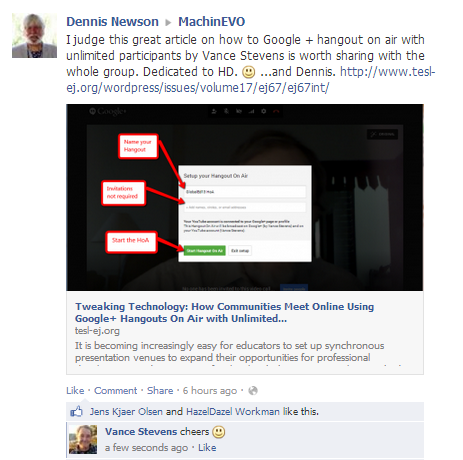
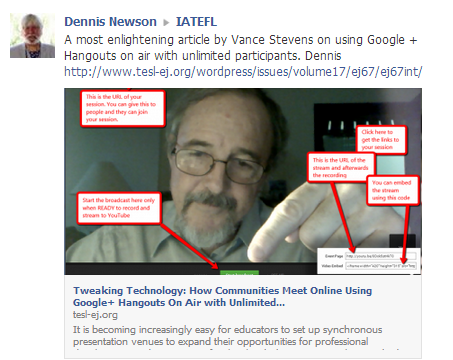
118. Stevens, V. (2013). LTMOOC and Instreamia. Teaching English as a Second Language Electronic Journal (TESL-EJ), 17(1), 1-6.
https://vancestevens.com/papers/TESL-EJ/2013TESL-EJ_Instreamia.pdf
https://www.researchgate.net/publication/354543103_LTMOOC_and_Instreamia_On_the_Internet_2013
Unpaginated HTML version: http://www.tesl-ej.org/wordpress/issues/volume17/ej65/ej65int/
117. Stevens, V. (2013). Training Teachers in Web2.0 Tools for Teaching and Learning EFL. In S. Dowling, H. Donaghue, C. Gunn, S. Hayhoe, & J. Raven (eds.), eLearning in Action, “Redefining Learning”, HCT Educational Technology Series, Book 2. Abu Dhabi: HCT Press.
archive/2013Training_Teachers_Web2.pdf = http://www.vancestevens.com/papers/archive/2013Training_Teachers_Web2.pdf
https://www.researchgate.net/publication/353871008_Training_Teachers_in_Web20_Tools_for_Teaching_and_Learning_EFL
No longer available at http://shct.hct.ac.ae/events/edtechpd2013/articles/Stevens.pdf (Entire book was available here: http://shct.hct.ac.ae/events/edtechpd2013/articles/index.asp)
116. Stevens, V. (2013). What's with the MOOCs? Teaching English as a Second Language Electronic Journal (TESL-EJ), 16(4), 1-14.
http://tesl-ej.org/pdf/ej64/int.pdf
https://vancestevens.com/papers/TESL-EJ/2013TESL-EJ_WhatsMOOCs.pdf
https://www.researchgate.net/publication/354716921_What's_with_the_MOOCs_On_the_Internet_2013
Unpaginated HTML version: http://www.tesl-ej.org/wordpress/issues/volume16/ej64/ej64int/
115. Stevens, V. (2012). Web 2.0 Toolkit for Teaching and Learning EFL Presentation Skill. Teaching English as a Second Language Electronic Journal (TESL-EJ), 16(2), 1-11.
http://tesl-ej.org/pdf/ej62/int.pdf
https://vancestevens.com/papers/TESL-EJ/2012TESL-EJ_Web20toolkit4teaching.pdf
https://www.researchgate.net/publication/354717059_Web_20_Toolkit_for_Teaching_and_Learning_EFL_Presentation_Skill_On_the_Internet_2012
Unpaginated HTML version: http://www.tesl-ej.org/wordpress/issues/volume16/ej62/ej62int/
114. Stevens, V. (2012). Learning2gether: Wiki-based worldwide teacher professional development. Paper presented at the annual TESOL Arabia conference in Dubai, March 9, 2012. In Davidson, P., Al-Hamly, M. Coombe, C., Troudi, S, and Gunn, C. (Eds.) 18th TESOL Arabia Conference Proceedings: Achieving Excellence through Life Skills Education.
Version submitted for publication, updated Aug 13, 2021: https://docs.google.com/document/d/1GXPNWpfa0uRJ66i-x-SaOqO6ulpK8bk4tZinhx0BffQ/edit?usp=sharing
https://www.vancestevens.com/papers/archive/Learning2gether2012fromtxtV4.docx.pdf
https://www.researchgate.net/publication/353878526_Learning2gether_Wiki-based_worldwide_teacher_professional_development
113. Stevens, V. (2012). DIYLMS: Learner-centered Do-it-yourself Learning Management System. In Dowling, S., Gunn, C., Raven, J., Gitsaki, C. (Eds.). Opening up Learning: HCT Educational Technology Series. HCT Press: Abu Dhabi; ISBN 978-9948-16-864-5), pp.103-112.
http://www.vancestevens.com/papers/archive/2012DIYLMS.pdf is an offprint of my article paginated pp. 0-11
https://www.researchgate.net/publication/353878597_Learner-centered_do-it-yourself_Learning_Management_Systems
The book itself is no longer available: http://shct.hct.ac.ae/events/edtechpd2013/articles2012/DIYLMS.pdf
but its cover and contents are archived: https://web.archive.org/web/20131207183422/http://shct.hct.ac.ae/events/edtechpd2013/articles/index.asp
 |
112. Yilmaz, B, and Stevens, V. (2012). Webheads in Action: A community of practice scaffolding multiliteracies skills in teacher professional development. Writing & Pedagogy 4,1:135–146.
|
111. Adams, S., Montagne, M., Rodriguez, J. and Stevens, V. (2012). Collaborative Learning for Teachers and Students: Earth Day and Earthbridges. TESL-EJ 16,(1), 1-14.
http://www.tesl-ej.org/pdf/ej61/int.pdf
https://vancestevens.com/papers/TESL-EJ/2012TESL-EarthDayBridges.pdf
https://www.researchgate.net/publication/268291603_Collaborative_Learning_for_Teachers_and_Students_Earth_Day_and_Earthbridges
Unpaginated HTML version: http://www.tesl-ej.org/wordpress/issues/volume16/ej61/ej61in/
110. Stevens, V. (2012). Turning a 3-hour Face-to-Face Seminar into an Opportunity for Extended Online Blended Learning. ELTAF Newsletter 16, Spring 2012, pp. 16-21.
http://vancestevens.com/papers/pdfs/ELTAF_NL_Spring2012_pp16-21.pdf
https://www.researchgate.net/publication/353287755_Turning_a_3-hour_Face-to-Face_Seminar_into_an_Opportunity_for_Extended_Online_Blended_Learning_ELTAF_Newsletter_2012
109. Stevens, Vance. (2012). Learner-centered Do-it-yourself Learning Management Systems. TESL-EJ 15,(4), 1-14.
http://tesl-ej.org/pdf/ej60/int.pdf
https://vancestevens.com/papers/TESL-EJ/2012TESL-EJ_DIYLMS.pdf
https://www.researchgate.net/publication/354330232_Learner--Centered_Do--it--yourself_Learning_Management_Systems_On_the_Internet_2012
Unpaginated HTML version: http://www.tesl-ej.org/wordpress/issues/volume15/ej60/ej60int/
108. Aiden Yeh, Sandra Rogers, Heike Philp, Kalyan Chattopadhyay, Carla Arena & Vance Stevens. (2011). The Electronic Village Online Provides Free Professional Development Annually. TESOL Italy Newsletter.Vol XXI, No. 3, June-July 2011; pp.9-10.
http://www.vancestevens.com/papers/pdfs/TESOLItalyNewsEVO.pdf
Complete issue online here: http://tesolitaly.org/new/wp-content/uploads/2013/08/May_June2011.pdf
https://www.researchgate.net/publication/353212409_The_Electronic_Village_Online_Provides_Free_Professional_Development_Annually_TESOL_Italy_Newsletter_2011
107. Stevens, V. (2011). Writing in a Multiliterate Flat World, Part II: Finding Audiences through Tagging and Aggregation. Writing & Pedagogy, Vol. 3.1, pp.153-168.
http://www.vancestevens.com/papers/archive/2011writing_flatworld2.pdf
https://www.researchgate.net/publication/270413792_Writing_in_a_Multiliterate_Flat_World_Part_II_Finding_Audiences_through_Tagging_and_Aggregation
106. Stevens, V. (2011). Transforming Learning with Creative Technogogy: Achieving the Aha! Moment. TESL-EJ 14,(4), 1-9.
http://www.tesl-ej.org/pdf/ej56/int.pdf
https://vancestevens.com/papers/TESL-EJ/2011TESL-EJ_CreativeTechnogogy.pdf
https://www.researchgate.net/publication/354329844_Transforming_Learning_with_Creative_Technogogy_Achieving_the_Aha_Moment_On_the_Internet_2011
Unpaginated HTML version: http://www.tesl-ej.org/wordpress/issues/volume14/ej56/ej56int/
105. Stevens, V. (2010). PLN: The paradigm shift in teacher and learner autonomy [PDF file]. Memoria Académica: Puertas Abiertas 2010(6), pp.1-11.
https://www.vancestevens.com/papers/archive/2010Stevens_purertasAbiertas_pr.4919.pdf
Was here, http://www.memoria.fahce.unlp.edu.ar/art_revistas/pr.4919/pr.4919.pdf - now archived at
https://web.archive.org/web/20200531115721/http://www.memoria.fahce.unlp.edu.ar/art_revistas/pr.4919/pr.4919.pdf
https://www.researchgate.net/publication/353175672_PLN_The_paradigm_shift_in_teacher_and_learner_autonomy_-_Puertas_Abiertas_2010
also available in html: http://www.puertasabiertas.fahce.unlp.edu.ar/numeros/numero-6/pln-the-paradigm-shift-in-teacher-and-learner-autonomy
This article differs markedly from the one with the same name cited below.
104. Stevens, V. (2010). PLN: The paradigm shift in teacher and learner autonomy. Braz-TESOL Newsletter, Issue 4, 2010, pp.12-13.
http://www.vancestevens.com/papers/archive/2010brazTesol_pln.pdf
https://www.researchgate.net/publication/353175633_PLN_The_paradigm_shift_in_teacher_and_learner_autonomy_-_Braz-TESOL_Newsletter_2010
and a draft can be found online here: http://tinyurl.com/vance-braztesol.
This article is much different from the one with the same name cited above.
103. Stevens, Vance. (2010). Writing in a multiliterate flat world, Part I. Multiliterate approaches to writing and collaboration through social networking. Writing & Pedagogy, Vol. 2.1, pp.117-131.
Offprint: stevens2010wap.pdf = full URL http://vancestevens.com/papers/pdfs/stevens2010wap.pdf
https://www.researchgate.net/publication/250013205_Writing_in_a_Multiliterate_Flat_World_Part_I_Multiliterate_Approaches_to_Writing_and_Collaboration_Through_Social_Networking
102. Stevens, Vance. (2010). Shifting sands, shifting paradigms: Challenges to developing 21st century learning skills in the United Arab Emirates. Chapter 20 in Egbert, J. (2010). CALL in Limited Technology Contexts, CALICO Monograph Series, Volume 9. pp.227-239.
http://www.vancestevens.com/papers/archive/2010CALICO_ShiftingSands.pdf
https://www.researchgate.net/publication/353171464_Shifting_sands_shifting_paradigms_Challenges_to_developing_21st_century_learning_skills_in_the_United_Arab_Emirates_2010
Area editors: Chin-Chi Chao and Yu-Feng Diana Yang (Asia), Senem Yildiz (Europe), Vance Stevens (Middle East and Africa), Jeff Nelson (Latin America), and Joy Egbert (US). My last draft version of this article has been placed online here: http://tinyurl.com/vance2010calico. You can buy the book from Calico here: https://calico.org/product/call-in-limited-contexts/
101. Stevens, Vance. (2010). The Ning Thing. Stevens, Vance. (2010). TESL-EJ 14,(1), 1-7.
http://www.tesl-ej.org/pdf/ej53/int.pdf
https://vancestevens.com/papers/TESL-EJ/2010TESL-EJ_NingThing.pdf
https://www.researchgate.net/publication/354237971_The_Ning_Thing_On_the_Internet_2010
Unpaginated HTML version: http://www.tesl-ej.org/wordpress/issues/volume14/ej53/ej53int/
100. Stevens, Vance. (2010). Webheads and Distributed Communities of Practice. Global Neighbors: Newsletter of TESOL's English as a Foreign Language Interest Section, EFLIS News March 2010 Volume 9 Number 1.
https://docs.google.com/document/d/123wLQKVGwMl27cOOF8xJfc0jZaohnJ199xNZt73jBDE/preview
https://www.researchgate.net/publication/353165963_Webheads_and_Distributed_Communities_of_Practice_2010_from_TESOL_2009
99. Stevens, V. (2010). How can teachers deal with technology overload: Reader response to Allan, J. (2009). Are language teachers suffering from technology overload? TESOL Arabia Perspectives 16(2), 22-23. TESOL Arabia Perspectives 17(1), 22-23.
http://vancestevens.com/papers/archive/2010teacher_tech_overload.pdf (= internal link, archive/2010teacher_tech_overload.pdf)
https://www.researchgate.net/publication/353146182_How_can_teachers_deal_with_technology_overload_Reader_response_to_Allan_J_2009_Are_language_teachers_suffering_from_technology_overload_2010
98. Stevens, Vance. (2009). Modeling Social Media in Groups, Communities, and Networks. TESL-EJ,13,(3), 1-16.
http://tesl-ej.org/pdf/ej51/int.pdf
https://vancestevens.com/papers/TESL-EJ/2009TESL-EJ_ModelingSocialMedia.pdf
https://www.researchgate.net/publication/354237657_Modeling_Social_Media_in_Groups_Communities_and_Networks_On_the_Internet_2009
Unpaginated HTML version: http://www.tesl-ej.org/wordpress/past-issues/volume13/ej51/ej51int/

97. Stevens, Vance. (2009). Writing in the eSphere: Where Connectivity and Literacy Collide. Writing & Pedagogy, Vol.1 #1. pp.125-130.
http://vancestevens.com/papers/archive/2009writing_esphere.pdf
https://www.academia.edu/5604280/Writing_in_the_e-Sphere_Where_Connectivity_and_Literacy_Collide
https://www.researchgate.net/publication/250013099_Writing_in_the_e-Sphere_Where_Connectivity_and_Literacy_Collide (full text available)
https://www.researchgate.net/project/Stevens-Vance-2009-Writing-in-the-eSphere-Where-Connectivity-and-Literacy-Collide-Writing-Pedagogy-Vol1-1-pp125-130 (but this one is 'archived' under one of my previous inaccessible profiles, no full text available).
96. Stevens, Vance. (2009 July 15). Engaging Collaborative Writing through Social Networking. In Koyama, Toshiko; Noguchi, Judy; Yoshinari,Yuichiro; and Iwasaki, Akio (Eds.). Proceedings of the WorldCALL 2008 Conference. The Japan Association for Language Education and Technology (LET). ISBN: 978-4-9904807-0-7, pp.68-71.
Full proceedings no longer here: http://www.j-let.org/~wcf/proceedings/proceedings.pdf
But are archived here: https://web.archive.org/web/20210425052538/http://www.j-let.org/~wcf/proceedings/proceedings.pdf
https://www.academia.edu/5604282/Engaging_Collaborative_Writing_through_Social_Networking
https://www.researchgate.net/publication/237421770_Engaging_Collaborative_Writing_through_Social_Networking
a proof version can be found here http://www.vancestevens.com/papers/archive/WorldCALL2008_proceedings_vancestevens.pdf
95. Stevens, Vance. (2009). Life-long learner autonomy meets Electronic Village Online. TESOL Arabia Learner Independence Special Interest Group, 2009 Conference Newsletter, p.9.
http://vancestevens.com/papers/archive/2009lifeLearnAutonomy.pdf
https://www.researchgate.net/publication/353143305_Life-long_learner_autonomy_meets_Electronic_Village_Online_2009
alternatively this download still works in 2021 http://tailearn.googlepages.com/LISIGNL09.pdf
94. Akayoglu, Sedat, Altun, Arif, & Stevens, Vance. (2009). Social presence in synchronous text-based computer-mediated communication. Egitim Arastirmalari - Eurasian Journal of Educational Research, 9(34, Winter),1-16.
https://docs.google.com/document/d/1GitprRppANrmnw2jVpFOITEPAT_T1s871VNPe4Wq1vw/edit
https://www.researchgate.net/publication/281102102_Social_Presence_in_Synchronous_Text-Based_Computer-Mediated_Communication
Full text is available on ResearchGate; on request from Arif Altun.
93. Seferoglu, Golge, & Stevens, Vance (Eds.). (2009). From the guest editors: Current issues and future trends in computer-assisted language learning and teaching. Special issue of EJER Egitim Arastirmalari - Eurasian Journal of Educational Research, 9(34, Winter), iii-v. Ankara: Ani Yayincilik Egitim Arashrmalan.
https://docs.google.com/document/d/1GitprRppANrmnw2jVpFOITEPAT_T1s871VNPe4Wq1vw/edit
https://www.researchgate.net/publication/353123031_Current_issues_and_future_trends_in_computer-assisted_language_learning_and_teaching_2009
Was once archived at http://ejer.com.tr/en/archives/2009-winter-issue-34/
92. Stevens, Vance, and Gavin Dudeney. (2009). Online Conferences and Teacher Professional Development: SLanguages and WiAOC 2009. TESL-EJ 13,(1), 1-9.
https://vancestevens.com/papers/TESL-EJ/2009TESL-EJ_SL_WiAOC.pdf
https://www.researchgate.net/publication/354208724_Online_Conferences_and_Teacher_Professional_Development_SLanguages_and_WiAOC_2009_On_the_Internet
There are two unpaginated HTML versions:
http://tesl-ej.org/ej49/int.html (lacks link to pdf)
http://www.tesl-ej.org/wordpress/past-issues/volume13/ej49/ej49int/ (pdf link yields 404)
91. Stevens, Vance. (2008). Trial by Twitter: The rise and slide of the year's most viral microblogging platform. TESL-EJ 12,(1), 1-14.
http://tesl-ej.org/ej45/int.pdf
https://vancestevens.com/papers/TESL-EJ/2008TESL-EJ_Trial_Twitter.pdf
https://www.researchgate.net/publication/354208639_Trial_by_Twitter_The_Rise_and_Slide_of_the_Year's_Most_Viral_Microblogging_Platform_On_the_Internet_2008
Unpaginated HTML version: http://tesl-ej.org/ej45/int.html
90. Stevens, Vance. (2008). Class of the future: Language learners can now meet up with native speakers in their home country, without leaving their computers. Vance Stevens enters the virtual world of Second Life. The Linguist (June/July), pp. 18-20.
http://sl2ndchance.pbwiki.com/f/linguist18-21_2ndLife_lo-res.pdf
https://www.researchgate.net/publication/353122764_Class_of_the_future_Language_learners_can_now_meet_up_with_native_speakers_in_their_home_country_without_leaving_their_computers_Vance_Stevens_enters_the_virtual_world_of_Second_Life
89. Stevens, Vance, Nelba Quintana, Rita Zeinstejer, Saša Sirk, Doris Molero & Carla Arena. (2008). Writingmatrix: Connecting Students with Blogs, Tags, and Social Networking. In Stevens, Vance & Elizabeth Hanson-Smith, Co-editors. (2008). Special Feature: Proceedings of the Webheads in Action Online Convergence, 2007. TESL-EJ 11,(4), 1-16.
http://tesl-ej.org/ej44/a7.pdf
https://vancestevens.com/papers/TESL-EJ/2007TESL-EJ_Writingmatrix.pdf
https://www.researchgate.net/publication/242126266_Writingmatrix_Connecting_Students_with_Blogs_Tags_and_Social_Networking
Full text available, and I have requested authorship, but I am unable to edit this entry since it was added under my previous profile
Unpaginated HTML version: http://tesl-ej.org/ej44/a7.html
88. Stevens, Vance & Elizabeth Hanson-Smith, Co-editors. (2008). Special Feature: Proceedings of the Webheads in Action Online Convergence, 2007. TESL-EJ 11,(4), n.p.
Unpaginated HTML: http://tesl-ej.org/ej44/toc.html (and, A Word from the Editors: http://tesl-ej.org/ej44/fromed.html)
87. Stevens, Vance. (2007). Who's in charge here? WiZiQ and Elluminate. TESL-EJ 11,(3), 1-8,
http://tesl-ej.org/ej43/int.pdf
https://vancestevens.com/papers/TESL-EJ/2007TESL-EJ_WiZIQ-Elluminate.pdf
https://www.researchgate.net/publication/354208102_Who's_in_charge_here_WiZiQ_and_Elluminate_On_the_Internet_2007
Unpaginated HTML version: http://tesl-ej.org/ej43/int.html
86. Stevens, Vance. (2007). Webheads as agents of change in overlapping clouds of distributed learning networks. APACALL Newsletter 11, pp. 3-8.
http://www.apacall.org/news/Newsletter11.pdf
https://www.researchgate.net/publication/353122645_Webheads_as_agents_of_change_in_overlapping_clouds_of_distributed_learning_networks_APACALL_Newsletter_2007
85. Dieu, Barbara, and Vance Stevens. (2007). Pedagogical affordances of syndication, aggregation, and mash-up of content on the Web. TESL-EJ 11,(1), 1-15.
http://tesl-ej.org/ej41/int.pdf
https://vancestevens.com/papers/TESL-EJ/2007TESL-EJ_PedagogicalAffordances_aggragation.pdf
https://www.researchgate.net/publication/220035853_Pedagogical_Affordances_of_Syndication_Aggregation_and_Mash-up_of_Content_on_the_Web
Unpaginated HTML version: http://tesl-ej.org/ej41/int.html
84. Stevens, Vance. (2007). The Multiliterate Autonomous Learner: Teacher Attitudes and the Inculcation of Strategies for Lifelong Learning. Independence, Winter 2007 (Issue 42).
http://vancestevens.com/papers/archive/VanceStevens_multiliterateAutonomousLearner.pdf (recovered in 2021 from the Wayback Machine)
https://www.researchgate.net/publication/353119816_The_Multiliterate_Autonomous_Learner_Teacher_Attitudes_and_the_Inculcation_of_Strategies_for_Lifelong_Learning_2007
The article was available November 9, 2007 from http://www.learnerautonomy.org/VanceStevens.pdf, but the IATFL LASIG site at http://lasig.iatefl.org/newsletter.html states that back issues of the newsletter are now only available for purchase for 6.50 GBP (plus postage; shipped only after full amt is paid); however the text of my article is still available at
83. Stevens, Vance. (2007). Unarticle: Unleashing the transformative power of the unorganized Internet. TESL-EJ 10,(4), 1-8.
http://www.tesl-ej.org/ej40/int.pdf
https://vancestevens.com/papers/TESL-EJ/2007TESL-EJ_Unarticle_unleashed.pdf
https://www.researchgate.net/publication/242577611_Unarticle_Unleashing_the_Transformative_Power_of_the_Unorganized_Internet_On_the_Internet_2007
Unpaginated HTML version: http://www.tesl-ej.org/ej40/int.html
You can comment on this article at http://advanceducation.blogspot.com/2007/03/unarticle.html
82. Stevens, Vance. (2007). Second Life and online collaboration through peer-to-peer distributed learning networks. In S. M. Stewart, J. E. Olearski, P. Rodgers, D. Thompson, & A.E. Hayes (Eds.). Proceedings of the Third Annual Conference for Middle East Teachers of Science, Mathematics and Computing (pp. 295-307). METSMaC: Abu Dhabi.
http://www.homestead.com/prosites-vstevens/files/efi/papers/metsmac/Stevens-METSMaC-2007.pdf
https://www.researchgate.net/publication/353119388_Second_Life_and_online_collaboration_through_peer-to-peer_distributed_learning_networks
81. Stevens, Vance. (2006). Second Life in Education and Language Learning. TESL-EJ 10,(3), 1-4.
http://www.tesl-ej.org/ej39/int.pdf
https://vancestevens.com/papers/TESL-EJ/2006TESL-EJ_SLinEdu_LanguageLearning.pdf
https://www.researchgate.net/publication/354177411_Second_Life_in_Education_and_Language_Learning_On_the_Internet_2006
https://www.academia.edu/5604285/Second_Life_in_Education_and_Language_Learning
Unpaginated HTML version: http://www.tesl-ej.org/ej39/int.html
You can comment on this article here, where the author ported it over from Wikispaces: http://sl2ndchance.pbworks.com/
80. Stevens, Vance. (2006). Issue: Tools for Online Teacher Communities of Practice. Learning Languages through Technology. Elizabeth Hanson-Smith and Sarah Rilling, editors. TESOL publications, pp. 257-273.
2006tesol_cops1488kb.pdf = https://vancestevens.com/papers/archive/2006tesol_cops1488kb.pdf
https://www.researchgate.net/publication/353119429_Tools_for_Online_Teacher_Communities_of_Practice_2006
The last submitted draft version of my paper is here: http://www.homestead.com/prosites-vstevens/files/efi/papers/tesol/publications/gvs26oct2005.htm
Click here to see an early draft originally submitted to APACALL = https://vancestevens.com/papers/apacall/profdev_cop.htm
79. Stevens, V. (2006). Revisiting multiliteracies in collaborative learning environments: Impact on teacher professional development. TESL-EJ 10,(2), 1-12.
http://www.tesl-ej.org/ej38/int.pdf
https://vancestevens.com/papers/TESL-EJ/2006TESL-EJ_Revisiting%20multiliteracies.pdf
https://www.researchgate.net/publication/254934897_Revisiting_Multiliteracies_in_Collaborative_Learning_Environments_Impact_on_Teacher_Professional_Development
https://www.academia.edu/5604284/Revisiting_Multiliteracies_in_Collaborative_Learning_Environments_Impact_on_Teacher_Professional_Development
Unpaginated HTML version: http://www.tesl-ej.org/ej38/int.html
78. Stevens, Vance. 2006. Guest Editor's Introduction: Proceeds of Webheads in Action Online Convergence: Volume 2. In Stevens, V. (Ed.) IATEFL Poland Computer Special Interest Group Teaching English with Technology A Journal for Teachers of English ISSN 1642-1027 Vol. 6, Issue 3 (August 2006).
http://www.tewtjournal.org/issues/past-issue-2006/past-issue-2006-issue-3/
A pdf file of the entire issue can be downloaded at the link above,
or because links at TEWT have changed more than once now, you can also download the pdf of the entire issue, Vol.6 #3 <== here (unpaginated).
The guest editor introduction is available here: http://www.vancestevens.com/papers/pdfs/1EditorsMessagebyVanceStevensGuestEditor2006-3.pdf
https://www.researchgate.net/publication/353117094_Guest_Editor's_Introduction_Proceeds_of_Webheads_in_Action_Online_Convergence_Volume_2_in_TEWT_63_2006
77. Stevens, Vance. 2006. Guest Editor's Introduction: Proceeds of Webheads in Action Online Convergence: Volume 1. In Stevens, V. (Ed.) IATEFL Poland Computer Special Interest Group Teaching English with Technology A Journal for Teachers of English ISSN 1642-1027 Vol. 6, Issue 2 (May 2006).
http://www.tewtjournal.org/issues/past-issue-2006/past-issue-2006-issue-2/
A pdf file of the entire issue Vol.6 #2 can be downloaded at https://tewtjournal.org/?wpdmact=process&did=MjA0LmhvdGxpbms (or via the link above, unpaginated).
Just the guest editor introduction is available here:
http://www.vancestevens.com/papers/pdfs/1EditorsMessagebyVanceStevensGuest Editor2006-2.pdf
https://www.researchgate.net/publication/352978607_Guest_Editor's_Introduction_Proceeds_of_Webheads_in_Action_Online_Convergence_Volume_1_2006
76. Stevens, Vance. 2006. Learner strategies at the interface: Computer-assisted language learning meets computer-mediated communication. In K. Wahba, Z. Taha, & L. England (Eds.). Handbook for Arabic Language Teaching Professionals in the 21st Century (pp.253-262). Lawrence Erlbaum Associates.
https://www.vancestevens.com/papers/pdfs/2006Learner_strategies_at_interface_cover_content.pdf
https://www.researchgate.net/publication/352976747_Learner_strategies_at_the_interface_Computer-assisted_language_learning_meets_computer-mediated_communication_2006
75. Stevens, V. (2006). Broadcasting in the Section 3: A to Z Handbook. In David Dixon, Heather Baba, Phil Cozens, & Mairi Thomas (Eds.). Independent Learning Schemes: A Practical Approach. Dubai: TESOL Arabia. No longer available at http://ilearn.20m.com/bookpub.htm. My contribution scanned and made available here
https://docs.google.com/document/d/1lVE8M8FvS2aLXBtmTyrnY_jjyFhNvv2FT7bZw_y36NE/edit?usp=sharing
https://www.researchgate.net/publication/352934927_Broadcasting_by_Vance_Stevens_2006_TESOL_Arabia
74. Stevens, Vance. (2005). Behind the scenes at the Webheads in Action Online Convergence, November 18-20, 2005: TESL-EJ 9,(3), 1-15.
http://tesl-ej.org/ej35/int.pdf
https://vancestevens.com/papers/TESL-EJ/2005TESI-EJ_BehindScenesWiAOC.pdf
https://www.researchgate.net/publication/237495743_On_the_Internet_Behind_the_scenes_at_the_Webheads_in_Action_Online_Convergence_November_18-20_2005
Unpaginated HTML version: http://tesl-ej.org/ej35/int.html
An earlier, shorter version of this article appears in Innovative Language Learning #8 (2005, APACALL Newsletter) http://www.apacall.org/news/Newsletter8.pdf
73. Stevens, Vance. (2005). APACALL Co-sponsors Webheads in Action Online Convergence, November 18-20, 2005. In Innovative Language Learning #8 (APACALL Newsletter), pp. 3-8.
This is the complete newsletter, http://www.apacall.org/news/Newsletter8.pdf
Just my original submission can be found at: http://www.vancestevens.com/papers/evonline2002/apacall_news.htm
https://www.researchgate.net/publication/352934223_APACALL_Co-sponsors_Webheads_in_Action_Online_Convergence_November_18-20_2005
72. Stevens, Vance. (2005). Multiliteracies for Collaborative Learning Environments. TESL-EJ 8,(3), 1-6.
http://tesl-ej.org/ej34/int.html; pdf: http://tesl-ej.org/ej34/int.pdf
https://www.academia.edu/5604283/Multiliteracies_for_Collaborative_Learning_Environments
https://www.researchgate.net/publication/238702370_Multiliteracies_for_Collaborative_Learning_Environments
71. Stevens, V. (2005). Computer-mediated communications tools used with teachers and students in virtual communities of practice, in S. M. Stewart & J. E. Olearski (Eds), Proceedings of the First Annual Conference for Middle East Teachers of Science, Mathematics and Computing (pp. 204-218). METSMaC: Abu Dhabi. ISBN 9948-8569-0-2.
http://www.homestead.com/prosites-vstevens/files/efi/papers/tesol/arabia/stevens-METSMaC-I.pdf
https://www.researchgate.net/publication/265819832_Online_webcast_Computer-mediated_communications_tools_used_with_teachers_and_students_in_virtual_communities_of_practice
70. Stevens, V. (2005). Creating online communities. TESOL Arabia Perspectives (12), 2: 6-11.
https://docs.google.com/document/d/1t_teU7QXbGFEnp6ip1yu3zI5pr6tZPYFLASrMJwGT9w/edit?usp=sharing
https://www.researchgate.net/publication/352901496_Creating_online_communities_2005_TESOL_Arabia_Perspectives
A version submitted to the Perspectives editor can be found here: http://sites.hsprofessional.com/vstevens/files/efi/papers/tesol/arabia/perspectives2004gvs.htm
69. Stevens, Vance. (2004). Establishing and Maintaining Web Presence: A guide for educators. TESL-EJ 8,(3), 1-6.
https://vancestevens.com/papers/TESL-EJ/2005TESI-EJ_Webpresence.pdf
https://www.researchgate.net/publication/354163476_Establishing_and_Maintaining_Web_Presence_A_guide_for_educators_On_the_Internet_2004
Unpaginated HTML version: http://tesl-ej.org/ej31/int.html
68. Stevens, V. (2004). Webhead communities: Writing tasks interleaved with synchronous online communication and web page development. In Leaver, B. and Willis, J. (Eds.). Task-based instruction in foreign language education: Practices and programs. Georgetown University Press. pp. 204-217.
http://www.vancestevens.com/papers/archive/2004taskbased_webheads.pdf
https://www.researchgate.net/publication/352901185_Webheads_communities_Writing_tasks_interleaved_with_synchronous_online_communication_and_web_page_development_2004
67. Stevens, V. (2004). Tech view: Tools for building online communities. Essential Teacher: ESL/EFL.reflections.practice, Spring 2004. pp. 32-35.
https://docs.google.com/document/d/1qQKa3t1RCwMomLSyDKc2yyid8lJyPyoM2SuMlRYCxKs/edit
https://www.researchgate.net/publication/352901133_Tools_for_building_online_communities_-_2004_Essential_Teacher
A draft version of this article can be found online here (useful if you want to grab text from it): http://sites.hsprofessional.com/vstevens/files/efi/papers/tesol/et/technoservice.htm
66. Stevens, Vance. (2004). The Skill of Communication: Technology brought to bear on the art of language learning. TESL-EJ 7,(4), 1-14.
https://vancestevens.com/papers/TESL-EJ/2004TESI-EJ_Skill-of-Communication_cairo.pdf
https://www.researchgate.net/publication/354161750_The_Skill_of_Communication_Technology_brought_to_bear_on_the_art_of_language_learning_On_the_Internet_2004
Unpaginated HTML: http://tesl-ej.org/ej28/int.html
The full text of my script of the plenary address delivered in Cairo is here: http://prosites-vstevens.homestead.com/files/efi/papers/cairo2004/plenary/speech.pdf
https://www.researchgate.net/publication/248013991_The_skill_of_Communication_Technology_brought_to_bear_on_the_art_of_language_learning_spoken_script_Cairo_2004
65. Stevens, V. (2003). Online language learning: Computer mediated communications. MLI Magazine (3rd edition, Summer 2003). pp.44-45. https://docs.google.com/document/d/1WD8p0pXPAToaFt4ksK6UcfV9CSdQaQ8FhfO0tgBpxQ8/edit?usp=sharing
https://www.researchgate.net/publication/352880528_Online_language_learning_Computer_mediated_communications_MLI_Magazine_2003
64. Stevens, Vance. (2003). A Virtual Learning Resource Center. TESL-EJ 7,(3), 1-4.
https://vancestevens.com/papers/TESL-EJ/2003TESI-EJ_mliVLRC.pdf
https://www.researchgate.net/publication/354161405_A_Virtual_Learning_Resource_Center_On_the_Internet_2003
Unpaginated HTML version: http://tesl-ej.org/ej27/int.html
63. I submitted the following to the TESOL Arabia Learner Independence Special Interest Group for their November 2003 newsletter
The 7th Annual Global Learn Day, Vance Stevens, PI-Abu Dhabi
Some links text altered and some links below removed Aug 2021 to reflect site closuresGlobal Learn Day began 7 years ago in the metaphor of a ship that departs the International Dateline at midnight GMT and circumvents the globe over 24 hours, picking up presentations on an eclectic mix of educational technology as it travels. Topics for GLD VII used to be here: <http://www.talkingcommunities.com/tc/gld7/speakers.htm>.
Snapshot made for 2003 early version of calendar of events here: https://web.archive.org/web/20041022083100/http://www.talkingcommunities.com/tc/gld7/speakers.htm
Snapshot made for 2007 version of calendar of events here: https://web.archive.org/web/20051024192808/http://www.talkingcommunities.com/tc/gld7/speakers.htmThe first GLD's used telephone hookups with presenters which were then streamed out worldwide via Real or Windows Media players. For my presentation in 1999 I had to disconnect my computer from the Internet in order be interviewed over the phone and I didn't have any interaction from listeners worldwide except as relayed through the interviewer. The latest software has made it possible to participate via a PC with only a headset. For the previous two years, Alado <was at http://www.alado.net> provided java-enabled chat rooms where participants simply visit one URL and install the java software at which point all wind up in the chatroom with other listeners and speakers.
The interface is sophisticated. Moderators of the chat room can 'synchronise browsing' which means that whatever URL he or she keys into the whiteboard area can be seen on the whiteboards of all other occupants of the room. In this way presentations can be 'pushed' to other viewers. There is a text area in addition to the aural component plus other bells and whistles. Assuming one has the latest version of Windows Media Player, presentations can be recorded. When this is activated, a wmp file is created on the user's hdd along with an HTML file that calls up the screens presented in synch with the audio, so the viewer retains a complete record of the event for replay later. PC users were able to try out the software at this URL: <http://www.alado.net/webheads>. Mac and PC users can find something similar at <http://www.learningtimes.org/>. You have to register with the community (free) to use the Meeting Room with features similar in all the above-mentioned respects to the Alado product.
Almost anyone can present at upcoming GLD events. If you want to become involved next year, just keep an eye on the <http://www.bfranklin.edu/gld> website and in the fall sign up to do a presentation. To do this you submit a form and record a message and your presentation will be scheduled according to your geographical location. This event has for 7 years been pushing the edge of CMC (computer-mediated communications) technologies over the Internet. Participants in GLD not only keep themselves abreast of latest developments in CMC but become part of a community of ed tech practitioners who interact throughout the year as well as during the annual event.
62. Stevens, V. (2003, June). It's for Teachers' Magazine Interview with Vance Stevens - conducted asynchronously by Nicky Hockly. It's for Teachers' Magazine. Originally, online (www) its-teachers.com/interviews/vance-stevens.asp. My in-progress, longer, updated version of the article and the shorter originally submitted published work are compiled into:
https://docs.google.com/document/d/1qn4yVOouFbWiBM6Rpu0c6rqqbw3Gh_XOxFb8gQ75d_I/edit?usp=sharing
https://www.researchgate.net/publication/352876163_It's_for_Teachers'_magazine_Interview_with_Vance_Stevens_-_conducted_asynchronously_by_Nicky_Hockly_in_2003
61. Stevens, V. (2003). How the CALL interest section began. On CALL News, 21:1 (October 2003).
The originally submitted version of the 2003 article was prepared at the request of Chris Sauer, CALL-IS Newsletter Editor, May 2003. It appeared in an email sent to all CALL-IS members in Fall 2003 via the TESOL organization. Here is its publication history:
The article was reprinted as Stevens, V. (2009). How the TESOL CALL Interest Section began, in On CALL News, 25:1 (March 2009) at https://www.tesol.org/read-and-publish/newsletters-other-publications/interest-section-newsletters/on-call/2011/10/28/on-call-news-volume-25-1-(march-2009). The bookmarks there didn’t work but you could scroll down to find the article. The link was also returning 404 in July 2021. A version of that URL was archived on Aug 26, 2017 here https://web.archive.org/web/20170826224233/https://www.tesol.org/read-and-publish/newsletters-other-publications/interest-section-newsletters/on-call/2011/10/28/on-call-news-volume-25-1-(march-2009) ; I made a pdf copy of this version from the archived one:
https://www.vancestevens.com/papers/archive/OnCALLNewsVolume25_1March2009.pdf
The article was finally updated and published as Stevens, V. (2015). How the TESOL CALL Interest Section began (updated). On CALL (Sept 2015). http://newsmanager.commpartners.com/tesolcallis/issues/2015-08-25/1.html
https://docs.google.com/document/d/1WMzrvmid0ZfEJLxXBmfnD563MA60UEvZWVrXzp367uM/edit?usp=sharing
https://vancestevens.com/papers/archive/How%20the%20CALL-IS%20began.pdf
60. Stevens, V. 2002. A day in the life of an online language educator. TESL-EJ 6,(3), 1-5.
https://vancestevens.com/papers/TESL-EJ/2002TESI-EJaDayintheLifeofYaodong.pdf
https://www.researchgate.net/publication/354144348_A_day_in_the_life_of_an_online_language_educator_OTI_2002
Unpaginated HTML version: http://www.tesl-ej.org/wordpress/issues/volume6/ej23/ej23int/
This was my first article as OTI Editor in the Dec 2002 issue of the TESL-EJ (Electric Online Journal).
Another version is here: http://www.homestead.com/prosites-vstevens/files/efi/papers/tesl-ej/02dec.htm
and there is a screenshot of the first page of the article here: http://screencast.com/t/6f155HTgDf0H
59. Stevens, V. and Altun, A. (2002). The Webheads community of language learners online. In Syed, Z. (Ed.).The process of language learning: An EFL perspective. Abu Dhabi: The Military Language Institute. pp. 285-318.
2001mli_stevens-altun2mb.pdf = http://vancestevens.com/papers/archive/2001mli_stevens-altun2mb.pdf
https://www.researchgate.net/publication/263309796_The_Webheads_community_of_language_learners_online
There is a pre-publication version of this paper at http://sites.hsprofessional.com/vstevens/files/efi/papers/t2t2001/proceeds.htm
58. Stevens, Vance. 2001. Developing a Community in Online Language Learning. In Syed, Zafar, and David Heuring, eds. Tools of the Trade: Teaching EFL in the Gulf. Proceeds of the Military Language Institute's 1st annual Teacher-to-Teacher Conference, May 3-4, 2000, Abu Dhabi (UAE) pp 85-101.
http://www.vancestevens.com/papers/archive/2000mli_webheads.pdf
https://www.researchgate.net/publication/352787825_Developing_a_Community_in_Online_Language_Learning_2001
57. Stevens, V. (2000). Developing the Writing for Webheads community of online language learners at the turn of the millennium. VenTESOL, November 28, 2000.
This paper was submitted to VenTESOL for publication in their newsletter. I believe it was published but have never seen a copy. A web version of what I sent them is at: http://www.vancestevens.com/papers/webheads/ventesol.htm, but updated and revised in 2021 at
https://docs.google.com/document/d/1Du6FRtoOoxLyIdwYOuakLw4ZfgvgTjoPalRS2kWAAM0/edit?usp=sharing
https://www.vancestevens.com/papers/archive/2000DevelopingWriting4Webheads_community_of_online%20language_LearnersVenTESOL.pdf
https://www.researchgate.net/publication/352878957_Developing_the_Writing_for_Webheads_community_of_online_language_learners_at_the_turn_of_the_millennium
56. Stevens, Vance. 2000. Designing a CALL facility from bottom to top at the Military Language Institute in Abu Dhabi. In Hanson-Smith, Elizabeth (Ed.). Technology-enhanced learning environments. Alexandria, VA: TESOL Publications. Pp. 21-33.
2000_ehs_mli1226kb.pdf = http://vancestevens.com/papers/archive/2000_ehs_mli1226kb.pdf
The final draft I submitted to the above publication is here: http://www.vancestevens.com/papers/tesol/tele2000/mli_call.html
https://www.researchgate.net/publication/352780258_Designing_a_CALL_facility_from_bottom_to_top_at_the_Military_Language_Institute_in_Abu_Dhabi_2000
55. Stevens, Vance. 1999. Writing for Webheads: An online writing course utilizing synchronous chat and student web pages. A paper submitted for the 4th Annual Teaching in the Community Colleges Online Conference: Best Practices In Delivering, Supporting & Managing Online Learning, April 7-9, 1999.
http://sites.hsprofessional.com/vstevens/files/efi/hawaii99.html
Recreated at https://docs.google.com/document/d/1E5sEXY0MEUhwGRPh292b8ywUOLVg48bF7wMy3HHMNjI/edit?usp=sharing
http://vancestevens.com/papers/archive/1999_Writing4Webheads_Online_writing_course_VanceStevens.pdf
https://www.researchgate.net/publication/352778448_Writing_for_Webheads_An_online_writing_course_utilizing_synchronous_chat_and_student_web_pages
54. I have an article in New Ways of Using Computers in Language Teaching (1997). Tim Boswood, Editor, 309 pp., ISBN 0-939791-69-2.
53. Stevens, Vance. (1996). Use and abuse of autonomy in computer-assisted language learning: Some evidence from student interaction with SuperCloze. Pemberton, R., E. Li, W. Or, and H. Pierson (Eds.). Taking Control: Autonomy in Language Learning. Hong Kong: Hong Kong University Press, pp.281-302.
1996useandabuse3mb.pdf = http://vancestevens.com/papers/archive/1996useandabuse3mb.pdf
This is the same article but without the color book jacket image: http://www.vancestevens.com/papers/pdfs/1996useandabuse.pdf
https://www.researchgate.net/publication/352778011_Use_and_abuse_of_autonomy_assisted_language_learning_from_student_interaction_with_SuperCloze_1996
52. Cobb, T. and V. Stevens. 1996. A Principled Consideration of Computers and Reading in a Second Language. Pennington, M.C. (Ed.). The Power of CALL. Houston: Athelstan. pp.115-136.
1996powerofcall_cobbstevens2mb.pdf = http://vancestevens.com/papers/archive/1996powerofcall_cobbstevens2mb.pdf
https://www.researchgate.net/publication/352776566_A_Principled_Consideration_of_Computers_and_Reading_in_a_Second_Language_1996
An attempt was made to reconcile the final draft submitted with the text in the above publication, here: http://www.vancestevens.com/papers/1996/cobb_stevens.htm.
Also reprinted in Hubbard, Phil (Ed.). (2009). Computer-assisted language learning: Critical concepts in linguistics. Volume II, Language Skills, Part 6: Reading and Writing. Routledge. 1600 pages in 4 volumes, as 28. Tom Cobb and Vance Stevens, ‘A Principled Consideration of Computers and Reading in a Second Language’, in M. C. Pennington (ed.), The Power of CALL (Athelstan, 1996), pp. 115–37. The tables of contents of all 4 volumes are visible on the Wayback Machine: https://web.archive.org/web/20120916061115/http://media.routledgeweb.com/pdf/9780415465397/9780415465397.pdf
51. Stevens, Vance. 1995. Concordancing with language learners: Why? When? What? CAELL Journal 6, 2:2-10.
1995caell-concordancing1mb.pdf = http://vancestevens.com/papers/archive/1995caell-concordancing1mb.pdf
html version: http://www.vancestevens.com/papers/archive/1995concodancing_languagelearners.htm
https://www.researchgate.net/publication/291884400_Concordancing_with_language_learners_Why_When_What
50. Stevens, V. (1993). Promoting productive language learning strategies in an implementation of computer-based cloze through an investigation of ESL learner interaction with the program. Two chapters submitted as part of a proposed dissertation.
Here are the drafts, resurrected from my papers on departure from UAE in 2018
49. Stevens, Vance. 1993. A survey of the MS-DOS/Windows Users Group membership. In M. Carrier & V. Stevens (Eds.). MS-DOS/Windows Users Group Newsletter 6, 3:9-12. Also, DOS Tips, same issue,
https://docs.google.com/document/d/1Zv4UY88ChQNbnlhoGe3L998HgY1WGe4r92Sr0fWRANU/edit?usp=sharing
https://www.researchgate.net/publication/352736216_1993_MS-DOS_Windows_UG_Newsletter_6-3_DOS_Tips_and_Member_Survey
48. Stevens, V. (1993). A useful data copy batch utility, and A review of Menushell version 3.4 by Dave Poulton. In V. Stevens, (Ed.). MSDOS Users Group Newsletter Vol.6, no.2, Winter.
https://docs.google.com/document/d/18_EGhvb3RE2lYEanlwP4bLEcrESmeR-mVGYO4YPYjhY/edit?usp=sharing
Also https://www.researchgate.net/publication/352776352_A_useful_data_copy_batch_utility_and_A_review_of_Menushell_version_34_by_Dave_Poulton_1993
47. Stevens, Vance. 1993/2. Concordances as enhancements to language competence. TESOL Matters 2, 6:11.
https://docs.google.com/document/d/1hVPtxhxKz671Ez0mahgv4VaTde7TRXRZqkHElKDeGr0/edit?usp=sharing
https://www.researchgate.net/publication/352735743_Concordances_as_enhancements_to_language_competence_1992-93_TESOL_Matters
46. Stevens, Vance. 1992. Humanism and CALL: A coming of age. In M. Pennington & V. Stevens (Eds.). Computers in applied linguistics: An international perspective. Clevedon, England: Multilingual Matters, pp. 11-38.
http://www.vancestevens.com/papers/archive/1992preface_humanism_call.pdf
https://www.researchgate.net/publication/352735544_Humanism_and_CALL_A_coming_of_age_1992
Also co-authored, with Martha Pennington, Introduction: Toward appropriate uses of computers in applied linguistics, pp. 1-8, same book.
The book was reviewed by
45. Stevens, Vance. 1992. An overview of the 9th Conference on Technology and Education. CAELL Journal 3, 2:13-18.
1992caell-parisconf767kb.pdf = http://vancestevens.com/papers/archive/1992caell-parisconf767kb.pdf
https://www.researchgate.net/publication/352710554_An_overview_of_the_9th_Conference_on_Technology_and_Education_CAELL_Journal_1992
44. Stevens, V. (Ed.). 1992. MSDOS Users Group Newsletter Vol.6, no.1, Summer.
https://docs.google.com/document/d/1bYsiKQaZvWkcKc0-MmUIjh1B5VvGAO44IH3dE6TMVdU/edit?usp=sharing
https://www.researchgate.net/publication/352710227_1992_MSDOS_Users_Group_Newsletter_V6_no1_Summer
43. Stevens, Vance. 1991. A study of student attitudes toward CALL in a self-access student resource centre. System 19, 3:289-299.
http://www.homestead.com/prosites-vstevens/files/efi/papers/stevens1991system.pdf
https://www.researchgate.net/publication/250733423_A_study_of_student_attitudes_toward_call_in_a_self-access_student_resource_centre
42. Stevens, Vance. 1991. Classroom concordancing: Vocabulary materials derived from relevant, authentic text. English for Special Purposes Journal 10: 35-46.
http://www.vancestevens.com/papers/pdfs/stevens1991espj_concordancing.pdf
https://www.researchgate.net/publication/223147801_Classroom_concordancing_Vocabulary_materials_derived_from_relevant_authentic_text
41. Stevens, Vance. 1991. Concordance-based vocabulary exercises: A viable alternative to gap-fillers. In Johns, Tim, and Philip King (Eds.). English Language Research Journal, Vol. 4, University of Birmingham, pp. 47-61.
http://www.vancestevens.com/papers/archive/1991Stevens_viableAlternative.pdf
Also via the menu found at: http://vancestevens.com/papers/1991_johns_king/vocabex91.htm
https://www.researchgate.net/publication/291823325_Concordance-based_vocabulary_exercises_A_viable_alternative_to_gap-fillers
40. Stevens, Vance. 1991. Reading and computers: Hangman and cloze. CAELL Journal 2, 3:12-16.
1991caellhman-close672kb.pdf = http://vancestevens.com/papers/archive/1991caellhman-close672kb.pdf
https://www.researchgate.net/publication/352763228_Reading_and_computers_Hangman_and_cloze_1991
39. Stevens, Vance. 1991. Strategies in solving computer-based cloze: Is it reading? Paper presented at the Annual Meeting of the Teachers of English to Speakers of Other Languages (25th, New York, NY, March 24-28, 1991). Listed at Education Resources Information Center (ERIC) Document Reproduction Service as No. ED335952 Strategies in Solving Computer-Based Cloze: Is It Reading? Stevens, Vance 1992. ERIC listing from Nov 2010: http://www.eric.ed.gov/ERICWebPortal/search/detailmini.jsp?_nfpb=true&_&ERICExtSearch_SearchValue_0=ED335952&ERICExtSearch_SearchType_0=no&accno=ED335952 and
pdf file from ERIC: http://www.eric.ed.gov/PDFS/ED335952.pdf and https://files.eric.ed.gov/fulltext/ED335952.pdf
pdf file alternative: https://www.vancestevens.com/papers/archive/1991cloze_readingED335952eric.pdf
https://www.researchgate.net/publication/353452051_Strategies_in_solving_computer-based_cloze_Is_it_reading_Paper_presented_at_TESOL_1991
38. Stevens, Vance. 1991. Computer HANGMAN: Pedagogically sound or a waste of time? Revised version of a paper presented at the Annual Meeting of the Teachers of English to Speakers of Other Languages (24th, San Francisco, CA, March 6-10, 1990). Education Resources Information Center (ERIC) Document Reproduction Service No. ED332524 Computer HANGMAN: Pedagogically Sound or a Waste of Time? Stevens, Vance 1991. ERIC listing from Nov 2010:
https://www.eric.ed.gov/ERICWebPortal/search/detailmini.jsp?_nfpb=true&_&ERICExtSearch_SearchValue_0=ED332524&ERICExtSearch_SearchType_0=no&accno=ED332524
pdf file from ERIC: https://www.eric.ed.gov/PDFS/ED332524.pdf and https://files.eric.ed.gov/fulltext/ED332524.pdf
pdf file alternative: https://www.vancestevens.com/papers/archive/1991HangmanED332524eric.pdf
https://www.researchgate.net/publication/234739747_Computer_HANGMAN_Pedagogically_Sound_or_a_Waste_of_Time
For the record, the 1991. MSDOS Users Group Newsletter Vol.5, no.2, Winter Roger Kenner Guest Editor. https://docs.google.com/document/d/1xixwz53jdCETmhO-GQGScxhSXBu0R7kZacNGTyanqt0/edit?usp=sharing
https://www.researchgate.net/publication/352643305_1991_MSDOS_Users_Group_Newsletter_V5_no2_Winter_Roger_Kenner_Guest_Editor
37. Stevens, Vance. 1991. Create your own concordancer with a one-line DOS command. MS-DOS Users' Group Newsletter 5, 1:2-3. In Stevens, V. (Ed.). 1991. MSDOS Users Group Newsletter Vol.5, no.1, Summer.
http://www.vancestevens.com/papers/archive/1991ms-dosUGnews5-1.pdf
https://docs.google.com/document/d/1OyauvJC4kAwl7MaK-BOByBEwvU28r82JvF1QziMPmOs/edit?usp=sharing
https://www.researchgate.net/publication/352643534_Create_your_own_concordancer_with_a_one-line_DOS_command_in_1991_MSDOS_Users_Group_Newsletter
36. Stevens, V. (Ed.). 1991. MSDOS Users Group Newsletter Vol.4, no.2, Winter.
https://docs.google.com/document/d/1MMZJd-VWe4VFs-LgEYcRptsfxNivycQOTdEievPY2VM/edit?usp=sharing
https://www.researchgate.net/publication/352643823_1991_MSDOS_Users_Group_Newsletter_V4_no2_Winter
35. Stevens, V. 1990. Insights into the threat of data corruption. In Stevens, V. (Ed.). 1990. MSDOS Users Group Newsletter Vol.4, no.1, Summer.
https://docs.google.com/document/d/12pIjsFmBUXSrrV_z9AeFqEkVnxw_NPBLejHwsI6RVww/edit?usp=sharing
https://www.researchgate.net/publication/352643613_Insights_into_the_Threat_of_Data_Corruption_in_1990_MSDOS_Users_Group_Newsletter
34. Stevens, V. 1990. Why not academic domain software? In V. Stevens, V. (Ed.). MSDOS Users Group Newsletter Vol.3, no,2, Winter.
https://docs.google.com/document/d/14NOyFn0hh4e0iTdjGPsxg95kG7ckpOMtQHf00Kfcj3Y/edit?usp=sharing
https://www.researchgate.net/publication/352643798_Why_not_academic_domain_software_1990_MSDOS_Users_Group_Newsletter
33. Stevens, Vance. 1990. Text manipulation: What's wrong with it anyway? CAELL Journal 1, 2:5-8; reprinted in ON-CALL 5, 1:5-10.
1990caell-txtmanipulation714kb.pdf = http://vancestevens.com/papers/archive/1990caell-txtmanipulation714kb.pdf
Reprinted in On-Call: 1990oncall-txtmanipulation883kb.pdf = http://vancestevens.com/papers/archive/1990oncall-txtmanipulation883kb.pdf
https://www.researchgate.net/publication/284955269_Text_manipulation_What%27s_wrong_with_it_anyway
32. Kenner, Roger, and Vance Stevens. 1989. A summary of "Descriptive research approaches for CALL activities" (colloquium at TESOL '89). C.A.L.L. Digest, 5(3), 6-7.
https://docs.google.com/document/d/1Q378xY1hGtXFCevOcJfZy52rAj89U12IN5jDJQPsmnc/edit?usp=sharing
https://www.researchgate.net/publication/352738790_Summary_of_the_Colloquium_on_Descriptive_Research_Approaches_for_CALL_Activities_at_the_1989_TESOL_Conference_in_San_Antonio
31. Stevens, Vance. 1989. A direction for CALL: From behavioristic to humanistic courseware. In Pennington, Martha (Ed.). Teaching languages with computers: The state of the art. La Jolla, CA: Athelstan Press.
http://www.vancestevens.com/papers/archive/1989behaviorist2humanistic.pdf
https://www.researchgate.net/publication/292710752_A_direction_for_CALL_From_behavioristic_to_humanistic_courseware
30. Stevens, Vance. 1989. Maybe we should give them what they want. C.A.L.L. Digest 5,7:6-7.
1989calldigest-givethemgrammar451kb.pdf = http://vancestevens.com/papers/archive/1989calldigest-givethemgrammar451kb.pdf
https://www.researchgate.net/publication/352550021_Maybe_we_should_give_them_what_they_want_grammar_CALL_Digest_1989
29. Stevens, Vance. 1989. Student attitudes toward CALL in a self- access centre. C.A.L.L. Digest 5,6:4-5.
1989calldigestsep-attitudes2call397kb.pdf = http://vancestevens.com/papers/archive/1989calldigest-symphony444kb.pdf
https://www.researchgate.net/publication/250733423_A_study_of_student_attitudes_toward_call_in_a_self-access_student_resource_centre
28. Stevens, Vance. 1989. Using Symphony in teacher applications. C.A.L.L. Digest 5, 4:8-9.
1989calldigest-symphony444kb.pdf = http://vancestevens.com/papers/archive/1989calldigest-symphony444kb.pdf
https://www.researchgate.net/publication/352549830_Using_Symphony_in_teacher_applications_CALL_Digest_1989
27. Stevens, V. (Ed.). 1989. MSDOS Users Group Newsletter Vol.3, no.1, Summer. Available: https://docs.google.com/document/d/1NK4j8_JDI6_8XBGC79as3C9AN8EkuPfrdZvLGvqlOVQ/edit?usp=sharing
https://www.researchgate.net/publication/352549945_MSDOS_Users_Group_Newsletter_V3_no1_Summer_1989
26. Stevens, V. 1989. Results of a survey of MS-DOS Users' Group members. MSDOS Users Group Newsletter 2, 2:1-4, (February).
https://docs.google.com/document/d/17Imqc2j7K1xYhf133xkqW-MKsaE24pKIM6xPOL2jM-4/edit?usp=sharing
https://www.researchgate.net/publication/352549678_Results_of_a_survey_of_MS-DOS_Users'_Group_members_1989
25. Stevens, V. (Ed.). 1988. MSDOS Users Group Newsletter 2, no.1, June.
https://docs.google.com/document/d/1z3rFC2tdT1X9u4sW3GDEpwbfMw1JhOvKxNYuFsfmJp0/edit?usp=sharing
https://www.researchgate.net/publication/352549754_MSDOS_Users_Group_Newsletter_V2_no1_June_1988
24. Stevens, V. 1988. Converting keystrokes to corresponding ASCII values. In V. Stevens (Ed.) MSDOS Users Group Newsletter 1, 2:3-4, (January).
https://docs.google.com/document/d/1DqVpYhCitKJwRXJ-OCFuYn2c7rlisRtiGC77zpetdd8/edit?usp=sharing
https://www.researchgate.net/publication/352549963_Converting_keystrokes_to_corresponding_ASCII_values_1988
23. Stevens, Vance. 1988. A critical but overlooked factor: Not can but will teachers modify the software? C.A.L.L. Digest 4,8:3-5.
https://docs.google.com/document/d/1RgXlDaA55Eq2T_hm5RKh1dHh3c8qPHmB1gJP60eS3Gc/edit?usp=sharing
https://www.researchgate.net/publication/352536535_1988_CALL_Digest_Not_can_but_will_teachers_modify_the_software
From a merged profile: https://www.researchgate.net/publication/284955179_A_critical_but_overlooked_factor_Not_can_but_will_teachers_modify_the_software
22. Stevens, Vance. 1988. Self-access language learning materials at Sultan Qaboos University. The Journal of Educational Techniques and Technologies 21, 2/3:2-4. 1988jett-selfaccessSQU496kb.pdf = http://vancestevens.com/papers/archive/1988jett-selfaccessSQU496kb.pdf
https://www.researchgate.net/publication/343041683_Self-Access_Language_Learning_Materials_at_Sultan_Qaboos_University
21. Stevens, Vance. 1988. Misconception and misuse in CALL. C.A.L.L. Digest 4, 4:2-3.
https://docs.google.com/document/d/1B-JnAXMXs1zgCM--1hkfiwTTgx1msgVEkMsdpyaS7C8/edit?usp=sharing
https://www.researchgate.net/publication/352537513_Misconception_and_Misuse_in_CALL_-_1988_CALL_Digest
20. Stevens, Vance. 1988. Studying vocabulary using concordances on microcomputers. TESOL Newsletter 22, 3:27. https://docs.google.com/document/d/1gKGTTwgZubdNa_IIXJecqqFeEksIIJp9yqTDdr3571o/edit?usp=sharing
https://www.researchgate.net/publication/352537967_Studying_vocabulary_using_concordances_-_1988_TESOL_Newsletter
Draft: http://www.vancestevens.com/papers/tesol/newsletter/1988online.htm
19. Stevens, Vance. 1987. Model applications: CALL in Oman. C.A.L.L. Digest 3,8:6-7.
1987calldigest-calloman.pdf = http://vancestevens.com/papers/archive/1987calldigest-calloman.pdf
https://www.researchgate.net/publication/352538187_CALL_in_Oman_-_1987_CALL_DIgest
18. Stevens, Vance. 1987. Impressions of the CALICO '87 symposium in Monterey. CALL-Digest 3, 4: 1-2.
https://docs.google.com/document/d/1GxCaDHKFbYYedsf4ZVOPj4qSNnpuwSCCQ94Y43FzOfQ/edit?usp=sharing
https://www.researchgate.net/publication/352540432_Impressions_of_the_CALICO_%2787_symposium_in_Monterey_CALL-Digest_1987
17. Stevens, Vance, Steve Spurling, Don Loritz, Roger Kenner, John Esling, and Moya Brennan. 1986. New ideas in software development for linguistics and language learning. CALICO Journal 4, 1:15-26. https://journals.equinoxpub.com/index.php/CALICO/article/view/23593;
Also available: http://www.vancestevens.com/papers/archive/1986CALICO_NewIdeas.pdf
https://www.researchgate.net/publication/234688716_New_Ideas_in_Software_Development_for_Linguistics_and_Language_Learning
16. Stevens, Vance. 1986. Using LUCY/ELIZA as a means of facilitating communication in ESL. TESOL Newsletter, April, Online column, pp.13-14. https://docs.google.com/document/d/1rrGxHkTV9yskCo1tDO4TnuL88THLGnJ79_zyP1dJSzQ/edit?usp=sharing
https://www.researchgate.net/publication/352509198_1986_Using_LUCY_ELIZA_as_a_means_of_facilitating_communication_in_ESL
15. Stevens, Vance, Roland Sussex, and Walter Vladimir Tuman. 1986. A bibliography of computer- aided language learning. New York: AMS Press, Inc. Previously appeared as ERIC ED# 254072.
This book was reviewed in Jones, R. 1987. Book Reviews: A bibliography of computer-aided language learning. JETT: Journal of Educational Techniques and Technologies 20, 2: 58-59.
https://docs.google.com/document/d/106kTBvoeU40Jd1dNTS7Zg-hpO4EQn3h8uQ7tgG6tviI/edit?usp=sharing
14. Stevens, Vance. 1986. Annotated bibliography of publications concerning computers in education: Emphasis on microcomputers in ESL and language learning; Revised edition. Education Resources Information Center, Washington, D.C.: ERIC Clearinghouse for Languages and Linguistics. ED# 266646; replaces previous versions, ERIC document ED246674 and ED254072. ERIC listing from Nov 2010: http://www.eric.ed.gov/ERICWebPortal/search/detailmini.jsp?_nfpb=true&_&ERICExtSearch_SearchValue_0=ED266646&ERICExtSearch_SearchType_0=no&accno=ED266646 and https://files.eric.ed.gov/fulltext/ED266646.pdf
13. Stevens, Vance, Comp. 1985. A Bibliography of Computer-Aided Language Learning. Education Resources Information Center (ERIC), ED254072.
ERIC listing from Nov 2010: http://eric.ed.gov/ERICWebPortal/search/detailmini.jsp?_nfpb=true&_&ERICExtSearch_SearchValue_0=ED254072&ERICExtSearch_SearchType_0=no&accno=ED254072 (replaced by version above).
12. Stevens, V. (1985). Making the new medium stick: A look at CALL. A paper presented at the Computer-Assisted Language Learning Interest Section academic session at the 19th annual TESOL convention, New York.
https://docs.google.com/document/d/1mAv3PiZN_MwJhq50Fw_6na5jxIiWo5DE48n4XXwMfQ4/edit?usp=sharing
https://www.researchgate.net/publication/352509185_1985_TESOL_New_York_-_Making_the_new_medium_stick
11. Stevens, Vance. 1985. You'd be surprised at how much public domain software you can adapt to ESL and language learning. TESL Reporter 18, 1:8-15. http://www.vancestevens.com/papers/archive/1985TESLReporter.pdf
https://www.researchgate.net/publication/279476999_You%27d_be_Surprised_at_How_Much_Public_Domain_Software_You_Can_Adapt_to_ESL_and_Language_Learning
10. Stevens, Vance. 1985. The word process of writing: Using a computer to study the writing process. CALL-IS Newsletter 2: 9-14.
1985wordprocessofwriting1600kb.pdf (The published article contained errors where paragraphs have been printed out of order; this version has arrows indicating the correct sequencing: https://docs.google.com/document/d/18Z3pooR-t1qNQZooOsZtVtlzvu_6NOT6Hy5W30FJ170/edit?usp=sharing)
https://www.researchgate.net/publication/352738192_The_Word_process_of_writing_-_corrected_-_1985_TESOL_Newsletter
The very first CALL Newsletter Volume 1, no.1 was published in 1984. I scanned my copy and have made it available here: https://docs.google.com/document/d/1FzEknzCqPFMOw8tT03N85s6ip-8kPMVhzLBB9iibkVA/edit?usp=sharing
9. Stevens, Vance. 1984. Annotated Bibliography of Articles Concerning Computers in Education with Emphasis on Microcomputers in Language Learning. Education Resources Information Center (ERIC), ED246674.
8. Stevens, Vance. 1984. Implications of research and theory concerning the influence of choice and control on the effectiveness of CALL. CALICO Journal 2, 1:28-33,48. https://journals.equinoxpub.com/index.php/CALICO/article/view/23654; pdf: https://journals.equinoxpub.com/index.php/CALICO/article/view/23654/19659
Also 1984calico-choicecontrol1113kb.pdf
https://www.researchgate.net/publication/234658188_Implications_of_Research_and_Theory_Concerning_the_Influence_of_Choice_and_Control_on_the_Effectiveness_of_CALL
7. Stevens, Vance. 1984. Research abstract on: The effects of choice and control in computer-assisted language learning in teaching supplementary grammar to intermediate students of ESL and to remedial English students at the college entry level. TESOL Quarterly 18, 1:141-3.
http://www.vancestevens.com/papers/pdfs/mathesis1984tesolQuarterly.pdf
https://www.researchgate.net/publication/264365947_The_Effects_of_Choice_and_Control_in_Computer-Assisted_Language_Learning_in_Teaching_Supplementary_Grammar_to_Intermediate_Students_of_ESL_and_to_Remedial_English_Students_at_the_College_Entry_Level
6. Stevens, V. 1984. Can CAI be evaluated? TESOL Newsletter 18, 1:16,18.Stevens, V. (1984). TESOL Newsletter Can CAI be evaluated.
https://docs.google.com/document/d/1pwNK8pypMIG8S-6r92bPdJMPurBaJfLulLleirRQ2jM/edit?usp=sharing
https://www.researchgate.net/publication/352509056_1984_TESOL_Newsletter_Can_CAI_be_evaluated
5. Stevens, Vance. 1983. A report of a project illustrating the feasibility of video/computer interface for use in ESL. CALICO Journal 1, 1:27-30,50. https://journals.equinoxpub.com/index.php/CALICO/article/view/23699; and PDF https://journals.equinoxpub.com/index.php/CALICO/article/view/23699/19704
Also available: 1983calico-videocall1063kb.pdf
https://www.academia.edu/5604278/A_REPORT_OF_A_PROJECT_ILLUSTRATING_THE_FEASIBILITY_OF_VIDEO_COMPUTER_INTERFACE_FOR_USE_IN_ESL
https://www.researchgate.net/publication/234562674_A_Report_of_a_Project_Illustrating_the_Feasibility_of_VideoComputer_Interface_for_Use_in_ESL
4. Stevens, Glenn Vance. 1983. The effects of choice and control in computer-assisted language learning in teaching supplementary grammar to intermediate students of ESL and to remedial English students at the college entry level. Unpublished thesis submitted to the Graduate Division of the University of Hawaii at Manoa in partial fulfillment of the requirements for the degree of Master of Arts in English as a Second Language, August, 1983
Available:
3. Stevens, V. (1981). What's an ESL teacher doing with a computer? TEAM. Dhahran, KSA: University of Petroleum and Minerals, pp. 3-11.
https://docs.google.com/document/d/1nIEE3Wj-wl-3yObPjMgK4KaDVf5bN9-ZQPyqlkPoeIE/edit?usp=sharing
https://www.researchgate.net/publication/352508993_1981_TEAM-UPM_What's_an_ESL_teacher_doing_with_a_computer
2. Stevens, V. (1980). The C.A.L. Facility at UPM. TEAM. Dhahran, KSA: University of Petroleum and Minerals, 37, Dec, pp. 12-15. (This is referenced in my next publication, above. I am not aware of the availability of any extant copies)
1. Stevens, V. (c1979). Do cats have elbows? TEAM. Dhahran, KSA: University of Petroleum and Minerals. A critique of the textbook being used at UPM in the language center at the time (sample language used to teach the concept in question, Cats don't have elbows but people do. I am not aware of the availability of any extant copies)
Reviews of CALL Books, Software; & Etc. - Navigate to other areas of this page
20. Stevens, Vance. March 2002. Software review of Concordance Ver. 2.0. CALICO Journal, Vol 19, No 3, pp.690-708.
https://journals.equinoxpub.com/index.php/CALICO/article/view/35167 and PDF https://journals.equinoxpub.com/CALICO/article/view/35167/pdf
https://www.researchgate.net/publication/321427435_Concordance_Ver_20
19. Stevens, Vance. (1996). CALICO software product review of Monoconc 1.2. CALICO Journal, Volume 14 Number 2-4, pp. 165-171. https://journals.equinoxpub.com/index.php/CALICO/article/view/34844; and PDF: https://journals.equinoxpub.com/index.php/CALICO/article/view/34844/pdf
https://www.researchgate.net/publication/320257667_Monoconc_12 (with abstract) or https://www.researchgate.net/publication/320273762_Monoconc_12 (under old profile; lacking abstract).
18. Stevens, Vance. 1995. Book review of Word Perfect: Literacy in the computer age, by Myron Tuman, 1992, University of Pittsburgh Press, English for Special Purposes Journal, 87-92.
http://www.vancestevens.com/papers/pdfs/1995wordperfectreview.pdf,
Abstracted for CALL-IS Newsletter 13, 1:11.1995tumanreview309kb.pdf
https://www.academia.edu/5604281/Word_perfect_Literacy_in_the_computer_age
https://www.researchgate.net/publication/256621226_Word_perfect_Literacy_in_the_computer_age_Myron_C_Tuman_Pittsburgh_University_of_Pittsburgh_Press_1992_xi_150_pp
17. Stevens, Vance. 1993. Book review of Computer assisted language learning and testing: Research issues and practice by Patricia Dunkel (Ed.), 1991, Newbury House. System 21, 2:257-260.
http://www.vancestevens.com/papers/pdfs/stevens1993system_review_dunkel.pdf
https://www.researchgate.net/publication/256568240_Computer_assisted_language_learning_and_testing_Research_issues_and_practice_Dunkel_Patricia_ed_New_York_Newbury_House_Division_of_HarperCollins_1991_300_pp
16. Stevens, Vance. 1993. Software review of Adam & Eve (Oxford). CAELL Journal 4, 3:35-39.
1993caell-adamevereview682kb.pdf = http://vancestevens.com/papers/archive/1993caell-adamevereview682kb.pdf
https://www.researchgate.net/publication/353330850_Software_review_of_Adam_Eve_Oxford_CAELL_Journal_1993
15. Stevens, V. (1992). CALL: A book review (review of CALL by David Hardisty and Scott Windeatt). CALL Newsletter, 9(1), 7-10.
https://docs.google.com/document/d/15UYCFDmDZb4hbl1stYxuGk49fN8RVnG2mPD_5Q6MiLg/edit?usp=sharing
https://www.researchgate.net/publication/353330083_CALL_A_book_review_of_CALL_by_David_Hardisty_and_Scott_Windeatt_1989_in_CALL_Newsletter_1992
Draft version 1989Hardisty_Wiindeat_review.pdf = http://vancestevens.com/papers/archive/1989Hardisty_Windeat_review.pdf
14. Stevens, Vance. 1992. Book review of Computers and Writing: Models and tools by Noel Williams and Patrik Holt (Eds.), 1989, Intellect Books. System 20, 3:395-397. http://www.vancestevens.com/papers/pdfs/stevens1992system_review.pdf
https://www.researchgate.net/publication/250733952_Computers_and_writing_Models_and_tools
13. Stevens, Vance. 1990. Software review of European nations and locations, The sea voyagers, and Famous scientists: Three content-based programs for ESL. CALL-IS Newsletter 7, 1:3,5-8. 1990feb_callnlreviews.pdf = http://vancestevens.com/papers/archive/1990feb_callnlreviews.pdf
https://www.researchgate.net/publication/353330347_Software_review_of_European_nations_and_locations_The_sea_voyagers_and_Famous_scientists_Three_content-based_programs_for_ESL_CALL-IS_Newsletter_1990
12. Stevens, Vance. 1989. Book review of Language, learners and computers: Human intelligence and artificial unintelligence by John Higgins, 1988, Longman. CALL-IS Newsletter 6, 3:3-4. 1989oct_higginsreview454kb.pdf = http://vancestevens.com/papers/archive/1989oct_higginsreview454kb.pdf
https://www.researchgate.net/publication/353321960_Book_review_of_Language_learners_and_computers_Human_intelligence_and_artificial_unintelligence_by_John_Higgins_1988_Longman_CALL-IS_Newsletter_1989
11. Stevens, Vance. 1989. Software review of Tales of adventure, Tales of mystery, and Tales of discovery. CALL-IS Newsletter 6, 1:6-8.
1989reviews536kb.pdf = http://vancestevens.com/papers/archive/1989reviews536kb.pdf
https://www.researchgate.net/publication/353321951_Software_review_of_Tales_of_adventure_Tales_of_mystery_and_Tales_of_discovery_CALL-IS_Newsletter_1989
10. Kenner, Roger, and Vance Stevens. 1989. A summary of "Descriptive research approaches for CALL activities" (colloquium at TESOL '89). C.A.L.L. Digest 5, 3:6-7. (I am not aware of the availability of any extant copies)
9. Stevens, Vance. 1988. Book review of Computers in language teaching and research by Leech, G., and C. Candlin (Eds.), 1986, Longman. CALL-IS Newsletter 5, 1:7-8.
1988reviews572kb.pdf = http://vancestevens.com/papers/archive/1988reviews572kb.pdf
https://www.researchgate.net/publication/353306735_Book_review_of_Computers_in_language_teaching_and_research_by_Leech_G_and_C_Candlin_Eds_1986_Longman_CALL-IS_Newsletter_1988
8. Stevens, Vance. 1988. Software review of Robot Odyssey 1. CALL-IS Newsletter 5, 1:8-10.
1988reviews572kb.pdf = http://vancestevens.com/papers/archive/1988reviews572kb.pdf
https://www.researchgate.net/publication/353306835_Software_review_of_Robot_Odyssey_1_CALL-IS_Newsletter_1988
https://docs.google.com/document/d/19MhSj0YgqCghSG8_8BusiBXSiBsbMZ3VLrcqiFEeNpM/edit?usp=sharing
7. Stevens, Vance. 1987. Book review of Working with computers: Computer orientation for foreign students by Michael Barlow, 1987, Athelstan. CALL-IS Newsletter IV:8-9. 1987barlow_review354kb.pdf = http://vancestevens.com/papers/archive/1987barlow_review354kb.pdf
https://www.researchgate.net/publication/353306623_Book_review_of_Working_with_computers_Computer_orientation_for_foreign_students_by_Michael_Barlow_1987_Athelstan
https://docs.google.com/document/d/1_JSxtP2jD-FCJdysdFQhF-Ubmma1htzHTNe4CDdO6IU/edit?usp=sharing
In this same a issue I wrote 4 of the 5 reviews in the article entitled Reviews of TESOL 1987 Sessions on CALL including one entitled Use of the Computer Now and in the Future for ESL given by Emily Thrush and Vance Stevens, on pages 1-3 at the link above.
6. Stevens, Vance. 1987. Software review of CAI adaptation of Robert J. Dixson's Essential idioms in English. TESOL Quarterly 21, 3:558-564.
http://www.vancestevens.com/papers/archive/1987TQ_EssentialIdiomsReview.pdf
Also https://www.researchgate.net/publication/264343263_CAI_Adaptation_of_Robert_J_Dixson's_Essential_Idioms_in_English_William_B_Richardson_and_Sheldon_Wise
This duplicate exists under old profile: https://www.researchgate.net/publication/306527179_CAI_Adaptation_of_Robert_J_Dixson's_Essential_Idioms_in_English
Full text for the duplicate appears to be available on ResearchGate, but I am unable to provide it or edit this entry since it was added under my previous profile. I have requested authorship.
5. Stevens, Vance. 1986. Book review of Writing and computers by Collette Daiute, 1985, Addison-Wesley. CALL-IS Newsletter 3:11-12.
1986daiutereview375kb.pdf = http://vancestevens.com/papers/archive/1986clue-in_review.pdf
https://www.researchgate.net/publication/353305914_Book_review_of_Writing_and_computers_by_Collette_Daiute_1985_Addison-Wesley_CALL-IS_Newsletter_1986
4. Stevens, Vance. 1986. Software review of Clue in (Regents/ALA) and The game show (Advanced Ideas). CALL-IS Newsletter 3:8-9.
archive/1986clue-in_review.pdf = http://vancestevens.com/papers/archive/1986clue-in_review.pdf
https://www.researchgate.net/publication/353305677_Software_review_of_Clue_in_RegentsALA_and_The_game_show_Advanced_Ideas_CALL-IS_Newsletter_1986
3. Stevens, Vance. 1985. Software review of Sentence combining I & II (Milliken). CALICO Journal 2, 4:41.
(I am not aware of the availability of any extant copies)
2. Stevens, Vance. 1985. Book review of Higgins and Johns's, Computers in language learning (Addison-Wesley). CALICO Journal 3, 2:27.
1985calico-higginsJohnsreview396kb.pdf = http://vancestevens.com/papers/archive/1985calico-higginsJohnsreview396kb.pdf
https://www.researchgate.net/publication/353305846_Book_review_of_Higgins_and_Johns's_Computers_in_language_learning_Addison-Wesley_1985
1. Stevens, Vance. 1983. Software review of English lessons on PLATO. TESOL Quarterly 17, 2:293-300.
http://www.vancestevens.com/papers/archive/1983Stevens_PLATO.pdf
Also, in full-text: https://www.researchgate.net/publication/353332235_Software_review_of_English_lessons_on_PLATO_TESOL_Quarterly_1983
Full text is not available at this listing: https://www.researchgate.net/publication/230532606_English_Lessons_on_PLATO
I have requested authorship, but I am unable to edit this entry since it was added under my previous profile.
Commercial and Shareware Software - Navigate to other areas of this page
4. I am credited on the CPI products produced in 1996 and 1997: See it, Hear it, Say it!, and Tracy Talk, The Mystery.
Traci Talk is reviewed by Harashima, H. (1999). Software review of Tracy Talk, the Mystery. Computer Assisted Language Learning 12 (3), 271–274; available
http://www.tandfonline.com/doi/pdf/10.1076/call.12.3.271.5708.Seeit, Hear it,Say it! is reviewed in Hoven, D. (1997). Review of See it hear it say it. CALICO Journal, Volume 14 Number 2-4, pp. 172-176.
3. In 1996 and 1997 I did Authorware conversions to Mac/Win of CPI's English Vocabulary: School & Work.
2. Stevens, Vance, and Steve Millmore. 1990-96. SuperCloze, HangMan-in-Context, HangWord Shareware, was available from the authors and on the Computer-Enhanced ESL/EFL Language Instruction Archive The TESOL/CELIA '96 CD-ROM, http://www.tesol.org/pubs/catalog/tech.html#99CALL.
In 1995 at the Long Beach TESOL conference,Superclose was the subject of a presentation by Raymonde Jabaji https://docs.google.com/document/d/1xrzrpUk7Lmj28D5awSxiow_4-jA2WdStbyfG9hU6IqA/edit?usp=sharing
Promotional flyers from the authors have been scanned and preserved here: https://docs.google.com/document/d/1KGNLNoM2xUc7sbMNStZLuNzCkqTEDfgS_dnByAOz0cg/edit?usp=sharing
This software, which used to be available in freemium format here: ftp://archive.latrobe.edu.au/pub/CELIA/english/dos/cloze/stevens.zip, has been relocated to http://vancestevens.com/stevens-millmore.zip. As noted in the revised documents, in its current iteration it is intended to be freeware, though I have yet to recover a 'misplaced' disencryption program that will suppress the Constant Reminder and Invoice screens and open up all the features of the programs. If you wish to download and use these programs, you have permission to do so; simply ignore the inconvenient messages.
1. Stevens, Vance, and Steve Millmore. 1987-93. Text Tanglers. Stony Brook, NY: Research Design Associates.
Here are some Text Tanglers promotional materials from Research Design Associates catelogues from as late as 1996:
https://docs.google.com/document/d/1TojIkC4hZZNf2m1MP2SSZ5Su6WJGXvTfdVBb80gocIw/edit?usp=sharing
This software was reviewed (critically) by Nina Garrett (1988) in The Journal of Educational Techniques and Technologies: http://www.vancestevens.com/papers/archive/1988GarrettTextTanglersReview.pdf
Course materials developed by Vance Stevens - Navigate to other areas of this page
Basic Social Networking and Internet search, notetaking, and tagging course materials developed at Petroleum Institute 2008-2009
Summer Computing Course developed at Sultan Qaboos University 1990
- Navigate to other areas of this page

TESL-EJ (Electric Online Journal) column: "On the Internet" - Navigate to other areas of this page
I took over from Jim Duber as Editor of the TESL-EJ (Electric Online Journal) column: "On the Internet" starting with the December 2002 issue, and I either edited an article for every issue or wrote one myself until passing on the position after May, 2021. There is a table with details of all the articles I've had a hand in publishing at On the Internet Editor for TESL-EJ from 2002 to May 2021 here: https://docs.google.com/document/d/11OYin0UDiFnyn8fnwI2OebPwFTRkAOzZ4e6yBOzJ9IA/edit?usp=sharing
Valid URLs for this page:
|
|
Copyright 2021 under Creative Commons License: https://creativecommons.org/licenses/by-sa/4.0/ in which you are free to share or remix this work as long as you attribute its source (Vance Stevens, this page URL) and share alike (under the same creative commons license as indicated here). Furthermore you may not frame this page in such a way that it appears to emanate from your site. If you see this page framed in a URL that is not one of those listed above, please report the violation to Vance Stevens. For comments, suggestions, or further information on this page Last updated April 7, 2022 at 13:40 UTC |